Celebrating the achievements of 50 years of international environmental cooperation

June 2022

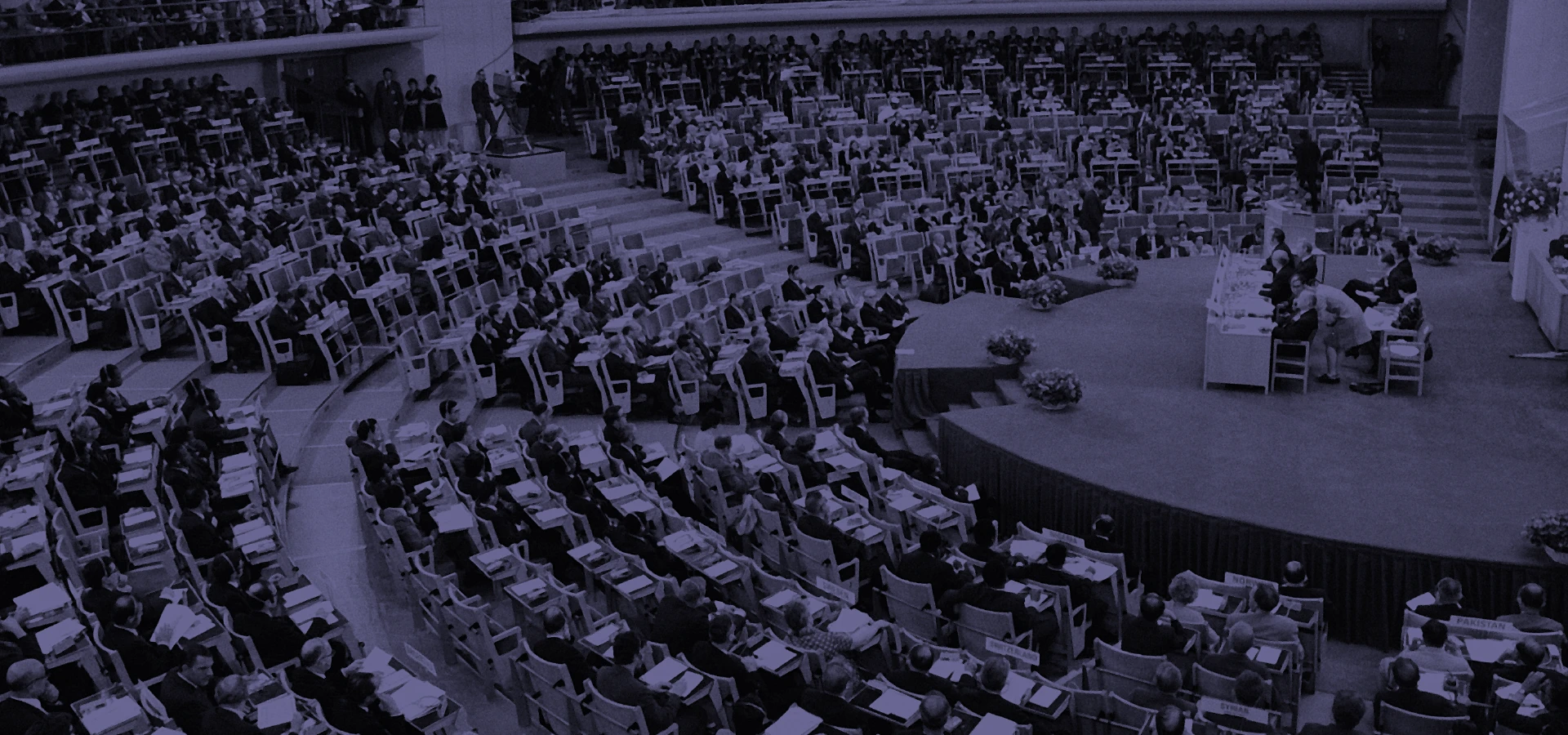
This month we’re commemorating a significant anniversary: it’s been 50 years since the United Nations held the world’s first major conference on international environmental issues. The Conference on the Human Environment took place in Stockholm, Sweden from 5 to 16 June 1972.
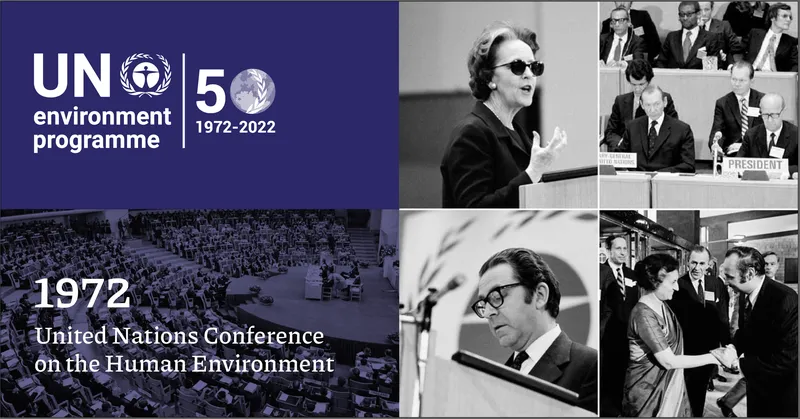
This event marked a turning point in international environmental politics. It brought industrialised and developing countries together to understand the links between economic growth, environmental concerns like air and water pollution, and the wellbeing of people and communities around the world. (Very much the SDG goals!)

The conference resulted in the Stockholm Declaration and an Action Plan for the Human Environment. It also led the UN to create the United Nations Environment Project (UNEP), the UN’s leading environmental organisation, which still exists.

Still relevant – now more than ever

While some of the language in the Declaration is dated, the ideas are still relevant. We like this (though today we’d use the term ‘natural environment’ rather than ‘human’. It was never just a ‘human’ environment!): 

The Conference calls upon Governments and peoples to exert common efforts for the preservation and improvement of the human environment, for the benefit of all the people and for their posterity.

Celebrating achievements, acknowledging partnerships, spurring greater action

Yes, the international community has unfortunately failed to make all the progress the Action Plan envisaged. And we all know that the path to protecting and regenerating the environment has been far from smooth. 

At the same time, we’ve seen major achievements. So, in the spirit of celebrating what we have achieved, acknowledging partnerships and spurring greater action, we’ve asked organisations at the forefront of environmental change in Australia, Aotearoa New Zealand and beyond to contribute an achievement.
Here is what they shared

wwf

The Rio Earth Summit in June 1992 was a 20-year acknowledgement of our global efforts and the need to do more to look after vulnerable communities and the environment. It was also the first time the Climate Change Convention was developed that led to the Kyoto Protocol in 2007 and Paris Agreement in 2015. Only by working together in collaboration can we succeed in turning the tide.

Monica Richter, Senior Manager, World Wildlife Fund

SBC

The major achievement of the past 50 years has been the establishment of the Intergovernmental Panel on Climate Change (IPCC). The increasingly alarming reports from this very credible group of experts has galvanised individuals, groups, businesses and governments to accelerate climate action and confront the existential threat of our times.

Mike Burrell, Executive Director, Sustainable Business Council

SBN

The extent that action on carbon is now integrated into everyday business is worth celebrating. We believe this provides a pathway towards the emerging circular economy, where resources are never abandoned to become waste and pollution, and where our landscape, waterways, oceans and communities are not only sustainable, but rejuvenated. 

Rachel Brown, CEO Sustainable Business Network (Aotearoa New Zealand)

Comvita

The Ellen MacArthur Foundation, established in 2010, brings thought leadership to inspire change and move from a linear economic system that relies on the environment to one that is circular – is restorative and regenerative to achieve long-term prosperity and resilience. This thinking personally aligns with us here at Comvita as we thrive for a world where bees and people can work in harmony #OnlyOneEarth

David Banfield, CEO, Comvita

spark

In 2019 New Zealand passed the Zero Carbon Act with near unanimous support across parliament and backed by the business community. The Act set climate change targets into law, including a long-term commitment to zero net carbon emissions by 2050, and created the framework for New Zealand to address the challenges of climate change.

Jolie Hodson, CEO, Spark

true

The growth in caring: the change in awareness that humans are not special, separate, the apex of creation; but that we are just one part of Life, that our health depends on the health of the environment. I have lived through this in my lifetime and it has been truly liberating. But there is a way to go.

David Trubridge, designer and leader in environmentally responsible design

EU

50 years on from the Conference there is not one single national or international trade and economic discussion on planet Earth that does not include environmental goals. The Paris Agreement put climate action at the heart of governance of any kind. Globally, more than 400 public development banks, plus financial regulators, regional authorities, cities, courts, consumers and citizens are aligning their activities with the Agreement. In the EU, the Green Deal is our kaupapa ['cause' in the Māori language]. For Europeans, our generation’s defining task is to become the first climate-neutral continent before 2050. 

Delegation of the European Union to Aotearoa New Zealand

ISC logo 2021 small

We’re proud to have been measuring what matters for a decade. What’s changed – appreciating the kinship we have with nature, and one another. Learning from First Nations People, intergenerational wellbeing is a responsibility to be shared equally. Here’s to accelerated progress in a decade of action. There’s so much we value, and no time to lose.

Ainsley Simpson, Chief Executive Officer Infrastructure Sustainability Council (ISC)

BANZ

In a world first, Aotearoa New Zealand granted natural resources – a region (Te Urewera, 2014) and a river (Whanganui Awa, 2017) – their own legal identity. Intended to safeguard these taonga (treasures) from environmental harm, this approach also honours te ao Māori (the Māori world) enabling their ancestors to be protected.

Chelydra Percy, CEO, Building Research Institute of New Zealand (BRANZ)

CLC

While not a specific event, I celebrate the growing inclusion of Te Ao Māori [Māori worldview] into thinking and decision-making for organisations of all shapes and sizes across Aotearoa NZ. Explicitly acknowledging the interconnectedness and interrelationship of all living and non-living things supports better environmental outcomes across generations.

Mike Bennetts, Convenor, Climate Leaders Coalition

NZGBC

The UN Environment Programme began its campaign to eliminate lead in petrol in 2002.  2021 has marked the end of leaded petrol worldwide – and cleaner air, cleaner soil, drinking water and food crops and improved health. It provides a template for phasing out all fossil fuels, achieving zero-carbon transport with active transport, more

Andrew Eagles, CEO, New Zealand Green Building Council

GBCA

We are proud of Green Star’s role in transitioning buildings to net zero. Our partner GPT Wholesale Office achieved carbon neutrality in 2020, while many more have committed to this goal by 2030. But as we commemorate 50 years, we are reminded of the critical need for more action.

Davina Rooney, CEO, Green Building Council Australia

Jaz

Ngai Tūhoe iwi leadership and Jasmax’s deep design and collaboration was a recipe to use the transformational ‘Living Building Challenge’ and generate radical outcomes. We changed industry’s awareness of it’s negative impacts and delivered world-leading sustainable outcomes: a 100-year zero carbon ‘Living’ Certification, and a project that regenerates Ngai Tūhoe mauri and the relationships with Te Urewera, and the wider world. Jasmax has been honoured to be part of this mahi. Now, we have all come to understand that Papatūānuku, Nōna ko te kawa o te ora – Papatūānuku, Her lore is the greatest truth.

Jerome Partington​​, Sustainability Manager, Jasmax

Sanford

The London Convention [which also resulted from the 1972 UN Conference] was one of the first global conventions to protect the marine environment – including international waters. It specifically prevented dumping of harmful waste materials into the sea, prevalent in the 1960s and early 1970s. The Convention’s protocols have been updated and remain entirely relevant and effective today.

Peter Longdill, GM Sustainability, Sanford

urban

The predator-free movement in New Zealand is so inspiring, from island sanctuaries created by volunteers in the 1960s to Government-sponsored programmes. It now has a strategy, Predator Free 2050, that communities across New Zealand are embracing. Our Coastal Community Garden is working with Predator Free New Zealand to host a trapping workshop as demand is so high – all driven by volunteers!

Karen Titulaer, Founder, Urban Bounty

lci 2015 horizontal

The UNEP/SETAC Life Cycle Initiative. This multi-stakeholder effort (a core example of SDG 17) has accelerated Life Cycle Thinking (LCT) and Life Cycle Assessment (LCA) being embedded into policy-making and environmental improvements. Actions to reduce environmental impacts are occurring globally.

Jim Fava, ‘father of LCA’. Executive Director Anthesis; Co-founder UNEP/SETAC (Society of Environmental Toxicology and Chemistry) Life Cycle Initiative

Newsroom

Thanks to our exponential growth in Earth Sciences over the past 50 years, we now know that everything we humans do has to work with nature, not against it.

Rod Oram, Columnist, Newsroom

UN Global Compact

Since the establishment of the Science-Based Targets initiative (SBTi) in 2015, nearly 1,000 companies have signed up to set science-based targets. SBTi helps companies set emissions reduction targets in line with climate science and Paris Agreement goals. A collaboration between CDP, the United Nations Global Compact, World Resources Institute (WRI) and the World Wide Fund for Nature (WWF), SBTi drives ambitious climate action in the private sector. The pace is increasing and it will be important for businesses to join the race to limit global warming to 1.5°C and prevent the worst effects of climate change.

Kylie Porter, Executive Director, UN Global Compact Network Australia

EPEA logo

Professor Michael Braungart‘s Cradle to Cradle vision of a world without waste, with nutrients circulating in a biological and a technical circle, was successfully transferred into the property world through cooperation between Drees & Sommer and EPEA (and our 2019 merger). Since then more and more buildings have been planned and built on the principles of reusing all materials and generating no waste. Design features like shading greens and cooling green facades are also cleaning the air.

Markus Diem, Head of Hamburg office for EPEA (part of Drees & Sommer)

The emergence of the Circular Economy as a business model that is increasingly embraced by both governments and businesses. By establishing the economic and risk mitigation justifications for Cradle-to-Cradle, the Ellen MacArthur Foundation provided the foundation from which to completely reimagine business as usual.

Jim Goddin, Head of Circular Economy, thinkstep-anz

The Minamata Convention has greatly reduced the release of mercury into our environment from human activities. It is named after the Japanese city of Minamata which experienced severe, decades-long mercury poisoning after industrial wastewater from a chemical factory was discharged into Minamata Bay. While still to achieve full global ratification and force, it shows how countries around the world can work together to improve our environment. It has been signed by 137 countries and is legally-binding. 

Simon Whitehouse, Director, thinkstep-anz

The Montréal Protocol (1987) regulates and phases out consumption and production of nearly 100 man-made chemicals which deplete the ozone layer. It’s the only UN treaty ratified by every country on earth. The hole’s closing. We’re not there yet, but we’ve seen huge (measurable!) progress.

Barbara Nebel, CEO, thinkstep-anz

You might also be interested in

Join our team

We are an award winning team with a history of over 15 years and the vibrant feel of a start up! Check out the available positions and explore the next step in your career.

Sustainability Strategy

Identify, define and embed sustainability initiatives that maximise value to your business through a cohesive approach. Doing well by doing good – it's the 21st century business model.

Science Based Targets

Science-based targets enable companies to understand and reduce their greenhouse gas emissions to limit global warming to well below 2°C, in accordance with the 2015 Paris Agreement.