
Circular economy services
Creating business opportunities, building resilience
Build a more competitive, resilient and resource-efficient business with practical circular economy projects.
At thinkstep-anz, we help businesses in New Zealand and Australia move from circular economy ambition to action. Whether you are starting with a readiness workshop, assessing a product or service, linking circularity to carbon reduction, or developing a full circular economy strategy, our modular projects give you a clear pathway forward.
Our work is based on international good practice, including ISO 59010, and supported by recognised circularity tools such as the Material Circularity Indicator, Life Cycle Assessment, carbon footprinting and Environmental Product Declarations.
What we do

Material Circularity Indicator

Circular Economy Strategy

Talk with a circular economy expert

Dr Jim Goddin is our Head of Circular Economy. He is a Chartered Engineer who specialises in designing systems based on circular economy principles. Jim help the world-renowned Ellen MacArthur Foundation produce two of the most used circularity metrics: the Material Circularity Indicator (MCI, which measures product circularity) and Circulytics (which measures business circularity). He also co-authored the ISO standards for Circular Economy, the ISO 59000 series.
Get started with our CE projects
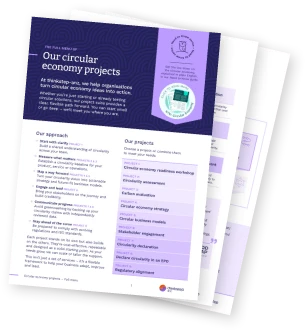
Turn your circular economy ideas into action. Whether you’re just starting or already testing circular solutions, our project suite provides a clear, flexible path forward. You can start small or dive deep – we’ll meet you where you are.
Our projects are:
- Modular. Start with one project or combine for a full strategy.
- Flexible.Tailored to your maturity, sector and goals.
- Best practice.Based on ISO 59010 for credibility and compliance.
The business case

Reduce your business risks
Circular economy (CE) helps you identify and manage supply risks and price volatility. Get ahead of government levies on materials and finished products.

Retain and build value
CE protects your intangible assets, like your intellectual property and branding. It locks in access to raw materials and reduces your costs by recovering the value you add to those materials.

Identify business opportunities
CE refreshes or redesigns your business model, products and services to generate new or stronger income streams.

Increase your brand loyalty
CE helps you communicate your circularity using proven metrics.

Manage your supply chain
CE involves your suppliers in identifying issues and building a truly circular product or service.

Keep your investors happy
CE makes your business more resilient in a changing world.

Reduce your waste
CE saves you money by reusing materials and reducing the costs of managing waste.
Frequently asked questions
A circular economy keeps resources in use for as long as possible. It benefits businesses, the environment, and people.
If you’re a business, ‘going circular’ can help you gain the most value from the resources you use, identify commercial opportunities, and reduce your costs. (It’s called circular economy for a reason!)
It can also help you identify and manage your business risks and reduce your waste. (But it’s much more than recycling!)
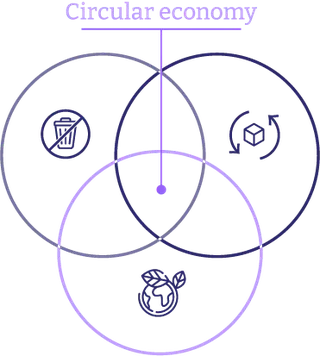
Circular economy is based on three principles:
- Keeping products and materials in use
- Designing out waste and pollution (it’s much more than recycling!)
- Regenerating natural systems.
It offers commercial opportunities unavailable in the traditional ‘take-make-dispose’ linear economy and reduces many of the risks associated with this economy. The result: a more resilient business.
You may also be interested in
Circular economy moves food more sustainably at FoodCap
FoodCap International engaged thinkstep-anz to help them develop their sustainability strategy on circular economy (CE) principles.
New ISO standards for the circular economy help avoid greenwashing
The newly released ISO standards for circular economy provide clear guidance on transforming your business model – and avoiding greenwashing.
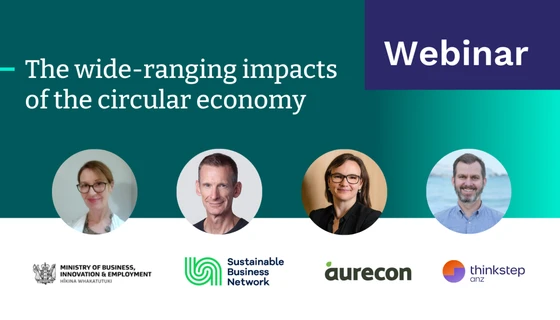
The wide-ranging impacts of the circular economy
In this webinar, we shared insights into the recently published report, Impacts of Circular Approaches on Emissions, Jobs, and Other Factors.