
What you Need to Know about the circular economy
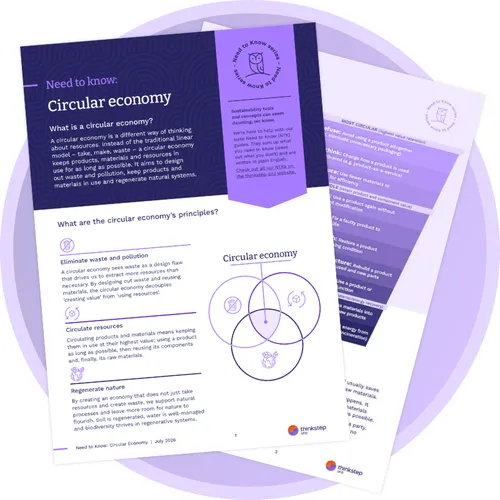
Find all the information on this page and more packaged into one easy PDF.
What is a circular economy?
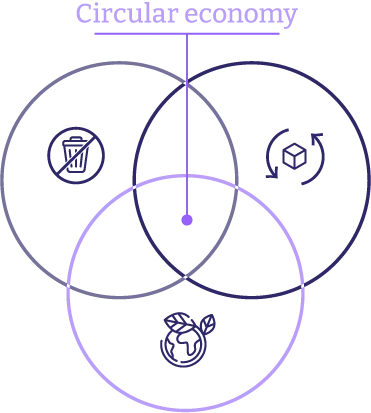
A circular economy is a different way of thinking about resources. Instead of the traditional linear model – take, make, waste – a circular economy keeps products, materials and resources in use for as long as possible. It aims to design out waste and pollution, keep products and materials in use and regenerate natural systems.
What are the circular economy's principles?

Eliminate waste and pollution
A circular economy sees waste as a design flaw that drives us to extract more resources than necessary. By designing out waste and reusing materials, the circular economy decouples ‘creating value’ from ‘using resources’.

Circulate resources
Circulating products and materials means keeping them in use at their highest value; using a product as long as possible, then reusing its components and, finally, its raw materials.

Regenerate nature
By creating an economy that does not just take resources and create waste, we support natural processes and leave more room for nature to flourish. Soil is regenerated, water is well-managed and biodiversity thrives in regenerative systems.
Why is the circular economy good for growing business?
Adopting circular practices can open new business opportunities, strengthen supply chain resilience, respond to customer demand and stay ahead of changing regulations.
More than 75% of global industry leaders now view circularity as a strategic priority, according to the World Economic Forum’s report, Circular Transformation of Industries.
Going circular creates economic value in four areas:

Regulation
Meet growing requirements for sustainable circular products.
- Help manage compliance risks
- Demonstrate proactive action

Resilience
Improve supply chain stability and resource security.
- Reduce supply chain vulnerabilities
- Collaborate with suppliers

Revenues
Create new income streams through circular products and services.
- Encourage business model innovation
- Diversify income

Costs
Save money by using fewer resources and reducing waste.
- Cut operational costs
- Protect intellectual property
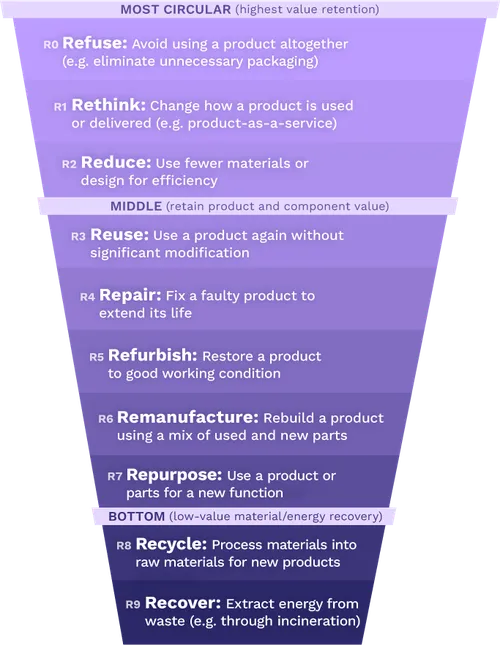
What are R-strategies in the circular economy?R-strategies, or the R-hierarchy or pyramid, are actions that focus on reusing materials and products as much as possible. Each “R” represents a strategy, ranked from most to least circular and resource-efficient. The framework shows that the higher the strategy sits in the hierarchy, the greater its potential to recover value, cut resource use and environmental impacts. These strategies help guide businesses, designers and policymakers in moving from a linear to a circular economy. |
|
So circular economy is not the same as recycling?
Recycling is important, but only part of the solution. The Circularity Gap Report 2025 notes that more recycling doesn’t ensure more circularity as demand keeps rising.

Recycling alone won’t close the gap
Even if all recyclable materials were recycled, the global circularity rate would only reach 25%, which is an improvement but still not enough.
Why?
Recycling deals with waste after it’s created and usually saves the least value. It doesn’t solve the demand for raw materials.
A circular economy tries to stop waste before it happens. It does so by designing products that use fewer raw materials and that keep them in use and valuable for as long as possible.
Think of it like this: Recycling is like cleaning up after a party. A circular economy is like planning the party so there’s no mess to clean up at all.
thinkstep-anz Need to Know series
This page is part of a series that simplifies sustainability topics. Explore the rest of our series.
How to unlock value
The World Economic Forum’s 2025 report Circular Transformation of Industries presents three strategies to help businesses transition to a circular economy.
In a nutshell: The circular economy is about using materials smartly (feedstock), making them last (lifespan) and then maximising how they’re used (capacity-sharing).

Circular feedstock
Use better (recycled or renewable) materials instead of new, raw materials.

Lifespan extension
Design products to last longer and be repaired, upgraded or refurbished instead of thrown away.

Capacity-sharing
Shift from selling products to offering access through rentals, leasing or pay-per-use models, where you retain ownership and serve customers directly.
How can you compare circularity?
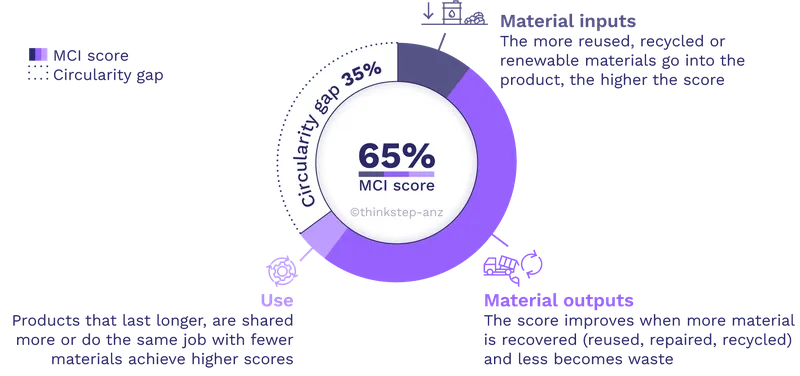
Comparing different circular economy models can be challenging, as each is assessed using different metrics. The Material Circularity Indicator (MCI), developed by the Ellen MacArthur Foundation, provides a consistent framework to measure circularity across all models. It has played a key role in the development of the ISO 59020 standard and is now used to help apply that standard in practice.
Other approaches, such as the WBCSD’s Circular Transition Indicator (CTI), also exist, but the MCI remains the most common tool used for reporting and comparison.
The MCI benefits from a single metric that includes every circular model and is used by all of the major life cycle assessment tools and a growing number of digital product passport systems.
Ways to progress your circular economy

1. Getting started:
Know where you stand before changing
- Create a common vision with buy-in across teams.
- Measure your starting point using an ISO 59020-compliant tool like the Material Circularity Indicator (MCI).
- Stay up to date with circular economy insights through webinars, blogs and industry resources.

2. Making progress:
Focus on changes that create value
- Build a circular economy strategy.
- Explore new circular business models such as turning waste into value.
- Engage your value chain to find more circular opportunities.

3. Leading the way:
Help shape the future of your industry
- Make a circular declaration, set a baseline and share your goals.
- Use data and evidence to communicate your product’s circularity with tools like Environmental Product Declarations (EPDs) or an independent assessment.
- Ensure you have a plan to be ready for changing regulations that may limit market access or disadvantage your brand.
Getting support
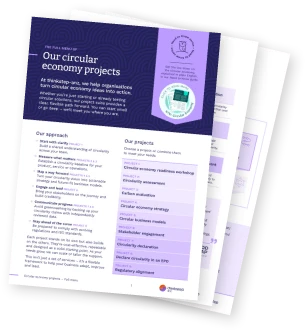
Turn your circular economy ideas into action with our circular economy projects.
Whether you’re just starting or already testing circular solutions, our project suite provides a clear, flexible path forward. You can start small or dive deep – we’ll meet you where you are.
Our projects are:
- Modular. Start with one project or combine for a full strategy.
- Flexible.Tailored to your maturity, sector and goals.
- Best practice.Based on ISO 59010 for credibility and compliance.
Talk with our circular economy expert
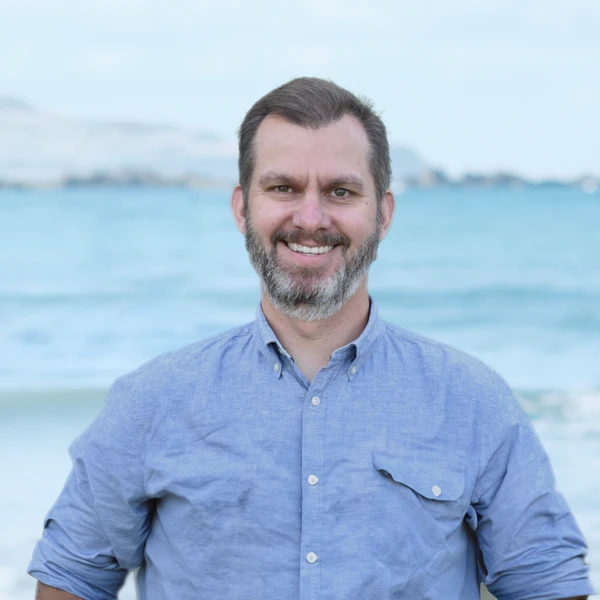
Dr Jim Goddin is our Head of Circular Economy. He is a Chartered Engineer who specialises in designing systems based on circular economy principles. Jim is an internationally recognised leader in the circular economy. He helped the world-renowned Ellen MacArthur Foundation produce two of the most used circularity metrics: the Material Circularity Indicator (MCI, which measures product circularity) and Circulytics (which measures business circularity).
You may also be interested in
Circular economy services
Make your business more resilient and get the most out of the resources you use. See how our experts can help you take the next steps.
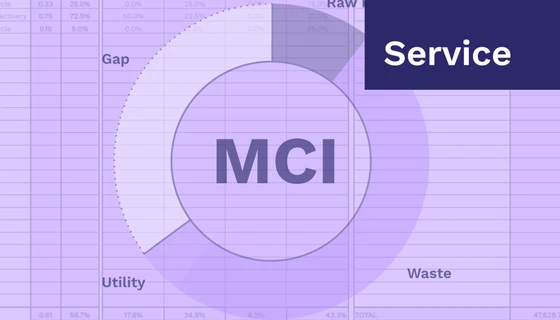
Material Circularity Indicator calculator
How ‘circular’ is your product? Our Material Circularity Indicator (MCI) calculator can get you started with a simple look at your product – without having to collect lots of data.
Cradle to Cradle
Design your products to Cradle to Cradle® (C2C) standard and do good in the world. C2C is the world’s most advanced standard for products that are circular, safe and responsibly made.