
Corporate Carbon Footprinting
Measure, manage and reduce Scope 1, 2 and 3 emissions for businesses in Australia and New Zealand
A corporate carbon footprint measures the greenhouse gas emissions associated with your organisation's operations and value chain, often called your GHG inventory. It provides the evidence needed to identify emissions hotspots, meet customer and investor expectations, prepare for climate disclosures and prioritise meaningful reduction opportunities.
Whether you are measuring your emissions for the first time or looking to improve an existing inventory, our team combines technical expertise with practical advice to deliver robust, decision-ready carbon data.
Ready to measure your emissions?
Whether you're starting your first GHG inventory or improving an existing carbon footprint, we'd be happy to discuss the best approach.
New to corporate carbon footrpinting?
Our free Corporate Carbon Footprint - Need to Know Guide explains the fundamentals of Scope 1, 2 and 3 emissions, how footprints are measured and what to expect from the process.
What we do
We help you measure
- define organisational and operational boundaries
- calculate a robust greenhouse gas baseline across Scope 1, 2 and 3 emissions
- identify robust emission factors
- measure financed emissions in line with recognised methodologies (where applicable
We help you report
- prepare inventories aligned with international standards (ISO 14064-1 and the GHG Protocol)
- support certification and disclosure programmes (Climate Active Carbon Neutral Standard (formerly NCOS), Ekos, CEMARS®, B Corp, DJSI, CDP)
- repare your inventory for independent assurance or audit
- develop audit-ready documentation
We help you reduce
- identify emissions hotspots and reduction opportunities
- develop practical carbon reduction strategies and decarbonisation pathways
- support implementation, target setting and ongoing reporting
What you will receive
- A complete greenhouse gas inventory aligned with international standards
- A clear breakdown of Scope 1, 2 and 3 emissions
- Identification of emissions hotspots
- Practical recommendations to reduce emissions
- Audit-ready documentation for reporting or assurance
How carbon footprinting works
Your organisation’s emissions come from your operations and your value chain (all the activities that together add value to your product or service).
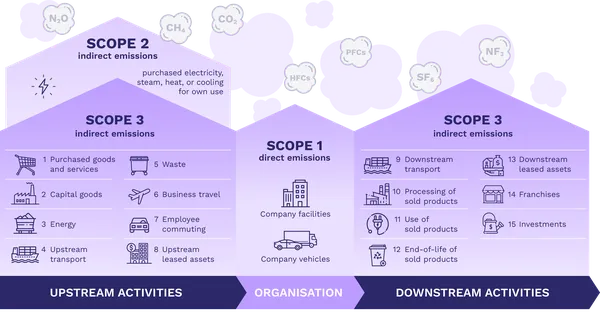
Greenhouse gas emissions are grouped into Scope 1, Scope 2 and Scope 3 under the GHG Protocol.
Scope 1 emissions are direct emissions. They come from sources you own or control, like your company’s vehicles and your production processes.
Scope 2 emissions are indirect emissions. They come from the electricity, steam, heat and cooling you buy to run your operations
Scope 3 emissions are your value chain emissions. These emissions include the goods and services you buy and sell, the transport you use, your employees’ commuting and your investments.
Talk with our experts

Katharina Bauch has been with thinkstep-anz since its earliest days and balances a wide range of responsibilities, from organising our team’s capacity to managing corporate carbon reporting and product carbon footprint/LCA/EPD projects. She has completed carbon inventories for metals/mining, manufacturing, government agencies, not-for-profit organisations and many more sectors.

Nicky Andrews has a strong background in sustainability reporting. With experiences in the corporate sector, teaching a master’s course in the subject at European Business School (EBS) Paris, and consulting experience across many sectors Nicky is well equipped to help clients with their sustainability reporting and to measure their impact.
You may also be interested in

Product carbon footprint
Calculating the carbon footprint of your products will help you tackle your organisation’s carbon emissions.

Carbon reduction strategy
For greatest impact, link your ‘reduction pathway’ to your business and sustainability strategies.

Sustainable Development Goals (SDGs)
Put your carbon strategy in context. We’ll help you understand which SDGs apply to your organisation and how they can guide your sustainability strategy.