
What you Need to Know about EPDs
We've packaged all the information on this page into one easy PDF.
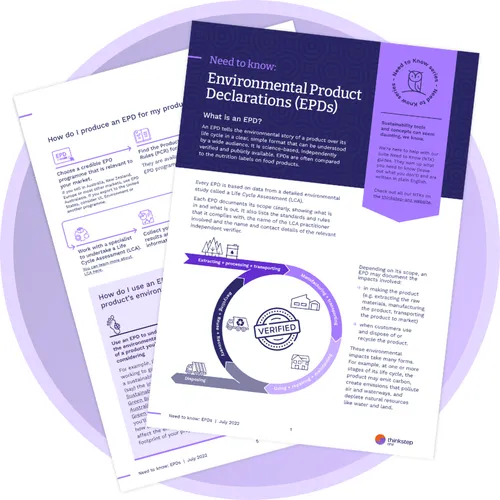
What is an EPD?
An EPD tells the environmental story of a product over its life cycle in a clear, simple format that can be understood by a wide audience. It is science-based, independently verified and publicly available. EPDs are often compared to the nutrition labels on food products.
Like to learn more? Get in touch with our EPD expert
Every EPD is based on data from a detailed environmental study called a Life Cycle Assessment (LCA). Each EPD documents its scope clearly, showing what is in and what is out. It also lists the standards and rules that it complies with, the name of the LCA practitioner involved and the name and contact details of the relevant independent verifier.
Depending on its scope, an EPD may document the impacts involved:
- in making the product (e.g. extracting the raw materials, manufacturing the product, transporting the product to market)
- when customers use and dispose of or recycle the product.
These environmental impacts take many forms. For example, at one or more stages of its life cycle, the product may emit carbon, create emissions that pollute air and waterways, and deplete natural resources like water and land.
Why should I produce an EPD for my product?
EPDs help manufacturers translate complex sustainability information about their product’s environmental footprint into simpler information that governments, companies, industry associations and end consumers can trust to make decisions. For example:
- Governments may refer architects and specifiers to EPDs for construction products when they tender a new building
- Supermarkets may use an EPD for a consumer product when they decide which brands to stock
- Interior designers may consult EPDs when they choose a paint supplier

thinkstep-anz Need to Know series
This page is part of a series that simplifies sustainability topics. Explore the rest of our series.
An EPD adds business value
As a manufacturer, developing and using an EPD to provide reputable, globally-recognised information about your products can lead to business opportunities that create value.
| Business opportunities | Business results |
|---|---|
|
|
Many audiences may be interested in the results of your EPD
They include your specifiers, designers, architects, wholesale customers, retail customers, investors, regulators, suppliers, community, and employees. EPDs help them find product information they can trust.
Why can EPDs be trusted?
EPDs are based on international standards and are independently verified
A qualified third-party must review and approve the data in an EPD before it is published. These rules and checks ensure that EPDs are reputable, trusted sources of information. Industries, companies and governments recognise them and often specify that they should be used (e.g. in tender documents and contracts).
EPDs are registered in a central system and publicly available
A credible EPD system is based on ISO 14025 (and EN 15804 for building products) which governs environmental labels and declarations. Some of the EPD systems we work with include EPD Australasia (affiliated with the International EPD System), UL Environment in the United States, PEP in France and IBU in Germany. The information in these registers is publicly available, meaning anyone can consult it.
EPDs for the same product follow common rules for data
Product Category Rules (PCRs) define how product manufacturers must collect the data they communicate in their EPDs. Thanks to these common rules, EPD users can compare EPDs for the same product across different manufacturers.
What information does an EPD provide?
EPDs contain information about environment impacts, including:
Energy: The amount of energy used (e.g. Cumulative Energy Demand (CED))
Carbon: The amount of carbon emitted (i.e. carbon footprint)
Impacts of emissions: The impact of emitted substances such as gases, liquids and particles (e.g. in depleting ozone, acidifying waterways, corroding buildings, and causing algae in waterways)
The EPD also includes:
- The scope of study (what it covers and what it leaves out)
- The standards and rules it complies with
- The name of the Life Cycle Assessment (LCA) practitioner who completed the original LCA
- The name and contact details of the EPD’s independent verifier.
How do I produce an EPD for my product?
Choose a credible EPD programme that is relevant to your market.
If you sell in Australia, New Zealand, Europe or most other markets, use EPD Australasia. If you export to the United States, consider UL Environment or another programme.
Find the Product Category Rules (PCR) for your product.
They are available from the EPD programme.
Following the PCR, gather data from your manufacturing and/or suppliers.
This takes time. A specialist can help, check your data and provide extra background data.
Work with a specialist to undertake a Life Cycle Assessment (LCA).
You can learn more about LCA here.
Collect your LCA results and supporting information in an EPD.
Have both the LCA report and EPD independently verified.
Register and publish your EPD with your EPD programme.
How do I use an EPD to understand a product’s environmental impact?
Use an EPD to understand the environmental footprint of a product you’re considering
For example, if you’re working to gain credits in a sustainability rating with (say) the Infrastructure Sustainability Council, Green Building Council of Australia or New Zealand Green Building Council, you’ll need to understand how the products you use affect the environmental footprint of your project.
Use an EPD to compare the environmental footprints of alternative products
For example, if you’re specifying the materials to use in a building, you may want to compare EPDs for different building products within a category (e.g. different sources of concrete). By comparing EPDs within a recognised product category, you can be confident you’re making a fair comparison backed by common standards and rules.
An EPD provides data. It’s not a judgment or recommendation
An EPD does not judge products or imply that a ‘declared’ product is environmentally better than another product. Context is important, and people using an EPD (e.g. a specifier) will need to take this into account when they assess the data an EPD presents.
Talk with an EPD expert

Our Services Director, Emily Townsend, is an experienced EPD practitioner. She supports better decision-making through life cycle thinking and provides robust, transparent information to enhance product sustainability. Get in touch with Emily to discuss how an EPD can help your business.