
What you Need to Know about LCA
We've packaged all the information on this page into one easy PDF.
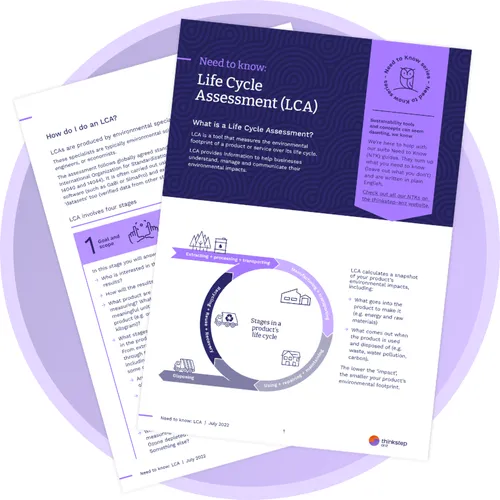
What is a Life Cycle Assessment (LCA)?
Life Cycle Assessment is a tool that measures the environmental footprint of a product or service over its life cycle. LCA provides information to help businesses understand, manage and communicate their environmental impacts.
The methodology has been around for 50 years and is well defined in ISO standards 14044 and ISO 14044.
Looking for practical support? Learn more about our Life Cycle Assessment services.
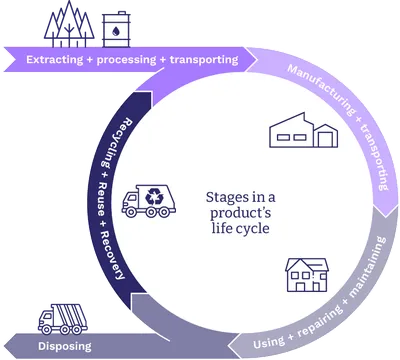
LCA calculates a snapshot of your product’s environmental impacts, including:
- What goes into the product to make it (e.g. energy and raw materials)
- What comes out when the product is used and disposed of (e.g. waste, water pollution, carbon).
The lower the ‘impact’, the smaller your product’s environmental footprint.
Why leading organisations undertake an LCA
- Support an Environmental Product Declaration (EPD)
- Identify environmental hotspots
- Compare products and materials
- Benchmark your products
- Support procurement requirements
- Substantiate environmental claims
- Inform product improvement
- Provide information for tender documents
What does an LCA measure?
LCA measures many types of environmental impacts, including energy, carbon and other emissions.
Our LCA specialists can help determine which impact categories are most relevant to your products and objectives.
What products can an LCA cover?
We have done LCAs for anything from a whole train, concrete, a building, packaging and even New Zealand Greenshell mussels. If you can identify a system with a beginning and an end, you can review how that system affects the environment from start to finish.
In each case, LCA measures the impact of a single unit of the product – say, one building or 100g of mussel meat.
How do I do an LCA?
The assessment follows globally agreed standards (the International Organization for Standardization’s ISO 14040 and 14044) and includes the following 4 steps:
1. Goal and Scope
- Who is interested in the results?
- What product are you measuring?
- Which impacts are you measuring? Energy used? Ozone depleted? Both? Something else?
2. Inventory analysis
In this stage you compile your data, all materials and energy you use, and all waste and emissions to air and water.
3. Impact assessment
This is where you calculate your impacts, such as your carbon footprint.
4. Interpretation
This is where you analyse the results and identify ways to improve your product.
thinkstep-anz can provide an LCA for a wide range of projects
Need help undertaking an LCA?
thinkstep-anz has completed hundreds of Life Cycle Assessments across Australia and New Zealand and can help define the right scope, collect data and interpret results.
How do I share the results of my LCA?
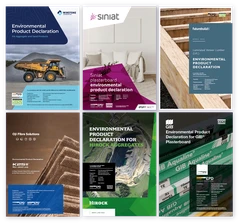
An Environmental Product Declaration (EPD) may be the way to go! An EPD is a verified, public summary of the information contained in your product’s LCA.

thinkstep-anz Need to Know series
This page is part of a series that simplifies sustainability topics. Explore the rest of our series.
What else do I need to know?
LCAs have their strengths and weaknesses
While LCAs may seem complex, they are never more complex than what you’re assessing: the end-to-end system involved in your product’s lifecycle.
LCA shines if you want to:
- consider a product’s full life cycle
- use data and analysis
- take a ‘systems’ approach and avoid shifting burdens
- highlight trade-offs between different environmental impacts
- gain a benchmark for future improvements
- support environmental claims with data
- collect data to assess a carbon footprint
LCA is less helpful if you’re wanting
- a view over time rather than a snapshot
- to know whether your product is ‘good’ or ‘bad’. LCA provides data without judgment.
- to assess impacts related to ecology and biodiversity
- to include impacts that can’t be quantified (e.g. the risk of a plastic product ending up in the ocean)
- to sum different impacts into a single ‘score’. As there is no absolutely scientific way to do this, you have to look at different impacts one at a time.
Considering an LCA?
Whether you need to support an EPD, respond to procurement requirements, compare products or identify environmental hotspots, our team can help.
Talk to an LCA Expert.

Chris Koffler is our Technical Director LCA. His 20 years of expertise span a wide range of industries including steel, aluminium, chemicals, building and construction, consumer goods and automotive. He contributed to more than 500 life cycle assessments (LCA), Environmental Product Declarations (EPDs) and carbon footprint projects.

Emily Townsend is our Services Director. She has over 12 years of experience working in sustainability and is the past President of the Life Cycle Association of New Zealand (LCANZ). She has worked across building products, the primary industry and infrastructure projects.

Chanjief Chandrakumar is a Melbourne-based sustainability specialist with more than 15 years of experience in climate change, life cycle assessment, and sustainable products. A Certified LCA Practitioner and our Projects & Team Lead LCA, he has worked across the horticulture, construction materials, agriculture, and manufacturing sectors.