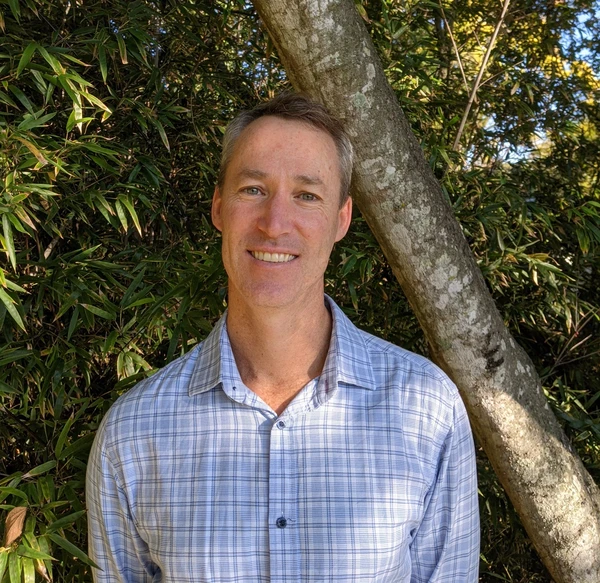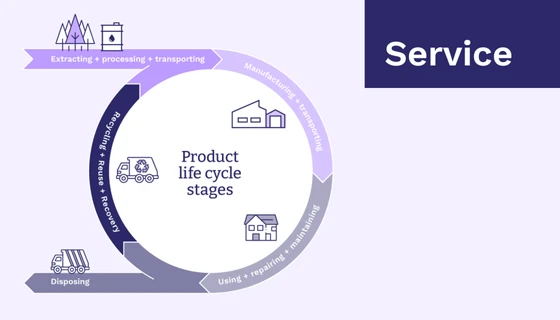
Our newest Senior Sustainability Specialist, Murray Hall, will help to meet the growing demand for Life Cycle Assessments (LCA). As a life cycle expert and a researcher on the living wage, Murray is interested in addressing the social and environmental spheres of sustainability. We talked with Murray about how he plans to explore these issues.
Throughout your career you have studied both social and environmental issues. How do social issues tie into sustainability?
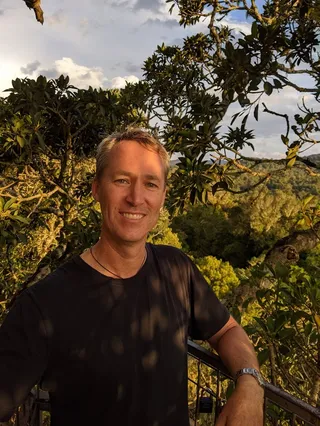 Sustainability is essentially a social concept: it’s about meeting the needs of people in a way that is fair and can be sustained without sacrificing future generations.
Life Cycle Assessment studies are used primarily for measuring environmental impacts, but they also show promise on social measures such as the living wage in supply chains. This is an area of particular interest for me.
With your experience working in the sustainability field for over two decades, how do you think LCA has managed to stay relevant?
I think LCA has really evolved.
The formulated aspects of LCA, like standards, are built up over time to gain consensus as with any credible method. The emerging areas of the method are more dynamic and responsive to new issues that come up. For example, when I started with LCA over two decades ago, the main focus was on capturing land and biodiversity impacts. These impacts were given equal importance to carbon (if not more). Over time LCA has evolved to become a mainstream methodology for measuring carbon, which is now better understood to be an urgent issue.
The strength of LCA is its ability to quantify a range of environmental impacts. With LCA, we can track a supply chain to not only work out environmental impacts, but also extend it to cover social and economic impacts.
How could LCA studies link environmental impacts with social impacts?
Traditionally, LCA focuses on quantifying environmental impacts but at thinkstep-anz, we have the opportunity to go further. There is potential for us to link environmental impacts with existing quantitative measures for social issues, such as how much people in the supply chain get paid for their work. There are databases that look at hotspots and checklists for social measures that could link with the databases that we use already.
Existing LCA models usually have a life cycle costing component, but we also have the potential to look at payments along the supply chains as well.
Your PhD on tracing the living wage through global supply chains uncovered valuable insights on the global living wage gap and ways to address it. Can you share some of the key findings?
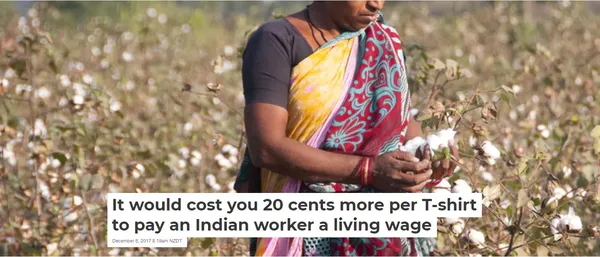
Murray's research on living wage, featured in The Conversation
Part of my PhD looked at how much more consumers need to pay for a T-shirt that is imported into Australia if everyone in the supply chain is paid a living wage. Paying a living wage to cotton farmers and textile workers in India would add about 20 cents more to the cost of that T-shirt.
Textiles are a high-profile industry for labour issues, but anything that we import involves a risk that labour is being underpaid, especially where there are agricultural inputs.
The production costs for a T-shirt made in India is about 2 to 3 dollars. The rest of the cost is largely for retail.
With that insight, you realise that if consumers could see the fair breakdown of prices and the money that goes to people lower down in the supply chain, they wouldn’t be very happy about it. A significant part of my research was understanding the magnitude of the problem.
I discovered the amount that people in the global economy are underpaid in terms of a living wage is equivalent roughly to the size of the Swiss economy.
Can countries like Australia and New Zealand play any meaningful role in addressing living wage issues?
Western countries benefit from trade with cheap goods from other countries. As richer countries, Australia and New Zealand can export things in large quantities and get back manufactured goods that use cheaper labour.
Although we don’t consume most of what is produced in countries with major living wage issues, we have buying power that we can leverage to clean up supply chains.
For countries like Brazil, Indonesia, and India, a lot of the production is for the domestic market, with many major export industries only exporting about 10 or 20 percent of what they produce. Since much of the demand is locally driven, part of the solution has to be focused on engaging with each country to support their domestic programmes.
Ethical trade can potentially influence local markets by developing and supporting higher standards and providing a bargaining position for local workers. Modern Slavery legislation is also a good example of how countries can act to support better practices through trade. Legislation around modern slavery requires an annual declaration from companies of a certain size and as soon as there’s a declaration, there is a legal basis for companies to do the right thing.
I think the Australian Modern Slavery Act drew heavily on legislation from the UK. Both could provide examples for legislation in New Zealand.
Modern slavery legislation such as Australia’s and the UK’s Modern Slavery Acts elevate the conversation to the level of the board, where it has to be taken very seriously.
What are you most looking forward to achieving with thinkstep-anz?
The great thing about thinkstep-anz is that there is a diversity of projects to work on.
We are in the responsible procurement area, which is a natural place to help drive policy for living wages. Many companies have created living wage policies as part of their responsible procurement policy.
On the environmental side, LCA is developing methods to underpin that as well. There is a lot of potential and demand in that area. I will work primarily in LCA but there is also an exciting opportunity to try to develop new ways to help companies to become more sustainable.
Where did your interest in sustainability originate?
 My origin story for sustainability is more of a life story than a career story. It goes all the way back to being a kid; from watching David Attenborough documentaries to forming an emotional connection to the environment through family holidays spent camping and canoeing. When I was a little older, my older sister was influential with her involvement in environmental activism at university.
I saw the disconnect between preserving the natural environment and meeting human demand, when human demand is also the thing consuming the environment. So rather than focusing on the environmental degradation, I wanted to work on reducing the impact people have on the environment.
In some ways, it has been a little unfortunate as a career choice — my friends who studied things like marine biology actually get to see the environment, whereas I tend to see factories and all the material flows and pollution. On the other hand, it feels tangible to work out where the opportunities are for improving things and to connect consumption to its reality.
What are your passions outside of sustainability?

Murray going for a surf on the south coast of New South Wales
My spare time is for reconnecting with things that I find inspiring and that is usually something near nature and away from the city, whether it is snowboarding, surfing, or anything in the ocean.
It always seems hard to switch gears from doing technical work to something that is creative, but when I do, it’s always a great feeling.