Whether you are new to carbon measurement or looking to make an ambitious pledge to further reduce your emissions, the following five steps offer inspiration for tackling your carbon in the year ahead. This can be taken as a step-by-step guide or a reference for your company’s next carbon initiative.
The reality is that reducing your carbon emissions is no longer an option – it’s as essential to a healthy planet as good nutrition is to a healthy body. The 2015 Paris Agreement united 195 of the world’s governments in committing to limit global warming to well below 2 degrees Celsius.
At thinkstep-anz, we believe the actions of businesses will be instrumental to achieving this goal. Keep in mind that the carbon strategy you choose will depend on your business goals and who you share your carbon reduction plan with. Here are our top five tips.
1. Start with a no-frills approach
If you are new to this, we recommend starting with a no-frills approach. Internal carbon reporting should be your first step. Focus on aligning the actions you take with your organisation’s values and be carbon conscious.
At the early stages, there is no need to communicate externally, nor is it necessary to get your targets externally verified or reviewed. However, it is always a good idea to follow best practice and get guidance from internationally recognised standards. The Greenhouse Gas Protocol (GHGP) provides the most widely used greenhouse gas accounting standards in the world.
2. Demonstrate best practice
If you want to gain some recognition, stand out among your peers for your carbon reporting, or even fulfil a membership requirement, you will need to demonstrate best practice. Step up to the task by referring to ISO standards.
First released in 2006 and updated in 2018, ISO 14064 part 1 provides a ‘foundation of best practices’ that can be used to build your greenhouse gas (GHG) reduction plan. An aggregated result can be communicated without having to give away too many of the details of your carbon footprint. You can share details on an individual basis if desired or required.
3. Report to an external audience
The next level is reporting to an external audience. This is a great option to impress business partners, investors, clients, and other stakeholders. You may not know these parties in great detail or understand their specific interests yet. The reporting should anticipate this and be highly transparent.
Including information about your supply chain – including Scope 3 emissions – demonstrates accountability. In turn, stakeholders will recognise that you are serious about measuring and reducing your carbon footprint.
This is the same with embodied carbon, which is included in Scope 3 emissions and can be trickier to track than more direct emissions. Your supply chain likely includes a number of ready-made products, so you need to be aware of the emissions of these products before you use them.
To prepare for external reporting and the higher stakes involved, seek out any hidden elements for carbon reporting and be ready to answer detailed questions in advance.
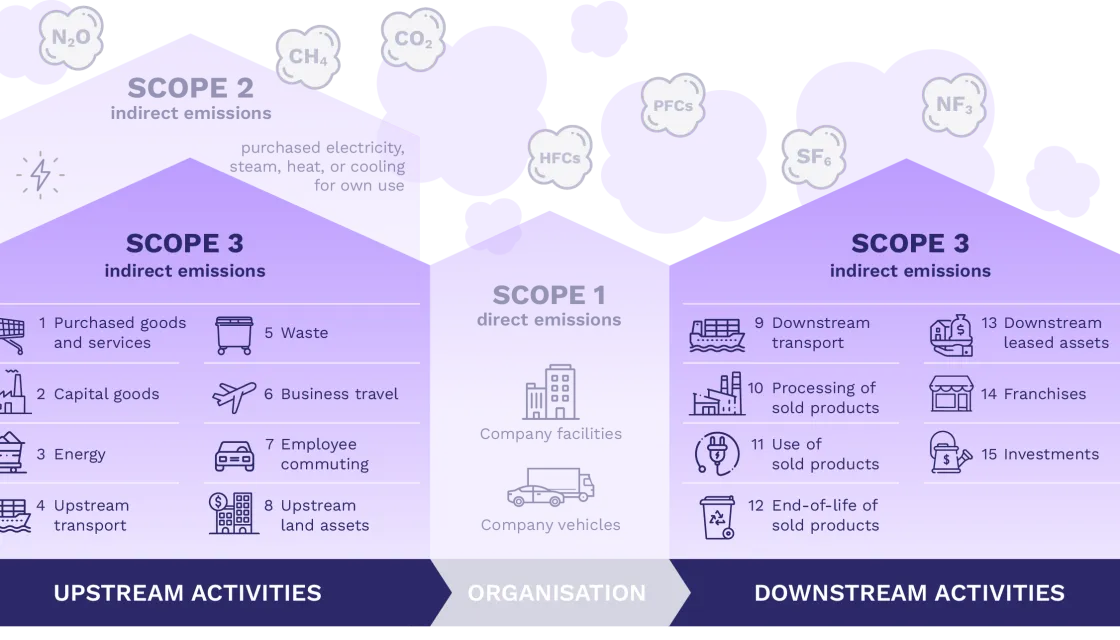
Figure 1: This image shows the different activities that make up Scope 3 emissions. Note that these include both upstream and downstream emissions.
4. Set an ambitious reduction target
The crown jewel for external reporting is publicly committing to a reduction target by setting an ambitious emission reduction goal. GHG emission reduction targets set by companies are only considered ‘science-based’ if they are in line with the latest climate science on what is required 'to limit global warming to well below 2°C above pre-industrial levels and pursue efforts to limit warming to 1.5°C'.
As with any diet, surrounding yourself with the right groups can be beneficial for receiving support, resources, and opportunities for fruitful collaboration. The Science Based Targets initiative (SBTi) and the Climate Leaders Coalition are two support groups that can help on your carbon reduction path.
SBTi ensures that companies keep their carbon diet in check by helping them set science-based targets. This will help to further impress future or potential clients and other key stakeholders by giving companies a competitive edge in the race to a low-carbon economy. By the end of 2023 there were 4352 companies with approved Science Based Targets (SBTs).
In New Zealand, the Climate Leaders Coalition has grown rapidly and is now the largest business collective tackling climate change in the country. Both Climate Leaders Coalition and the SBTi have set their targets in accordance with the 2015 Paris agreement. thinkstep-anz is one of 76 companies in Oceania to have approved Science Based Targets and is also one of 88 signatories of the Climate Leaders Coalition.
5. Balance your carbon reductions with offsetting
Offsetting can be the final step to achieving a well-rounded carbon reduction plan. While it is generally not practical to offset the majority of your carbon footprint, carbon offsets are a way to lower the impact of unavoidable, specific activities such as work-related flights.
Balance is key for any diet; the carbon diet is no exception. The only way to achieve your carbon reduction goals is to set an ambitious yet realistic target. View it as a long-term investment and conscious lifestyle change, rather than a fad.
This article was first published in NZ Manufacturer magazine, February 2021. We updated it in January 2024.