By Martin Fryer, Head of Strategy and Disclosures, thinkstep-anz
November 2026
A good sustainability report explains the issues that matter most, provides reliable evidence of performance and sets out what happens next. It connects sustainability with business decisions and gives readers a balanced picture of progress, setbacks and remaining gaps.
My advice is to start with the decisions the report needs to support. What should a customer, investor or employee understand after reading it? What should it confirm to executive teams and the board?
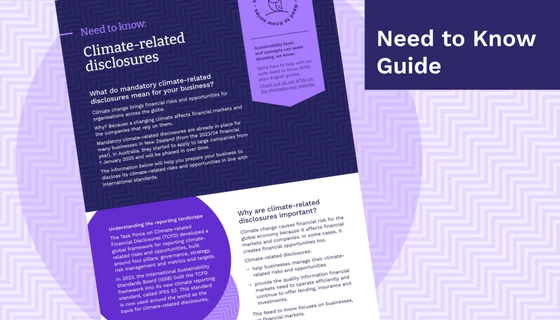
These ten tips apply to broad sustainability reporting in Australia and New Zealand. Mandatory climate disclosures have specific requirements, which I explain below..
1. Decide what the report needs to achieve
Set a clear purpose before collecting content or commissioning a design. The report may need to meet legal requirements, support tenders, answer customer questions or explain progress against a strategy.
Write down the main purpose and use it to test what belongs in the report. Agree responsibilities, deadlines and approval steps early, including any assurance work required.
2. Write for the people who will use it
Identify your priority audiences and the decisions they need to make. Investors may need to understand financial exposure; customers may want evidence that supports their purchasing requirements.
Our work with Lyttelton Port Company began with its need to engage stakeholders, including investors. We helped review its material issues, identify data gaps and develop a roadmap towards integrated reporting. The reporting approach followed the business need.
3. Check your obligations before choosing a framework
Start with what the organisation must report. Then choose how to communicate any wider sustainability information. Standards can complement each other, but they are not interchangeable and can be over prescriptive.
In Australia, mandatory climate reporting applies to entities with annual financial reporting obligations under Chapter 2M of the Corporations Act that also meet the relevant sustainability reporting thresholds. Reporting begins for financial years starting on or after 1 January 2025 for Group 1, 1 July 2026 for Group 2 and 1 July 2027 for Group 3. Check the statutory sustainability report contains climate statements, any notes and a directors’ declaration. The climate statements must meet the Corporations Act and Australian Accounting Standards Board (AASB) S2 requirements. A broader environmental and social report is a separate consideration.
In New Zealand, climate reporting entities generally prepare statements under the Aotearoa New Zealand Climate Standards. However, exemptions and interim relief can affect obligations. As at 5 November 2026, proposed changes to remove some entities from the regime have not become law. The Financial Markets Authority (FMA) has extended its “no action” relief for affected entities and specified reporting periods. This is an enforcement approach, not a repeal of the law: check eligibility and dates before relying on it.
For voluntary reporting, a proportionate starting point can make sense. Be clear whether you meet a standard’s requirements or simply draw on its guidance.
Which reporting approach fits your needs?
|
Standard or approach |
Main focus |
When it is relevant |
|
Significant impacts on the economy, environment and people, including human rights. |
Reporting impacts to a broad range of stakeholders. |
|
|
Sustainability-related financial risks and opportunities. S2 focuses on climate. |
Investor-focused reporting under International Sustainability Standards Board (ISSB) standards. Mandatory use depends on local adoption. |
|
|
Climate-related financial disclosures in Australia. |
Mandatory reporting for in-scope entities; also available for voluntary use. |
|
|
Climate disclosures, adoption provisions and general requirements across NZ CS 1, 2 and 3. |
New Zealand climate reporting, subject to applicable exemptions and relief. |
|
|
How strategy, governance, performance and prospects relate to value over time. |
Connecting financial and sustainability information; can be used alongside IFRS S1 and S2. |
|
|
Framework-informed reporting |
Selected guidance applied to a clearly defined purpose. |
Voluntary reporting without claiming full compliance. It does not replace mandatory disclosures. |
4. Use materiality to prioritise reporting topics
Give the most significant issues the attention they deserve. A materiality assessment helps establish priorities, but the assessment must suit the reporting approach.
Under GRI, material topics reflect the organisation’s most significant impacts on the economy, environment and people. Under ISSB standards, material information concerns sustainability-related risks and opportunities that could affect business prospects and influence investors’ decisions. Stakeholder views inform the work; they do not replace analysis of impacts, risks and opportunities.
5. Connect sustainability with business decisions
Show how each priority relates to strategy, investment, risk and everyday operations. A list of activities is not enough: explain what changed and why it matters.
For example, a water-efficiency project might reduce water use, operating costs and exposure to supply interruptions. Explain the relevant benefits and support them with evidence. Include who is responsible for the next steps.
6. Explain performance, not just the numbers
Choose measures that help readers assess progress. Define them, give a useful comparison and explain significant changes.
If emissions fall, explain whether this reflects operational improvements, lower production or a change in calculation methods. Where useful, show both total emissions and emissions per unit of output. Keep methods consistent and explain changes to the data or reporting boundary.
7. Make boundaries and limitations clear
State the reporting period and which operations, sites, subsidiaries and value-chain activities are covered. Explain exclusions, estimates and important assumptions.
I recommend keeping an evidence record as the report develops: the source of each figure, who owns it and how it was checked. This supports internal review and any assurance process. Be precise about which information has received independent assurance; do not imply the whole report has been assured if only selected measures have.
8. Support every environmental claim
Use specific statements backed by evidence. Broad labels such as “sustainable” or “environmentally friendly” can suggest more than the data supports.
For a reduction claim, name the measure, comparison period and scope. Explain important trade-offs and keep supporting information easy to find. If you cannot substantiate a claim, narrow it or leave it out.
9. Report setbacks and the response
Include missed targets, slower progress and data gaps alongside achievements. Explain the cause, what the organisation is changing and when readers can expect an update.
A missed target needs a useful explanation. “We did not meet our target” tells readers less than an account of the obstacle, the corrective action and who will deliver it.
10. Make the report easy to navigate and understand
Use plain English, descriptive headings and charts that explain the findings. Bring writers and designers into the process early so the structure supports the evidence.
Our work with Green Gorilla shows how this can work. We helped identify priorities, develop a sustainability strategy and translate it into a concise, designed summary with clear language and infographics. The summary gives customers and other stakeholders a clear way to understand the strategy.
Make the reporting work useful
My test for a good report is whether it clearly conveys a level of ambition and readers can find supporting information that helps them understand what matters, judge progress and see what happens next. Use the reporting process to engage with internal stakeholders, improve decision making and accountability within the business too.
At thinkstep-anz, our reporting services bring together strategy, materiality, technical analysis, writing and design. We can help identify reporting requirements, strengthen the evidence or bring the whole report together. Talk to our team about where your reporting needs the most support.