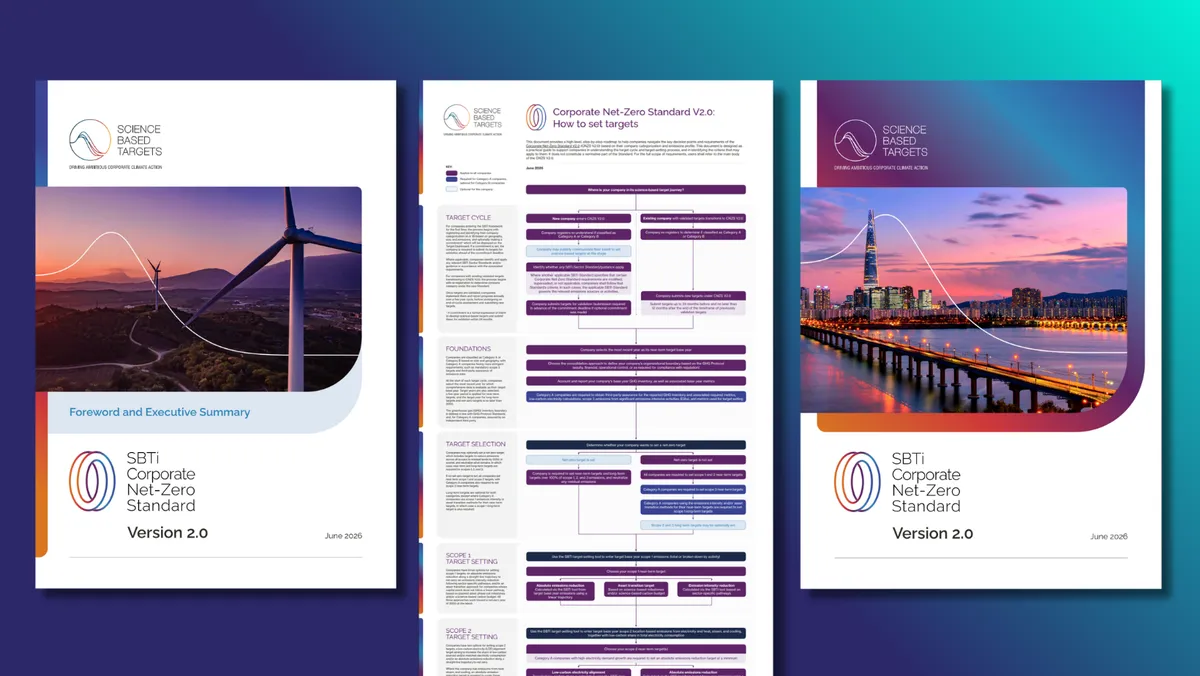
A week on from the release of the Science Based Target initiative’s (SBTi)’s new Net-Zero Standard, I find the greatest reassurance not in what changed, but in what did not.
Much has been written about the new requirements, validation pathways and implementation expectations. Those changes are important. And you need to know about them. (Read our explainer to get up to speed with the new standard)
But the core principles remain consistent. For years, two questions have surfaced whenever I speak with boards, executives and sustainability teams about net zero:
Can we be net zero from day one?
Can we use offsets?
The answer to both questions has always been clear. And it has not changed.
Can a company be net zero from day one?
No.
A company cannot simply calculate its emissions, buy enough carbon credits to match them and declare itself net zero.
That was not acceptable under the previous standard and is not acceptable under the new one.
SBTi continues to define net zero as the outcome of deep emissions reductions across a company's operations and value chain. Only once emissions have been reduced as far as possible can any residual emissions be addressed through removals.
In other words, net zero is a destination. Not a purchase.
Is offsetting an option?
Yes. But not in the way many people think.
Offsetting and carbon removals play a role. They can help address emissions that remain after extensive decarbonisation efforts.
What they cannot do is replace the hard work of reducing emissions. That principle remains firmly embedded in Version 2.0.
Despite years of debate about carbon markets, credits and climate claims, SBTi has held its ground. The hierarchy remains clear:
- Reduce emissions first.
- Reduce them deeply.
- Reduce them across the value chain.
- Then address what remains.
So what has changed?
The biggest shift is what companies need to do to prove they are serious.
Version 1 was largely about setting targets.
Version 2 is much more focused on delivering them.
There is greater emphasis on transition plans, implementation, accountability, reporting and demonstrating progress over time. It is a natural evolution.
After all, the challenge facing most businesses today is no longer whether they can announce a target. It is whether they can achieve it.
More importantly, it is whether stakeholders believe they can achieve it. A net-zero target without a credible pathway is just an aspiration. Investors, customers, regulators and employees increasingly want to see not only where a company intends to go, but how it plans to get there.
That is what Version 2.0 is really about. Not just setting a target. Demonstrating that it is achievable.
The new Standard is bringing more clarity
The destination remains the same. Real emissions reductions remain the foundation of credible climate action. Net zero is still achieved through transformation, not transactions.
That clarity matters for businesses making long-term decisions. Companies are investing in assets, operations and supply chains that may last decades. They need confidence that the definition of net zero will not fundamentally change every few years.
Because while the language may evolve and the reporting requirements may become more sophisticated, the central idea remains unchanged:
There is no shortcut to net zero.
If there are no shortcuts to net zero, the obvious next question is: what should businesses do now?
In Part 2, we will look at the practical steps organisations can take today to prepare for SBTi Corporate Net-Zero Standard 2.0.