
What you Need to Know about the Material Circularity Indicator
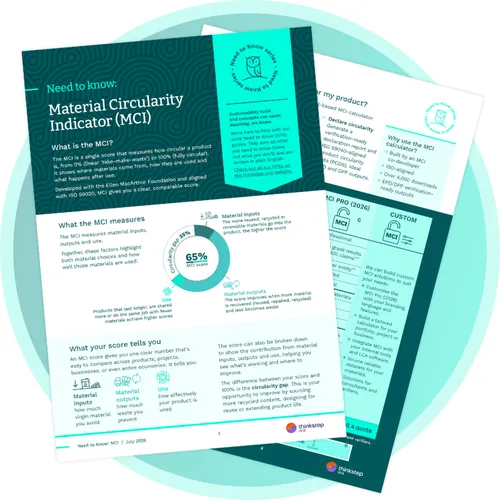
Find all the information on this page and more packaged into one easy PDF.
What is the Material Circularity Indicator?
The MCI is a single score that measures how circular a product is, from 0% (linear ‘take-make-waste’) to 100% (fully circular). It shows where materials come from, how they are used and what happens after use.
Developed with the Ellen MacArthur Foundation and aligned with ISO 59020, MCI gives you a clear, comparable score.
What the MCI measures
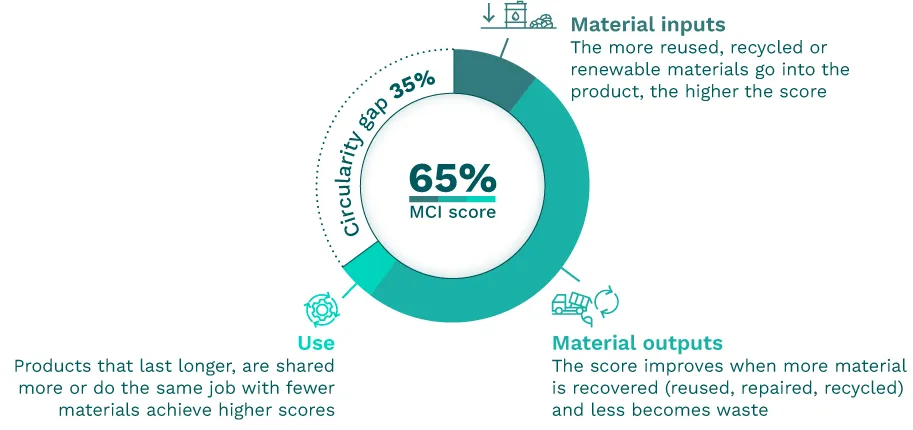
The MCI measures material inputs, outputs and use. Together, these factors highlight both material choices and how well those materials are used.
What your score tells you
An MCI score gives you one clear number that’s easy to compare across products, projects, businesses, or even entire economies. It tells you:
 |
 |
 |
|
Material inputs how much virgin material you avoid |
Material outputs how much waste you prevent |
Use how effectively your product is used |
The score can also be broken down to show the contribution from material inputs, outputs and use, helping you see what’s working and where to improve.
The difference between your score and 100% is the circularity gap. This is your opportunity to improve by sourcing more recycled content, designing for reuse or extending product life.
Why use the MCI?
The MCI gives businesses a trusted, ISO-aligned way to measure and improve circularity, compare strategies and communicate results clearly. It’s built into most leading life cycle assessment (LCA) tools and increasingly used in digital product passport systems.
Businesses use the MCI to:

Measure and track circularity
Assess how circular a material, product, project or business is, set KPIs and monitor progress over time.

Compare and improve strategies
Evaluate designs, sourcing options, lifespans and portfolios to identify opportunities to reduce virgin material use, waste and inefficiencies.

Support decision-making
Guide procurement, investment and product development towards more circular solutions.

Commmunicate with confidence
Validate sustainability claims and share results using a recognised, standardised metric.

Integrate with reporting (EPD, DPP, ESPR)
Include circularity results alongside LCA data in Environmental Product Declarations (EPDs), use the PCDS data in your Digital Product Passports to meet ESPR requirements.

thinkstep-anz Need to Know series
This page is part of a series that simplifies sustainability topics. Explore the rest of our series.
Which certifications include circular metrics?
As the shift to a circular economy accelerates, a growing number of certification schemes and regulations require business report on circularity and demonstrate how they are reducing waste and resource use. The MCI offers a credible and consistent way to measure and report circularity across these schemes.
Green Star Buildings
Green Star Buildings assesses and reports on the circularity of building materials using the MCI. Many product EPDs in Australia and New Zealand now include MCI results.
Infrastructure Sustainability Council (ISC)
ISC awards credits for projects using the MCI and recognises businesses that help suppliers adopt it.
BREEAM Building Circularity Score
This uses the same material flow indicators as the MCI (excluding utility factor), allowing easy transition between the two frameworks.
Corporate Sustainability Reporting Directive (CSRD)
CSRD requires companies to disclose resource use, circularity and related performance indicators under European Sustainability Reporting Standards (ESRS). The MCI can support these disclosures.
BCorp Certification
The Environmental Stewardship & Circularity impact topic requires businesses to assess and meaningfully address their environmental footprints, particularly through circular economy practices; the MCI can provide concrete evidence of performance and improvements in this area.
Ecodesign for Sustainable Products Regulation (ESPR)
Products sold in the EU will be required to meet performance and information standards on sustainability and circularity, with the MCI potentially used to measure and communicate product-level circularity.
How do I calculate my MCI?
You can use thinkstep-anz’s MCI calculator:
- it's been developed by experts
- it's ISO-aligned
- it's already been downloaded over 4,000 times.
1. Calculate your MCI score
No need to download or learn a new app, our calculator is built in Microsoft Excel. Input your bill of materials and end-of-life and utility data to easily calculate an MCI score for any product.
2. See what drives the number
Visualise your score and main drivers for circularity. Compare the impacts of alternative materials, designs and end-of-life options.
3. Declare circularity
Generate a verification-ready declaration report and ISO 59040-aligned product circularity data (PCDS). Ideal for Environmental Product Declarations (EPDs) and Digital Product Passports (DPPs) - meeting ESPR requirements in a fast, cost-effective, machine-readable format.
Download the Material Circularity Indicator (MCI) calculator
How we can help
Move from understanding to action with support at three levels. Our team is led by Dr Jim Goddin, co-developer of the MCI methodology and a contributor to the ISO 59020 standard.

Expert support
Our multi-disciplinary team of experts can provide guidance on circular economy, LCA, EPDs and all things sustainability. We can independently review your calculations, provide tender-safe wording and help you tell your circularity story with MCI.

MCI calculations
Get started with the MCI calculator or talk to us about your needs. We can customise MCI solutions for any organisation, wherever you are on the journey.

Go strategic with the circular economy
When you are ready to lift from product to portfolio, choose from our suite of nine off-the-shelf projects aligned to ISO 59010. They’ll help you set direction, governance and metrics for circular economy.
New to circularity and not sure where to start?

Contact us at engage@thinkstep-anz.com and we will point you to the best next step.
Or talk to our circular economy expert
Dr Jim Goddin is our Head of Circular Economy and is an internationally recognised leader in the circular economy. He helped the world-renowned Ellen MacArthur Foundation produce two of the most used circularity metrics: the MCI and Circulytics.
You may also be interested in

Material Circularity Indicator calculator
How ‘circular’ is your product? Our Material Circularity Indicator (MCI) calculator can get you started with a simple look at your product – without having to collect lots of data.
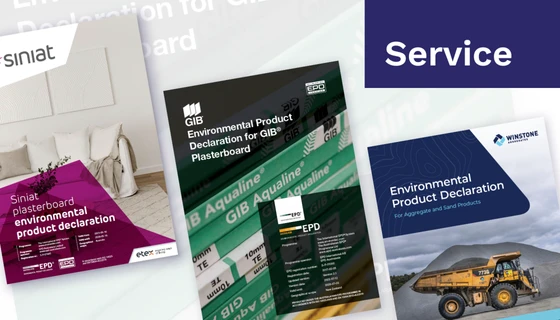
Environmental Product Declaration (EPD)
Promote your product with a verified, public summary of its environmental impact. All EPDs start with LCAs.