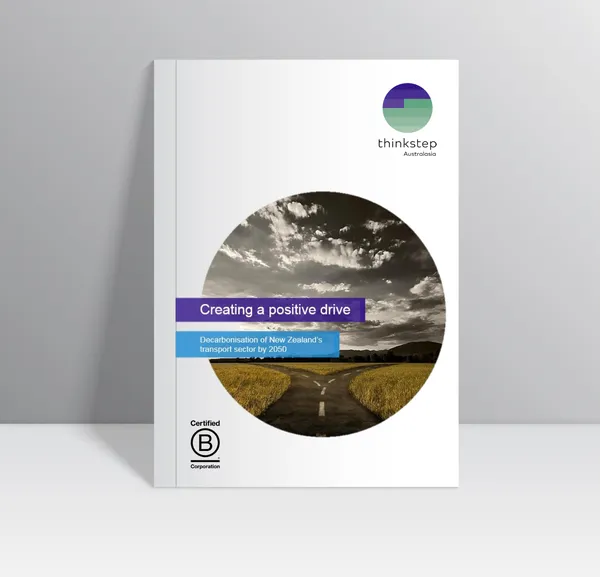
Transport has a key role to play in New Zealand’s low-carbon future. thinkstep-anz’s report Creating a Positive Drive presents four future visions for New Zealand in which the carbon footprint of transport is reduced by up to 90% of 2015 levels by 2050 through a combination of new vehicle technologies and behavioural changes. This would mean a 17% reduction in total gross greenhouse gas emissions.
The scenarios considered are deliberately optimistic, focusing on a complete transition away from fossil fuels towards renewable electricity, renewable hydrogen and biofuels – all of which can be produced locally. The scenarios consider both the current individualised model and a more novel ‘sharing’ model for future transport. In all cases, the improvement over today is dramatic, indicating that transport has a key role to play in New Zealand’s low-carbon future.
Achieving such large improvements comes with some major trade-offs, including nearly doubling electricity generation and a conversion of 5% of all agricultural land in New Zealand to biofuel production. The good news is that many of the solutions to rapidly decarbonise New Zealand’s transport sector already exist.
The role of government and business, as we see it, is to make these low-carbon choices easy and convenient. Encouraging uptake of ride-sharing through widespread use of carpool lanes alongside creating a pricing model for electric vehicles that makes them attractive to New Zealand consumers are two options. Investment in biofuels and renewable hydrogen, together with continued investment in renewable electricity generation, seem like logical next steps beyond this.
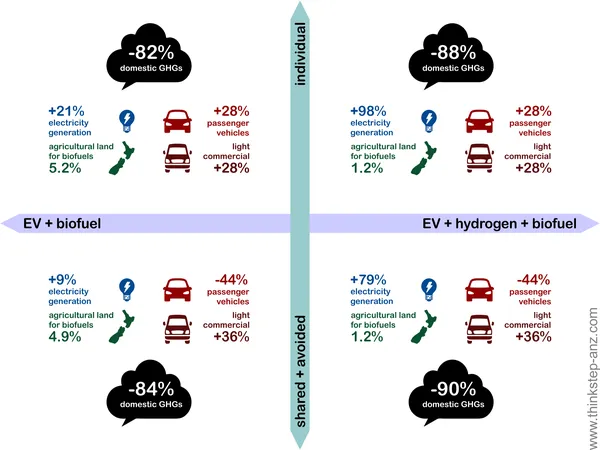
Transport scenarios for 2050 relative to 2015. All of these scenarios assume that EVs are used for passenger journeys and that planes and ships use biofuels. The scenarios consider the impacts of using biofuels for heavy and commercial vehicles (left hand side) vs hydrogen fuel cells (right hand side). They also look at what happens when personal travel behaviour continues as it is today (top half) vs a more shared or avoided approach using increased uptake of public transport, car sharing, teleworking and home deliveries from online shopping (bottom half).
Report by thinkstep-anz's Dr Jeff Vickers, Ben Fisher & Queenie Hon.