Our carbon footprint
Our footprint
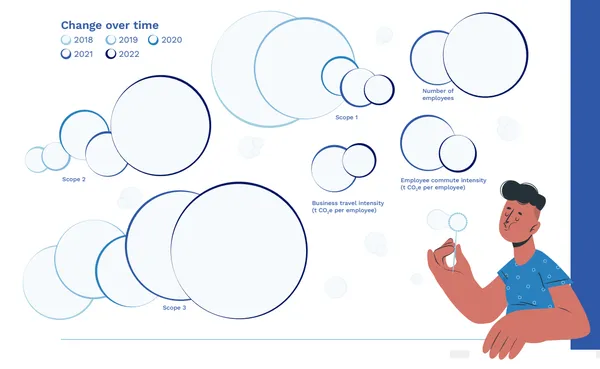
Our carbon footprint covers our operations in Australia and Aotearoa New Zealand. Our total emissions are growing as our business grows. As we use generic emissions factors, not emission factors specific to our actual suppliers, we are likely to be overstating our emissions. (Many of our suppliers are members of the Climate Leaders Coalition and have publicly committed to reducing their greenhouse gas emissions in line with science.)
Our Science Based Target
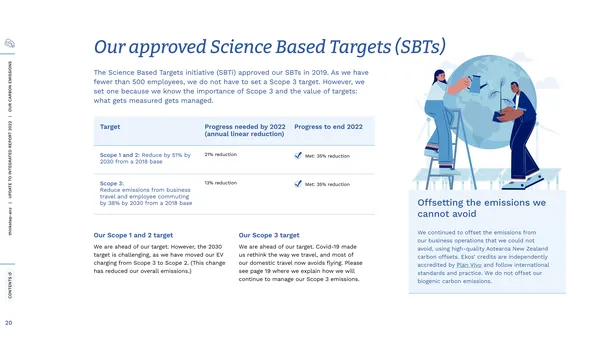
The Science Based Targets initiative (SBTi) approved our SBTs in 2019. As we have fewer than 500 employees, we do not have to set a Scope 3 target. However, we set one because we know the importance of Scope 3 and the value of targets: what gets measured gets managed.
Learn more about our science-based target in our Integrated Report.
Targets for reducing emissions are considered ‘science-based’ if they are in line with what the latest climate science deems necessary to meet the goals of the Paris Agreement. Learn more here.
Our emissions
A summary of our emissions:
| GHG Emissions (tCO 2 e) | 2018 | 2019 | 2020 | 2021 | 2022 |
|---|---|---|---|---|---|
| Scope 1 (renewable) | 3.6 | 3.1 | 1.2 | 1.2 | 0.9 |
| Scope 1 (non-biogenic) | 0.3 | 0.3 | 0.1 | 0.1 | 0.1 |
| Total Scope 1 | 3.9 | 3.4 | 1.3 | 1.3 | 1.0 |
| Scope 2 | 0.5 | 0.5 | 0.9 | 0.8 | 1.9 |
| Scope 3 | 83 | 88 | 80 | 125 | 151 |
| Totals | 87 | 92 | 83 | 127 | 154 |
Learn more on page 18 of our Integrated Report
Scope 1 (direct, including biogenic)
These come from the woodburner in our Wellington office. These emissions fell 21% between 2021 and 2022. Our office was better insulated and our woodburner more efficient. While these emissions make up a relatively small part of our carbon footprint (currently 0.9%), we will continue to seek ways to reduce them. This includes potentially replacing the gas stove in our Wellington office.
Scope 2 (indirect)
These emissions rose 123% between 2021 and 2022. Opening our physical Auckland office was the main reason for this growth. We also moved our EV charging from Scope 3 (business travel) to Scope 2. While these emissions make up a relatively small part of our carbon footprint (currently 1.2%), we will continue to seek ways to reduce them. This includes potentially installing solar power in our Wellington office.
Scope 3 (value chain)
These emissions rose 21% between 2021 and 2022. We bought more goods and services as our Australian business grew. Employee commuting and business travel grew in absolute terms as our headcount increased and Covid-19 restrictions eased. However, these emissions per employee (our ‘emissions intensity’) fell. We classified our spend more accurately in 2022 and used slightly different emission factors.
Looking ahead, we will continue to manage our business travel carefully. Meeting in person at times is important to build an engaged team, particularly when many team members work remotely. Some clients prefer to meet in person.
External verification
Our commitments are regularly scrutinised or certified by:
You may also be interested in
The Science Based Target initiative
WWF and thinkstep ANZ talk about the Science Based Target initiative, the difference between a carbon target and a science-based carbon target and the important shift from 2 towards 1.5 degrees. Watch video here.
Business led initiatives
The Sustainable Business Council (SBC) talks with thinkstep ANZ about their target, the Climate Leaders Coalition and what the Science Based Target initiative means for businesses in New Zealand. Watch video here.
thinkstep-anz's approved target
Barbara Nebel explains thinkstep ANZ’s approved science-based target. She shares their motivation, their experience of going through the process and their plan to reduce their emission by 38% by 2030. Watch video here.
At thinkstep-anz it is in our DNA to enable organisations to succeed sustainably. This means that we cannot just advise other companies to do the right thing in sustainability; we strongly believe that we have to do our share.
We’ve therefore committed to:
- robust and transparent disclosure of our own emissions each year,
- an ambitious carbon reduction target, and
- the offset of our remaining business operations emissions.