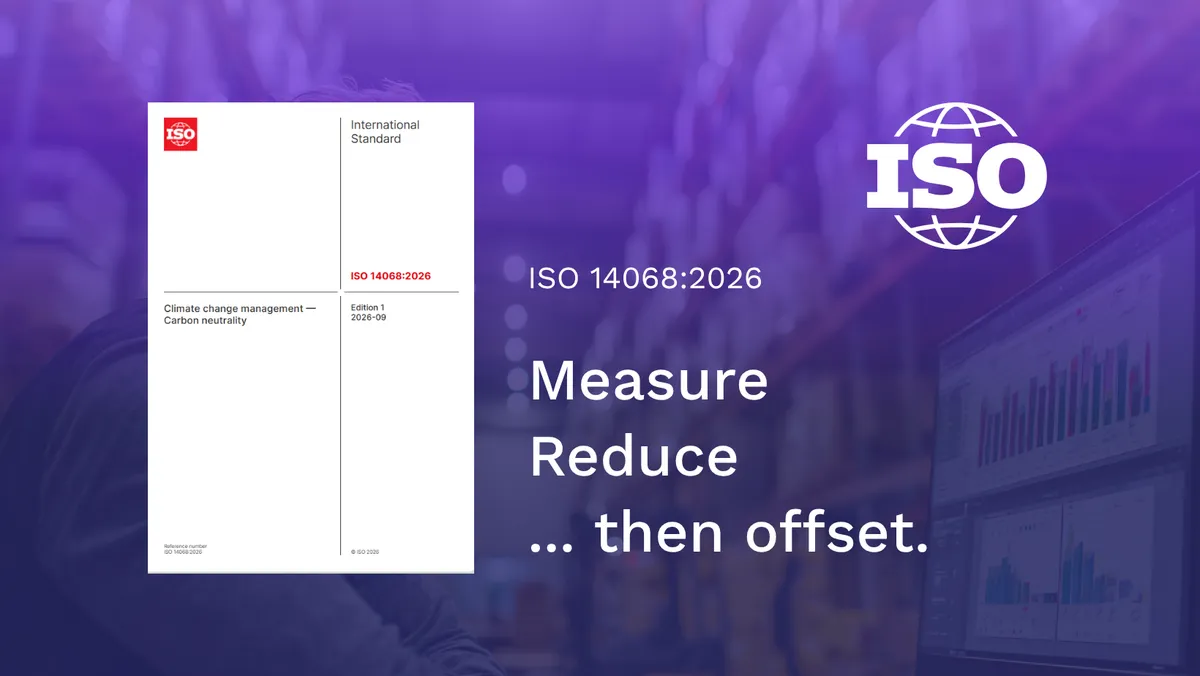
The recently released update of ISO 14068:2026 puts the hierarchy behind carbon neutrality into focus: measure, reduce, then offset. It also makes an important distinction between unabated and residual emissions. Here is what businesses making carbon neutral claims need to know.
ISO has released ISO 14068:2026 - Climate change management - Carbon neutrality, the international standard for achieving and demonstrating carbon neutrality.
Published in September 2026, the standard replaces ISO 14068-1:2023. The 2026 publication is not a fundamental rewrite of the 2023 requirements, but its release is a useful reminder of what ISO means by carbon neutrality - and what it does not mean.
At the heart of ISO 14068 is a hierarchy: reducing greenhouse gas emissions and enhancing removals within the value chain take priority over offsetting.
That sounds straightforward. But one distinction in the standard is particularly important: the difference between unabated emissions and residual emissions.
Unabated emissions are not residual emissions
The terms can sound similar, but they mean different things.
Unabated emissions are greenhouse gas emissions that remain after the emission reduction activities that have been undertaken.
Residual emissions are a subset of unabated emissions. They are the emissions that remain after all technically and economically feasible greenhouse gas emission reductions have been implemented.
That distinction matters.
Imagine an organisation calculates a carbon footprint of 10,000 tonnes of CO2e. It implements several reduction projects and brings its footprint down to 8,000 tonnes.
Those 8,000 tonnes are unabated emissions.
That does not automatically mean they are all residual emissions. There may still be practical and economically feasible opportunities to reduce them further.
Residual emissions are what remains when those feasible reduction opportunities have been exhausted.
Can you still be carbon neutral if you have unabated emissions?
This is where carbon neutrality and net zero are sometimes confused.
ISO 14068 establishes a hierarchy in which emission reductions and removal enhancements within the value chain take priority over offsetting. Carbon credits can then be used to counterbalance the remaining carbon footprint.
This means carbon neutrality should not be treated simply as:
Calculate footprint → buy equivalent carbon credits → claim carbon neutral.
Instead, carbon neutrality sits within a carbon neutrality management plan and a pathway of continual improvement.
An organisation can therefore have unabated emissions while progressing along that pathway. The important point is that offsetting should not become a substitute for reducing emissions.
Over time, the footprint should reduce - and so should the reliance on carbon credits.
Reduce first, offset what remains
The hierarchy is important because carbon credits and emissions reductions do fundamentally different things.
Reducing a tonne of CO2e from your operations or value chain means that tonne is no longer being emitted.
Buying and retiring a carbon credit does not remove that emission from your own carbon footprint. It counterbalances it through a qualifying reduction or removal elsewhere.
Both can play a role in carbon neutrality, but they are not interchangeable.
ISO 14068 therefore prioritises:
- GHG emission reductions within the subject
Reduce direct and indirect emissions wherever possible. - GHG removal enhancements within the value chain
Increase qualifying removals associated with the organisation, product or other subject. - Offsetting
Use qualifying carbon credits to counterbalance the remaining carbon footprint.
The sequence matters.
Carbon neutrality is not the end of the journey
This is perhaps the most useful way to think about ISO 14068.
A carbon neutral claim does not mean:
"We have reduced everything we possibly can."
It means an organisation has followed the requirements for carbon neutrality, including quantifying its footprint, implementing reductions and removals in accordance with its carbon neutrality management plan, and counterbalancing the remaining footprint with qualifying carbon credits.
The distinction between unabated and residual emissions makes clear that there can still be further reductions to make.
That is why a credible carbon neutrality programme should show not only how the remaining footprint has been counterbalanced, but also how the footprint itself is changing over time.
Looking for carbon neutral certification? Read the small print
If you are looking for carbon neutral certification, look for a programme that requires compliance with ISO 14068.
Terms such as "aligned with", "based on", "inspired by" or "following the principles of" ISO 14068 are not the same as compliance with the standard.
Ask whether the certification requires conformity with ISO 14068:2026, including its requirements for emissions reductions, carbon credits and carbon neutrality claims.
A certificate or logo is only part of the story. Make sure the standard behind it is too.
What should businesses do now?
If your organisation already makes a carbon neutral claim, start by understanding exactly what sits behind it.
Look beyond the number of carbon credits purchased. Check how your footprint has been calculated, what reductions have actually been achieved, what further reduction opportunities remain and how your carbon neutrality management plan addresses them.
If you are considering certification, understand precisely what the certification scheme requires and how closely those requirements correspond to ISO 14068.
And if someone describes your remaining emissions as "residual", ask one more question:
Have we really implemented all technically and economically feasible reductions - or are some of these emissions actually still unabated?
That distinction may be only one word, but it says a lot about where an organisation is on its decarbonisation journey.