What you Need to Know about Scope 3 carbon emissions
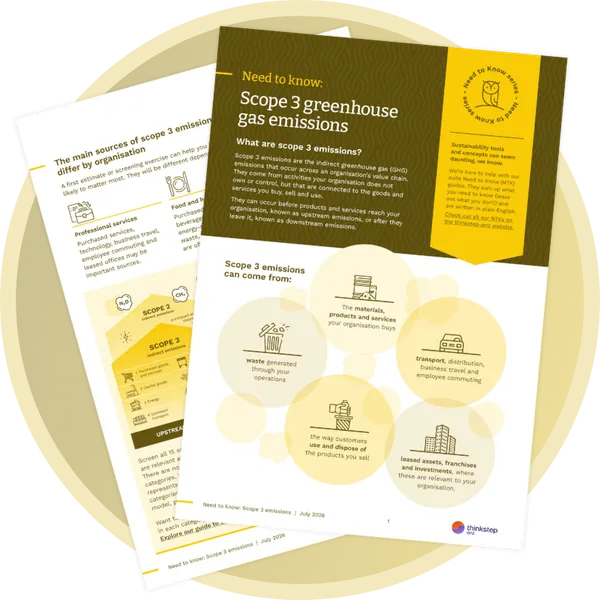
We've packaged all the information on this page into one easy PDF.
What are Scope 3 emissions?
Scope 3 emissions are the greenhouse gas emissions that sit in an organisation’s ‘value chain’. They come from:
- the materials, products and services your organisation buys
- transport, distribution, business travel and employee commuting
- waste generated through your operations
- the way customers use and dispose of the products you sell
- leased assets, franchises and investments, where these are relevant to your organisation.
Like to learn more? Get in touch with our Scope 3 expert
How do scope 3 emissions differ from scopes 1 and 2?
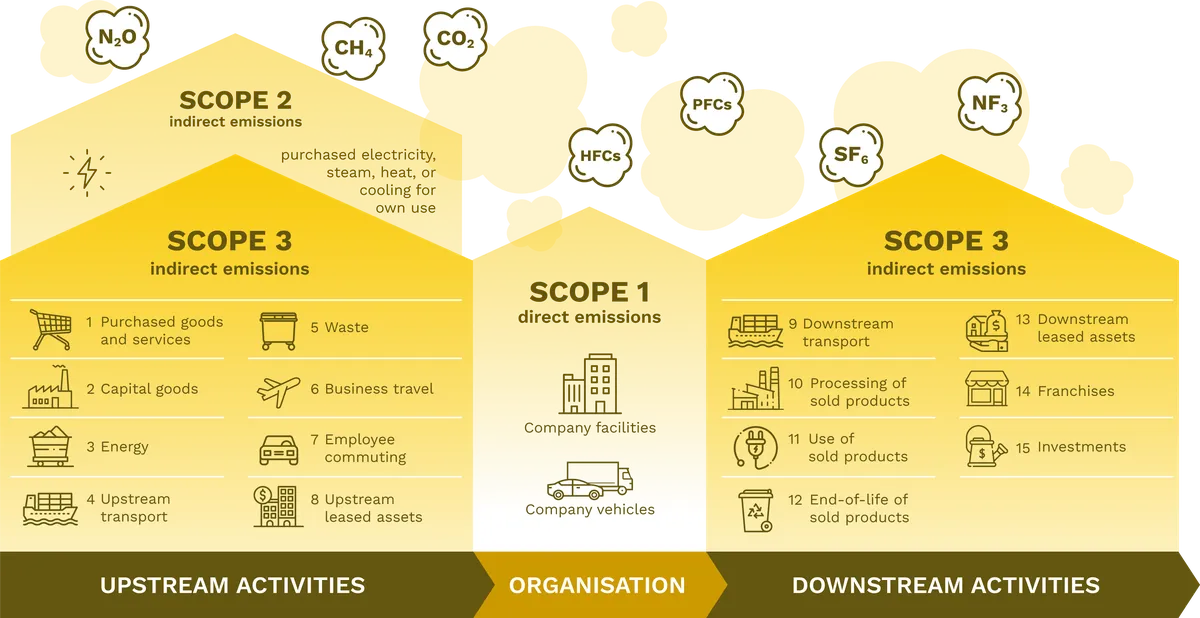
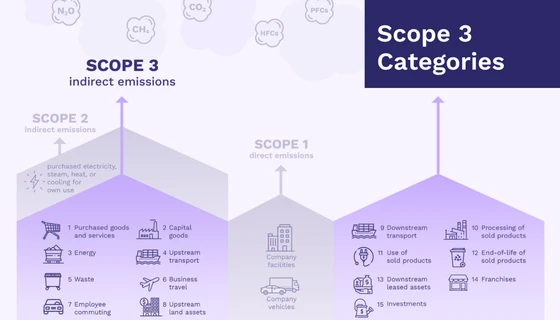
Scope 1: direct emissions come from sources your organisation owns or controls. Examples include fuel used in company vehicles or boilers, refrigerant leaks and emissions from some industrial processes.
Scope 2: indirect emissions from purchased energy come from generating the electricity, steam, heating and cooling your organisation buys and uses.
Scope 3: other indirect emissions occur across your value chain. They include emissions linked to your suppliers, customers and other activities connected with your organisation.
Why do scope 3 emissions matter?
For many organisations, scope 3 emissions make up the largest part of their carbon footprint. They can also be the hardest emissions to measure because the information sits with suppliers, customers and other organisations in the value chain.
Why should I manage my scope 3 emissions?
Understanding these emissions helps you see where your greatest climate impacts happen and where you may have the most influence. It can also help you respond to reporting requirements, customer questions and procurement expectations.
| Business opportunities | Business results |
|---|---|
| Identify your risks (climate, financial, regulatory) | Lower risks and costs |
| Reset your strategy (how you offer value in a low-carbon economy) | A more resilient organisation |
| Stand out from competitors | Stronger relationships |
| Improve relationships with customers and suppliers | Investor confidence |
| Build your brand value and reputation | Engaged employees |
| Market share | |
| Social licence |
The main sources differ by organisation
A first estimate or screening exercise can help you identify the categories that are likely to matter most. They will be different depending on your sector and business.
Professional services
Purchased services, technology, business travel, employee commuting and leased offices may be important sources.
Food and hospitality
Purchased goods like food and beverages, packaging, freight, energy-related activities and waste, including foodwaste are often significant.
Technology and manufactured products
Raw materials, components, manufacturing, freight and customers’ use of sold products may dominate the footprint.
The 15 categories of scope 3 emissions
The Greenhouse Gas Protocol groups scope 3 emissions into 15 categories. Categories 1 to 8 are upstream and Categories 9 to 15 are downstream.
Want to understand what is included in each category? Explore our guide to all 15 scope 3 categories.
Screen all 15 scope 3 categories to find out if they are relevant and material to your organisation. There are no universally mandatory scope 3 categories. In practice, only a subset usually represents the majority of your emissions. Which categories matter most depends on your business model, products, services and value chain.
| Business type | Categories most likely relevant |
|---|---|
| Manufacturing | 1, 2, 3, 4, 11 |
| Retail | 1, 4, 9, 11 |
| Food & beverage | 1, 4, 11 |
| Professional services | 1, 3, 6, 7, 8 |
| Investors & financial institutions | 15 |

thinkstep-anz Need to Know series
This page is part of a series that simplifies sustainability topics. Explore the rest of our series.
How do I measure my scope 3 emissions?
Scope 3 data will rarely be perfect when you start. The important thing is to build a complete picture using the best information available, be transparent about assumptions and improve the data over time.
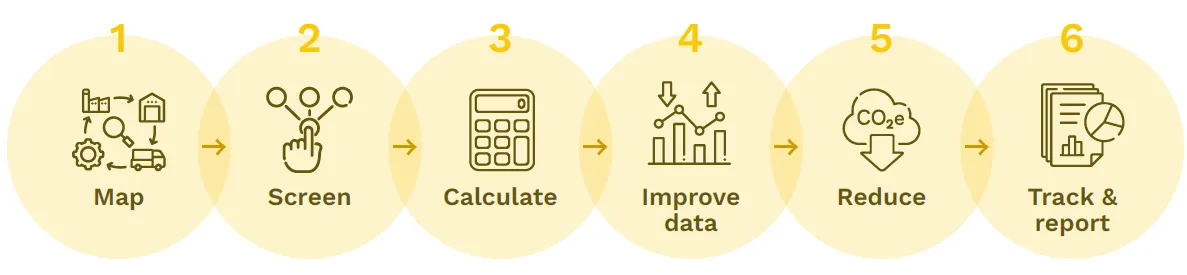
Step 1: Map your value chain.
Identify the goods and services you buy, how they reach you, what happens in your operations and how customers use and dispose of what you sell.
Step 2: Screen all relevant categories.
Estimate which categories and activities are likely to contribute most. Screening helps you prioritise detailed data collection, but it does not automatically justify leaving other emissions out.
Step 3: Calculate your scope 3 footprint.
Use the best available combination of spend data, physical activity data, supplier-specific information and recognised emission factors. Record your sources, methods, boundaries and assumptions.
Step 4: Improve the data that matters most.
Focus detailed data collection on emissions hotspots and the areas where better information will support decisions and track reductions.
Step 5: Set targets and take action.
Choose actions that address the source of emissions and work with the people who can influence them.
Step 6: Track and report progress.
Update the inventory regularly, explain material changes and keep evidence that supports your calculations and claims.
Choosing the right data
There is no single source of data for calculating scope 3 emissions. Most organisations use a combination and improve the quality of their data over time.
Spend-based data
The amount spent on goods and services. It is a quick way to estimate emissions and identify hotspots but is less precise than activity or supplier data.
Physical activity data
Information such as kilograms of material, litres of fuel or tonne-kilometres of freight. It usually provides a more accurate result.
Supplier-specific data
Information from suppliers, such as product carbon footprints or Environmental Product Declarations. Check that it is credible, current and covers the right activities.
Recognised emission factors
An emission factor represents the amount of GHG an activity releases. Use reliable factors relevant to the location, year and activity.
Start with the data available, then improve priority categories. Record your sources, methods, boundaries and assumptions.
For New Zealand organisations, thinkstep-anz’s audited and peer-reviewed spend-based emission factors can help estimate emissions from purchased goods and services.
How can I reduce my scope 3 emissions?
Scope 3 emissions sit with your suppliers, customers, employees and other organisations in your value chain. You may not control these emissions directly, but you can influence them.
Like trimming a shared garden hedge, scope 3 emissions need a shared approach. You will make more progress by working with others than by tackling them alone.
Work with others to reduce your scope 3 emissions
Here are some examples for a manufacturer:
| Scope 3 emission source | Who to work with | Questions to ask | Possible actions |
|---|---|---|---|
| Category 1: Purchased goods and services | Suppliers and procurement teams | Which materials create the most emissions? Do suppliers measure their emissions or have reduction targets? | Use less material, choose lower-emission alternatives and include carbon requirements in purchasing decisions. |
| Category 4: Upstream transport | Suppliers and freight providers | How far are materials transported? What vehicles and fuels are used? Are trucks travelling fully loaded? | Combine shipments, improve routes and use lower-emission transport where practical. |
| Category 11: Use of sold products | Product designers, sales teams and customers | How often and for how long do customers use the product? How much energy does it need? | Improve energy efficiency, extend the product’s life and give customers clear advice on efficient use. |
| Category 12: End-of-life treatment of sold products | Product designers, customers and waste providers | Can the product be repaired, reused or recycled? Is it easy to separate into different materials? | Design for repair and recycling, reduce difficult-to-recycle materials and support take-back or recovery schemes. |
Your scope 3 emissions are often someone else’s direct emissions. Working together can help both organisations reduce them.
But aren’t we double-counting if everyone accounts for their scope 3 emissions?
Yes, if everyone reports on their scope 1, 2 and full scope 3 emissions (and we’re a long way off that!) then we’re double counting.
However, the aim of scope 3 reporting is not to map all emissions across the economy. The aim is for every company to identify where they can influence emissions in their value chain.
Organisations own scope 3 emissions jointly with someone else in their supply chain. So working with the ‘co-owner’ is the only way to reduce them.
Which standards cover Scope 3 emissions?
Greenhouse Gas Protocol
The Greenhouse Gas Protocol’s Corporate Value Chain (Scope 3) Standard is the main international framework for measuring and reporting corporate value-chain emissions. It defines the 15 categories and their minimum boundaries.
ISO 14064-1
ISO 14064-1:2018 sets requirements and guidance for measuring and reporting greenhouse gas emissions and removals at an organisational level. It groups indirect emissions differently from the GHG Protocol. The two organisations are now working together to harmonise their standards. For now, continue to use the current published standards and the requirements of your reporting scheme.
The GHG Protocol scope 3 standard is changing
The GHG Protocol is revising its scope 3 standard. As at July 2026, the proposals are working drafts, not requirements. They indicate that reporting is likely to become more complete, transparent and evidence-based.
- Businesses may need to report at least 95% of their scope 3 emissions.
- Any excluded emissions may need to be estimated, limited to 5% and explained.
- Businesses may need to show the data and calculation methods used and disclose verification status.
- A proposed Category 16 may cover other value-chain activities, including some facilitated emissions, e.g. digital market places or booking platforms.
- Category 15 requirements for financed emissions may become more detailed.
The final requirements may change through consultation and approval. Check the publication date before relying on this summary.
How thinkstep-anz can help
Scope 3 emissions can be complex, but you do not need perfect data to get started. We can help you build a practical inventory, focus on the emissions that matter and improve your information over time.
Understand your footprint
We can map your value chain, screen the scope 3 categories and calculate your emissions using suitable activity data and emission factors.
Provide emission factors
Our annually updated Emission Factors for New Zealand help you estimate scope 3 emissions using financial data already in your accounting systems. We can also develop specific emission factors for your organisation based on LCA data.
Improve your data
We can help you identify data gaps, set priorities, develop supplier data requests and put processes in place for repeatable reporting.
Move from measurement to action
We can identify hotspots, support target setting and bring procurement teams, suppliers and other parts of your business together to reduce emissions.
Prepare to report
We can document methods, assumptions and evidence clearly, helping you prepare for climate disclosures, customer requests and assurance.
Choose your next step
Explore the categories: Learn what is included in each of the 15 scope 3 categories.
Get expert support: See how our scope 3 specialists can help.
Ready to get started?
Talk to our team about calculating, improving or reducing your scope 3 emissions.
Talk with our experts

Nicky Andrews has a strong background in sustainability reporting. With four years’ experience assessing corporate responsibility for National Australia Bank, and teaching a master’s course in the subject at European Business School (EBS) Paris, Nicky is well equipped to help clients with their sustainability reporting and to measure their impact.
Nicky holds a Master of Environmental Management at Massey University. The course covered sustainability issues in New Zealand and tools like Life Cycle Assessments and circular economy which can help address them and add value to business.

Katharina Bauch has been with thinkstep-anz since its earliest days and balances a wide range of responsibilities, from organising our team’s capacity to managing corporate carbon reporting and product carbon footprint/LCA/EPD projects.
You may also be interested in
Our Scope 3 Category Guide
Our free online assessment can show which Scope 3 categories are most relevant to your business.

Our Scope 3 services
If you're ready to take action on your Scope 3 emissions, we're ready to work with you to make real changes.