
Scope 3 emissions: which categories matter to your business?
Everything you need to know about scope 3 (value chain) emissions.
Your scope 3 emissions span your entire value chain
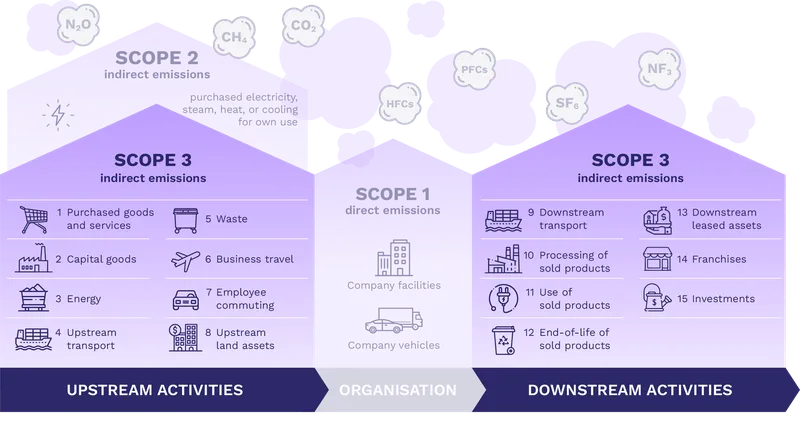
Scope 3 emissions are the indirect greenhouse gas (GHG) emissions that occur across an organisation’s value chain. They come from activities your organisation does not own or control, but that are connected to the goods and services you buy, sell and use.
Scope 3 emissions are often the largest part of an organisation's carbon footprint and can occur before products and services reach your organisation, known as upstream emissions, or after they leave it, known as downstream emissions.
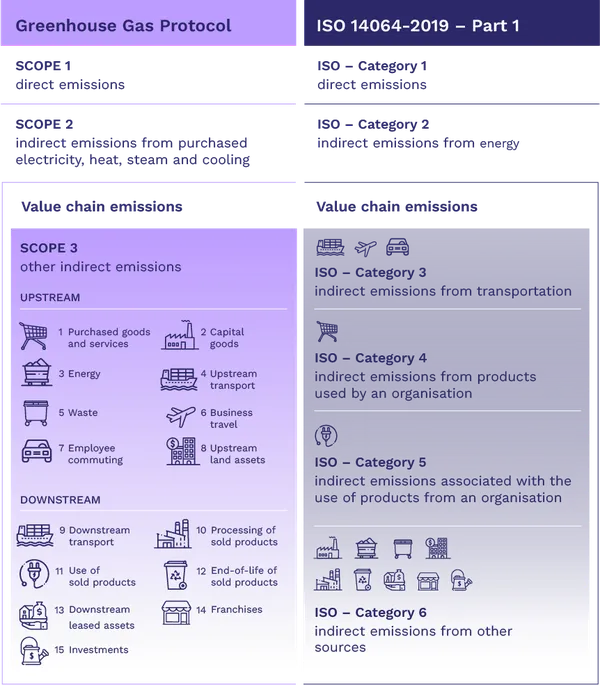
The GHG Protocol groups these emissions into 15 scope 3 categories, helping organisations identify, measure and manage emissions across their value chain.
The international standard ISO 14064-1:2019 takes a slightly different approach. Rather than 15 categories, it groups indirect emissions into four broader categories (Categories 3-6). The graphic below shows how the Greenhouse Gas Protocol and ISO approaches relate to one another. Each of the detailed Scope 3 category pages also identifies the corresponding ISO category, making it easy to navigate between the two frameworks.
The GHG Protocol is currently revising its Corporate Value Chain (Scope 3) Standard. This work is part of the GHG Protocol’s partnership with the International Organization for Standardization (ISO) to create a more consistent global approach to measuring and reporting emissions. This means the changes may matter for companies that use ISO standards, as well as those that follow the GHG Protocol directly. Read more in our blog here.
Which categories matter most?
Review all 15 scope 3 categories to identify which ones matter for your organisation. You do not need to report every category. Focus on those that make up most of your emissions, based on your business model, products, services and value chain.
| Business type | Categories most likely relevant |
|---|---|
| Manufacturing | 1, 2, 3, 4, 11 |
| Retail | 1, 4, 9, 11 |
| Food & beverage | 1, 4, 11 |
| Professional services | 1, 3, 6, 7, 8 |
| Investors & financial institutions | 15 |
Need help calculating your Scope 3 emissions?
Whether you are preparing your first Scope 3 inventory or improving data quality with supplier-specific information, our team can help.
Upstream emissions

1. Purchased goods and services
Goods and services your organisation buys, from raw materials to professional services.

2. Capital goods
Buildings, equipment and machinery your organisation purchases.

3. Fuel- and energy-related activities
Emissions from producing the fuel and energy you use that are not included in Scope 1 or Scope 2.

4. Upstream transport
Transport and storage of the goods you buy before they reach your organisation.
Read the upstream transport guide →

5. Waste
Waste generated by your organisation and how it is treated or disposed of.

6. Business travel
Flights, accommodation and other travel undertaken for business purposes.

7. Employee commuting
Travel between home and work by your employees.

8. Upstream leased assets
Buildings, vehicles and equipment your organisation leases and uses but does not own.
Downstream emissions
9. Downstream transport
Transport and storage of your products after they leave your organisation.

10. Processing of sold products
Processing carried out by other businesses before your products are sold to the end customer.

11. Use of sold goods

12. End-of-life of sold goods
Recycling, disposal and treatment of your products at the end of their life.

13. Downstream leased assets
Buildings, vehicles and equipment your organisation owns and leases to others.

14. Franchises
Franchise operations that use your brand but are operated by others.

15. Investments
Companies, projects and assets your organisation invests in.
Talk with our experts
Why organisations choose thinkstep-anz
- Hundreds of Scope 3 carbon footprints completed
- More than 20 years of carbon accounting experience
- Experts in the Greenhouse Gas Protocol and ISO 14064
- Specialists in Life Cycle Assessment, Product Carbon Footprints and EPDs
- Experience across manufacturing, food & beverage, packaging, government, infrastructure, logistics, energy and financial services

Katharina Bauch has been with thinkstep-anz since its earliest days. She works with companies and associations to develop their individual strategy to reduce carbon. This covers guidance on best practice for carbon accounting, setting targets, carbon reporting and near/long-term carbon reduction roadmaps.

Nicky Andrews has a strong background in sustainability reporting. With experiences in the corporate sector, teaching a master’s course in the subject at European Business School (EBS) Paris, and consulting experience across many sectors Nicky is well equipped to help clients with their sustainability reporting and to measure their impact.
Ready to get started?
Whether you need to identify your material Scope 3 categories, calculate your baseline or improve data quality, we can help.