
Scope 3: 11. Use of sold products
What is included, how to calculate emissions, common challenges and solutions, where to find data and practical ways to reduce them.
This guide explains scope 3, category 11 - use of sold products. It covers what to include, how to calculate emissions, where to find data, common challenges and practical ways to reduce emissions.
Use of Sold Goods at a glance:
- Greenhouse Gas Protocol: Category 11 - Use of Sold Products
- ISO 14064-1:2019: Category 5 - Indirect GHG emissions associated with the use of products from an organisation
- Covers emissions generated while customers use your products
- Often one of the largest scope 3 categories for manufacturers
- Includes energy consumed during the product's lifetime
See all 15 scope 3 categories
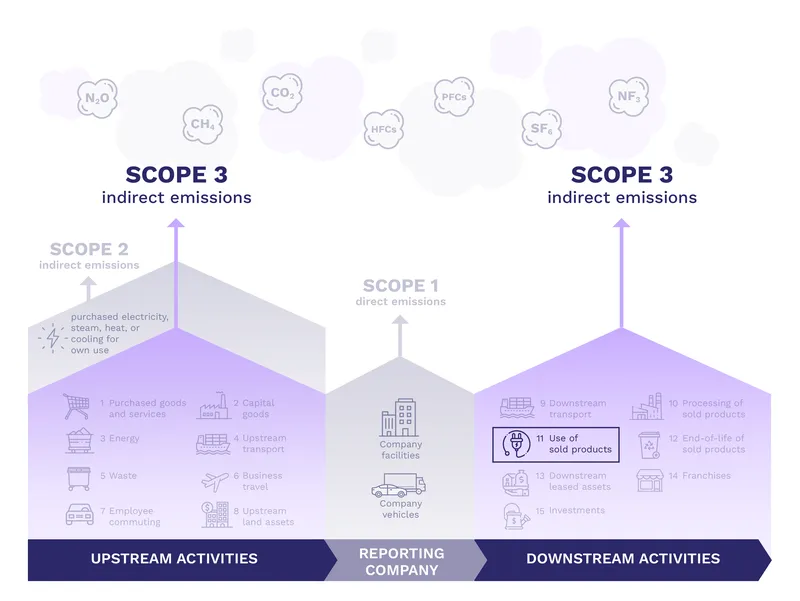
What is included?
The Greenhouse Gas Protocol defines this category as emissions from the use of goods and services sold by your organisation. The scope 3 standard divides emissions in this category in two types:
| Type of Emissions | Product Type | Examples |
|---|---|---|
| Direct use-phase emissions (required) | Products that directly consume energy (fuels or electricity) during use | Cars, airplanes, engines, motors, power plants, buildings, appliances, electronics, lighting, data centres, web-based software |
| Fuels and feedstocks | Petroleum products, natural gas, coal, biofuels, and crude oil | |
| Greenhouse gases and products that contain or form greenhouse gases that are emitted during use | CO 2 , CH 4 , N 2 O, HFCs, PFCs, SF 6 , refrigeration and air-conditioning equipment, industrial gases, fire extinguishers, fertilisers | |
| Indirect use-phase emissions (optional) | Products that indirectly consume energy (fuels or electricity) during use | Clothing (requires washing and drying), food (requires cooking and refrigeration), pots and pans (require heating), and soaps and detergents (require heated water) |
Source: Table 5.8 from the scope 3 standard
Who is Scope 3 category 11 most relevant for?
This is a big one for a lot of industries. It can make up to 25% for the utilities and technology sectors. For personal and household goods it is likely to make up more than 30% and for the construction and materials industry almost 40%.
What are the challenges?
It’s difficult to know how the end user will use the products.
Where should I start?
Some electrical goods have an energy-saving mode, you can make that the default setting for your products.
If you were for example selling electric heaters, make the default temperature 20°C instead of 25°C.
Last updated July 2026
Previous or next category
← 10. Processing of sold products 12. End-of-life of sold goods →
Talk with a Scope 3 expert

Nicky Andrews is a corporate sustainability expert with a focus on carbon reporting and climate. She helps clients to understand and manage their carbon impact across the whole value chain. This includes preparing carbon footprints, setting emissions reduction targets, and identifying lower carbon alternatives.
You may also be interested in
Scope 3 Need to Know
Our Need to Know guides give you short summaries of sustainability topics in an easy to share PDF. Learn the basics of Scope 3 emissions.
Our Scope 3 Explorer
Our free online assessment can show which Scope 3 categories are most relevant to your business.
Our Scope 3 services
If you're ready to take action on your Scope 3 emissions, we're ready to work with you to make real changes.