
Scope 3: Category 1 – Purchased goods and services
What is included, how to calculate emissions, common challenges and solutions, where to find data and practical ways to reduce them.
This guide explains scope 3's category 1 – Purchased goods and services, included, how to calculate emissions, where to find data, common challenges and practical reduction strategies.
Purchased goods & services at a glance:
- Greenhouse Gas Protocol: Category 1 - purchased goods & services
- ISO 14064-1:2019: Category 4 - Indirect GHG emissions from products used by an organisation
- often one of the largest scope 3 categories
- often estimated using spend-based emission factors before moving to supplier-specific data
See all 15 Categories
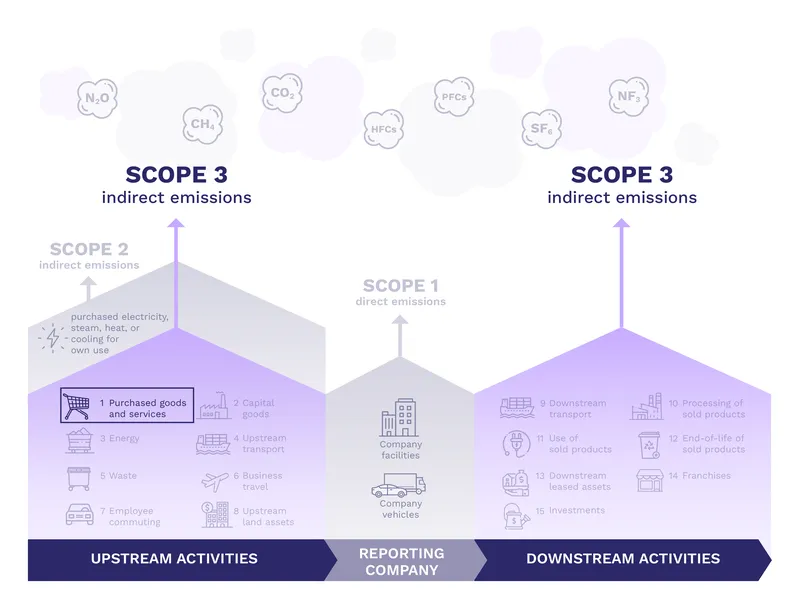
What is included?
The Greenhouse Gas Protocol defines category 1 as emissions generated by producing the products the reporting company bought or acquired by in the reporting year. Products include both goods (tangible products) and services (intangible products).
Examples
- Production-related products including materials, fresh ingredients, components and parts
- Non-production-related products including office furniture, office supplies and Personal Protective Equipment (PPE)
- Services including accounting services, cloud storage and IT support.
What is excluded?
- Capital goods (Category 2)
- Fuel and energy-related activities (Category 3)
- Electricity (Scope 2)
Who is the category most relevant to?
- Manufacturing
- Professional services
- Food & beverage
- Retail
- Government
- Healthcare
- Chemicals industry
Where can I find the data I need?
| Data source | Accuracy | Typical use |
|---|---|---|
Supplier-specific data |
Highest | Selected, high volume purchases |
Environmental product declaration (supplier specific) |
Highest | Selected, high volume purchases |
Product carbon footprint (generic) |
High | Individual products |
Life Cycle Assessment (generic) |
High | Individual products |
Industry-average emission factors per material |
Medium | Product categories |
Spend-based emission factors |
Low | Screening |
When can I use spend-based emission factors?
If supplier-specific data is unavailable, spend-based emission factors provide a practical way to estimate category 1 emissions using procurement data.
Common challenges - and how to overcome them
| Challenge | Practical advice |
|---|---|
| Thousands of suppliers | Start with your highest-spend suppliers and focus on the purchases that are likely to have the greatest emissions impact. |
| Limited supplier data | Use spend-based or industry-average emission factors to establish a baseline, then progressively replace these with supplier-specific data. |
| Long global supply chains | Prioritise the parts of the supply chain that are most material to your business. |
| Inconsistent procurement categories | Group purchases into meaningful categories and align procurement data with your emissions calculation approach. |
| Balancing accuracy with practicality | Start with the best available data, then improve data quality over time by collecting supplier-specific information, Product Carbon Footprints, LCAs or EPDs for your most material purchases. |
Five steps to get started
- Review procurement spend
- Identify high-value purchasing categories
- Estimate emissions using spend-based factors
- Replace estimates with supplier-specific data where available
- Identify “hotspots” (your largest emissions sources) as your biggest opportunities for reductions
Tips to improve data quality and reduce emissions
Once you have established a baseline, focus on improving both the quality of your data and the opportunities to reduce emissions.
- Improve data quality with supplier-specific information
- Prioritise engagement with your highest-impact suppliers
- Select lower-carbon products and materials
- Increase recycled content where appropriate
- Optimise product and packaging design
- Include carbon in your responsible procurement guidelines
Last updated July 2026
Need help with Category 1?

Nicky Andrews is a corporate sustainability expert with a focus on carbon reporting and climate. She helps clients to understand and manage their carbon impact across the whole value chain. This includes preparing carbon footprints, setting emissions reduction targets, and identifying lower carbon alternatives.
You may also be interested in
Scope 3 Need to Know
Our Need to Know guides give you short summaries of sustainability topics in an easy to share PDF. Learn the basics of Scope 3 emissions.

Case study
Moose Toys wanted to strengthen its sustainability strategy with a transparent, validated science-based target.

Our Scope 3 services
If you're ready to take action on your Scope 3 emissions, we're ready to work with you to make real changes.