
Scope 3: Category 2 – Capital goods
What is included, how to calculate emissions, common challenges and solutions, where to find data and practical ways to reduce them.
This guide explains scope 3, category 2: capital goods. It covers what to include, how to calculate emissions, where to find data, common challenges and practical ways to reduce emissions.
Capital goods at a glance:
- Greenhouse Gas Protocol: Category 2 - capital goods
- ISO 14064-1:2019: Category 6 - Indirect GHG emissions from other sources
- Covers buildings, equipment, machinery and vehicles
- Usually material when organisations invest in new assets
- Emissions are reported in the year of purchase
See all 15 Categories
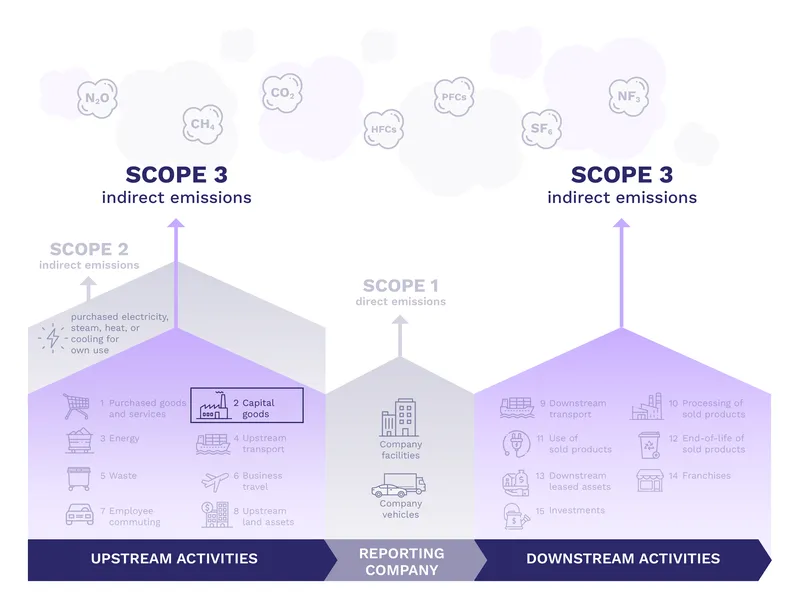
Capital goods are reported in the year of purchase
Unlike financial accounting, scope 3 emissions from capital goods are not depreciated over the life of the asset. The full cradle-to-gate emissions (=upfront embodied carbon) are reported in the year the capital good is purchased.
It's important to remember that a high category 2 footprint is not necessarily a bad outcome. Investing in newer, more efficient equipment can increase emissions in the year of purchase while reducing operational emissions for many years afterwards.
Capital goods include
- Manufacturing equipment
- Production machinery
- Buildings and facilities
- Forklifts
- Vehicles
- IT servers
What is not included?
This category only includes emissions that occur from making the goods – not those from using them.
- Operating the equipment (scope 1 or scope 2)
- Maintenance services (usually category 1)
- Fuel used by vehicles (scope 1)
- Electricity consumed during operation (scope 2)
Who is this scope 3 category most relevant to?
For most businesses, capital goods don’t make up a huge percentage of emissions on a regular basis. If you set up a new factory or business though, you need to look not only at how efficient your equipment or fleet is but also at what went into making it.
Can Capital Goods emissions be depreciated?
No. While in financial accounting capital goods are typically depreciated over the life of the asset, this is not the case when accounting for scope 3 emissions. You have to account for the total cradle-to-gate emissions of your capital goods in the year you buy them. As these investments won’t happen every year your, scope 3 emissions from capital goods may fluctuate significantly from year to year.
Where can I find the data I need?
| Data source | Accuracy | Typical use |
|---|---|---|
Supplier-specific data |
Highest | Selected, high volume purchases |
Environmental product declaration (supplier specific) |
Highest | Construction materials |
Product carbon footprint (generic) |
High | Equipment |
Life Cycle Assessment (generic) |
High | Individual products |
Industry-average emission factors per material |
Medium | Product categories |
Spend-based emission factors |
Low | Screening |
What are the challenges?
| Challenge | Practical advice |
|---|---|
| Limited supplier data | Begin with spend-based estimates and improve over time. |
| Large one-off purchases | Explain significant year-to-year changes in your reporting. Highlight future savings when upgrading equipment. |
| Comparing suppliers | Request Product Carbon Footprints or Environmental Product Declarations during procurement. |
| Balancing cost and emissions |
Tips to improve data quality and reduce emissions
- Start early and try to include emissions in your capital planning process.
- Include embodied carbon in procurement decisions.
- Request Product Carbon Footprints or EPDs from suppliers.
- Specify lower-carbon materials where practical.
- Consider refurbished or remanufactured equipment.
- Extend asset life through maintenance and upgrades.
- Include carbon performance in capital investment decisions.
- Apply an internal carbon price when comparing investment options.
Last updated July 2026
Previous or next category
← 1. Purchased goods and services 3. Fuel- and energy-related activities→
Need help with category 2?

Katharina Bauch is Head of Carbon with a focus on carbon reporting. She also has a background in Life Cycle Assessment and helps clients to understand and manage their carbon impact across the whole value chain. This includes preparing carbon footprints, setting emissions reduction targets, and identifying lower carbon alternatives.
Frequently asked questions
You may also be interested in
Scope 3 Need to Know
Our Need to Know guides give you short summaries of sustainability topics in an easy to share PDF. Learn the basics of Scope 3 emissions.

Our Scope 3 services
If you're ready to take action on your Scope 3 emissions, we're ready to work with you to make real changes.
Our EPD services
Environmental Product Declarations (EPDs) support procurement requirements, Green Star and Infrastructure Sustainability (IS) Rating projects.