
Scope 3: Category 4 – Upstream transport
What is included, how to calculate emissions, common challenges and solutions, where to find data and practical ways to reduce them.
This guide explains scope 3, category 4: upstream transportation and distribution. It covers what to include, how to calculate emissions, where to find data, common challenges and practical ways to reduce emissions.
Upstream Transport and Distribution at a glance:
- Greenhouse Gas Protocol: Category 4 - Upstream Transportation and Distribution
- ISO 14064-1:2019: Category 3 - Indirect GHG emissions from transportation
- Covers transporting and storing purchased goods before they reach your organisation
- Most significant for organisations with complex supply chains
- Includes transport provided by third parties, not your own vehicles
See all 15 Categories
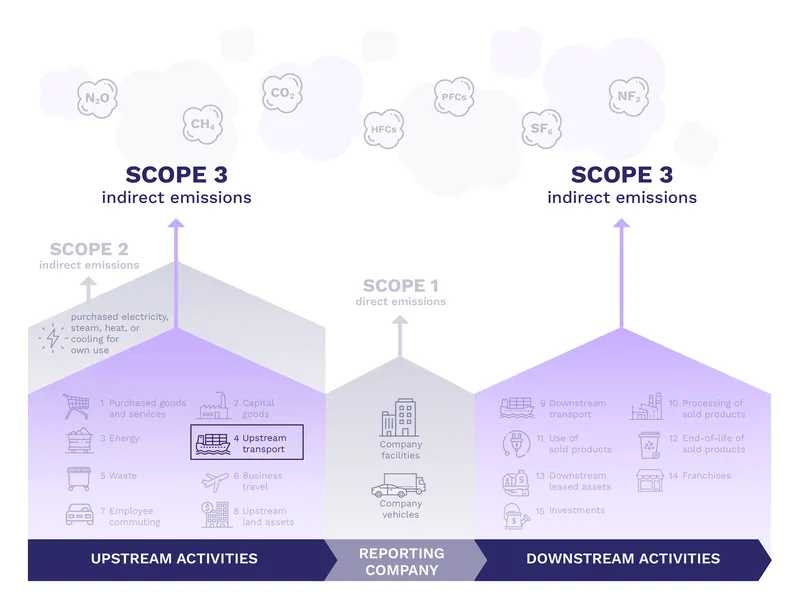
Didn't I already include transport emissions somewhere else?
Not always. It depends on who owns the goods, who owns the vehicles and where the transport occurs in the value chain.
You already cover transport in your own vehicles in scope 1 (fuel) or scope 2 (electricity) and transport before your tier 1 suppliers in category 1 - purchased goods and services.
What is included?
All third-party Transport and distribution services used by your organisation, including
- Purchased goods from your tier 1 supplier to your site
- Inbound logistics of the material
- Movement of material and products between your organisation’s own facilities, if you don't own the vehicle
- Storing purchased products in warehouses, distribution centres, and retail facilities.
Emissions in this category can stem from:
- Air transport
- Rail transport
- Road transport
- Marine transport
| Transport and distribution activity in the value chain | Scope and category of emissions |
|---|---|
| Transport and distribution in vehicles and facilities owned or controlled by your organisation | Scope 1 (for fuel use) or scope 2 (for electricity use) |
| Transport and distribution in vehicles and facilities leased by and operated by your organisation (and not already included in scope 1 or scope 2) | Scope 3, category 8 (Upstream leased assets) |
| Transport and distribution of bought products, upstream of your organisation’s tier 1 suppliers (e.g., transport between a company’s tier 2 and tier 1 suppliers) | Scope 3, category 1 (Purchased goods and services) as emissions from transport are already included in the cradle-to-gate emissions of your purchased products. You don’t need to report these emissions separately from category 1. |
| Producing vehicles (e.g., ships, trucks, planes) bought or acquired by your organisation | Account for the upstream (i.e., cradle-to-gate) emissions associated with manufacturing vehicles in scope 3, category 2 (Capital goods) |
| Transporting fuels and energy used by your company | Scope 3, category 3 (Fuel- and energy-related emissions not included in scope 1 or scope 2) |
| Transport and distribution of products bought by your organisation between your tier 1 suppliers and your own operations (in vehicles and facilities not owned or controlled by your organisation) | Scope 3, category 4 (Upstream transportation and distribution) |
| Transport and distribution services bought by your organisation, including inbound logistics, outbound logistics (e.g., of sold products), and Transport and distribution between your organisation’s own facilities (in vehicles and facilities not owned or controlled by your organisation. ) | Scope 3, category 4 (Upstream transportation and distribution) |
| Transport and distribution of products sold by your organisation between your operations and the end consumer (if not paid for by you), including retail and storage (in vehicles and facilities not owned or controlled by you.) | Scope 3, category 9 (Downstream transport and distribution) |
(Table based on GHG Protocol Technical Guidance for Scope 3 Emissions)
Who is this scope 3 category most relevant to?
Category 4 emissions can add up to 12% of the total emissions for the industrial goods and services industry and 6% for food and beverage manufacturers. It is also relevant for retail.
How can I calculate emissions from transport?
| Method | Use case | Accuracy |
|---|---|---|
Fuel-based |
Fuel consumption data is available | Best |
Distance-based |
Shipment weights and distances known | High |
Spend-based |
Limited transport data available | Low |
Five steps to get started
- Identify your inbound transport providers.
- Gather shipment or freight data.
- Select the most appropriate calculation method.
- Identify transport hotspots.
- Prioritise opportunities to reduce emissions.
Tips to improve data quality and reduce emissions
- Collect shipment-level data from freight providers
- Switch from air freight to sea or rail where practical
- Source products closer to your operations
- Consolidate shipments to improve vehicle utilisation
- Work with logistics providers that are reducing emissions
- Request carrier-specific emissions data where available
Last updated July 2026
Previous or next category
Need help with category 4?

Katharina Bauch is Head of Carbon with a focus on carbon reporting. She also has a background in Life Cycle Assessment and helps clients to understand and manage their carbon impact across the whole value chain. This includes preparing carbon footprints, setting emissions reduction targets, and identifying lower carbon alternatives.
You may also be interested in
Scope 3 Need to Know
Our Need to Know guides give you short summaries of sustainability topics in an easy to share PDF. Learn the basics of Scope 3 emissions.
Our Scope 3 Explorer
Our free online assessment can show which Scope 3 categories are most relevant to your business.
Our Scope 3 services
If you're ready to take action on your Scope 3 emissions, we're ready to work with you to make real changes.