
Our circular economy team are experts in the field. Here Dr Jim Goddin and Sally-Anne Kasner share their tips for businesses starting out in circular economy. They also explain some of their latest work and how circular thinking can make your home more sustainable too.
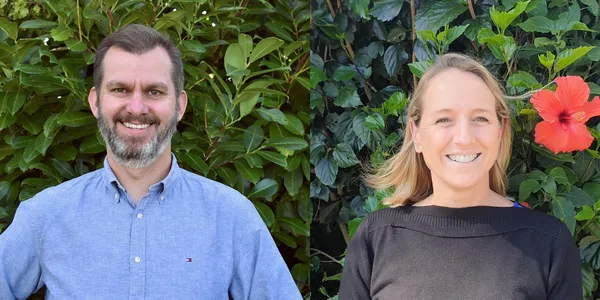
Dr Jim Goddin and Sally Anne Kasner
What are your tips for getting started with circular economy?
Sally recommends:
- Measure your baselines. ‘Map your business: measure how you currently use energy (electricity or process heat) and water (potable and waste) and the solid waste you create (including what you recycle and on-sell).’
- Connect your baselines to what you do. ‘Think about your measures in terms of each product you make or service you offer. For example, if you’re an office-based service, think about the measure per staff member. You can then focus on minimising the energy and water you use, which will reduce your impacts on the environment and help you save money.
Jim recommends:
- Start with a plan. ‘You can’t do everything at once and you shouldn’t try to. Take the time to read how CE ideas can apply to your business (check out our Need to Know!) and see what tools are available.’
- A small step in the right direction is good. ‘Each change to make your business more circular will reduce your risks and make your supply chain more secure.’
What’s a circular economy project you’re particularly proud of?
Sally contributed a chapter to ACE Hub’s 2022 report The State of Circularity. ‘My chapter explored how businesses and societies can keep value circulating by using circular systems. It was exciting to see the report launched at the inaugural Circularity Conference in Sydney in October 2022.'
Jim helped draft the UK’s Critical Minerals Strategy. ‘The UK is investigating how to recover rare earth elements used in electric vehicles and wind turbines when they reach their end of life. Reducing supply risks for these materials is an important part of the circular economy which we’re likely to see more of.’
What do you do to go circular at home?
Sally knows that systems thinking applies at home too. ‘Our family find ways to design out waste,’ she says. ‘We use solid shampoo and conditioner bars, and resealable containers and beeswax sandwich wraps. We also compost our organic waste so none of it goes to landfill.’
Jim thinks about circularity when shopping with his family. ‘We're careful what we buy. We look for products that last or that we can repair easily. And we're big fans of reusable packaging,’ he adds.
3 May 2023