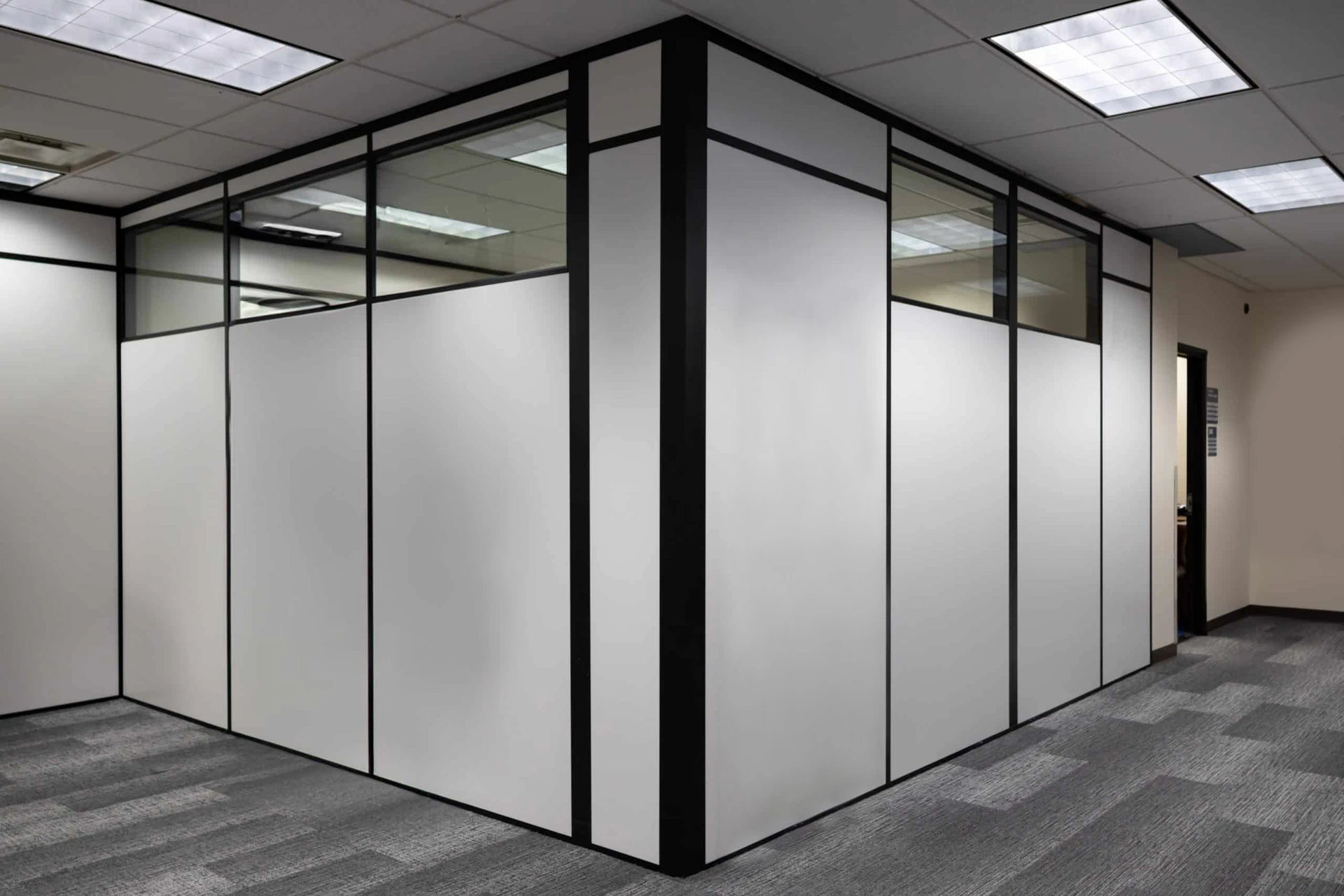
Office Partitions Ltd is a fictional company that provides gypsum partition walls for leased office spaces. We created this example case study to show how to use MCI Pro step by step. All graphics are direct outputs from the MCI Tool.
Like many fit-out businesses, Office Partitions Ltd faced a familiar challenge: when tenants moved out, partition systems were usually demolished and sent to landfill as mixed material waste. Some construction scrap was recovered for recycling, but most material still ended up in skips.
When a building manager asked Office Partitions Ltd to show how it could support circular procurement, the business needed a clear, evidence-based answer. The manager had set a clear expectation: any proposed system needed to reach at least 50% circularity.
Using MCI Pro, Office Partitions Ltd assessed its current partition system, identified the biggest circularity gaps and tested improvement options.
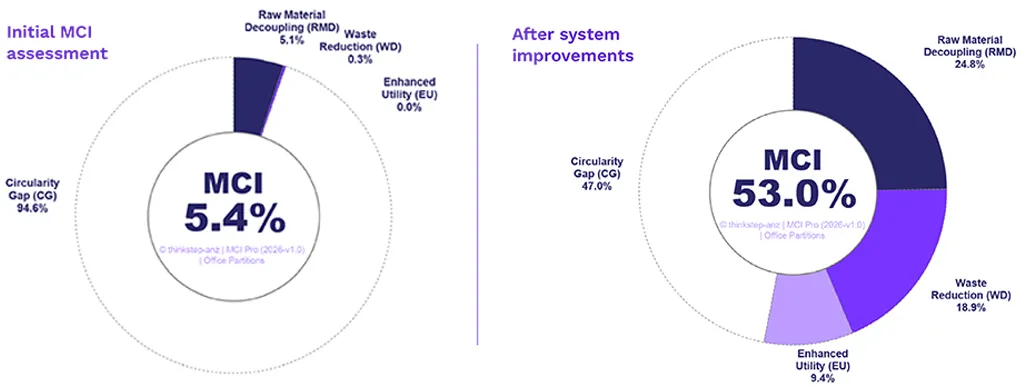
The result: a practical pathway from 5.4% circularity to 53% circularity - enough to meet the building manager’s minimum threshold of 50%.
Step 1: define the product system
The first step was to define what was being assessed: a gypsum partition wall system used in leased office fit-outs.
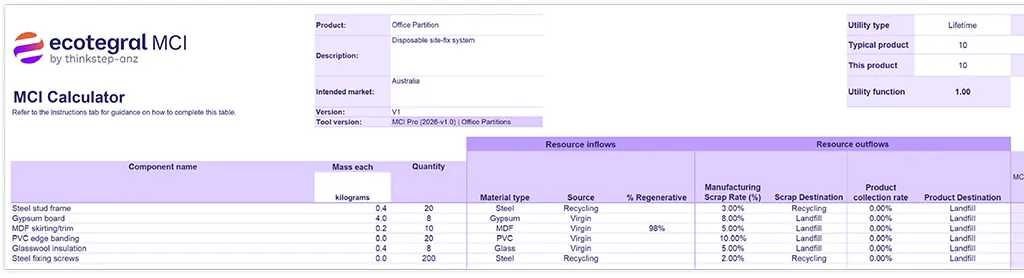
The assessment included the main materials used in the partition system, including gypsum board, steel stud framing, steel fixing screws, glasswool, MDF skirting and PVC components. This gave the business a structured bill of materials to work from.
The team entered the materials used in the partition system, creating a clear bill of materials for the assessment.
Step 2: enter material input data
Next, Office Partitions Ltd entered data on where materials came from, including virgin, recycled, reused or renewable content.
This step showed that some materials were already contributing to circularity. For example, the steel stud frame and steel fixing screws had some circularity because of recycled content and scrap recycling during construction. The MDF skirting and trim performed better because it used FSC-certified timber.
Gypsum board, however, had 0% circularity in the starting assessment. This made it an obvious improvement opportunity.
Step 3: enter end-of-life data
The team then entered data on what happens to the partition materials after use.
This was where the current system performed poorly. When tenants left an office, the partition system was usually demolished and sent to landfill as mixed material waste. Some scrap from on-site construction was recovered, but end-of-life recovery was limited.
Step 4: calculate the starting MCI score
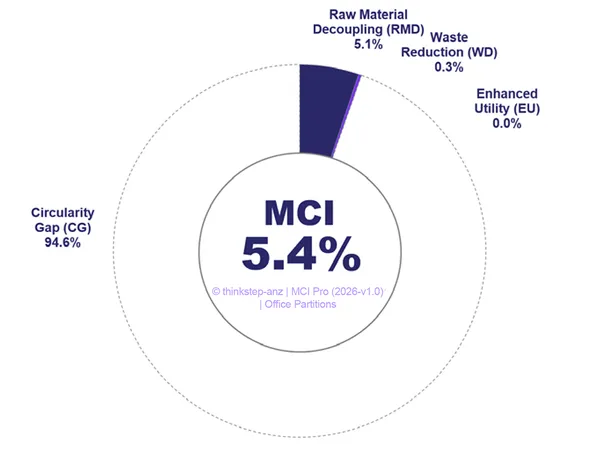
MCI Pro calculated the starting circularity score for the partition system: 5.4% circular.
This gave Office Partitions Ltd a clear baseline. It also made the challenge visible. The building manager would not consider a solution below 50%, so the existing system was well short of the procurement requirement.
Step 5: identify circularity hotspots by mass carbon and cost
The hotspot analysis showed that the biggest opportunities were not spread evenly across the system.
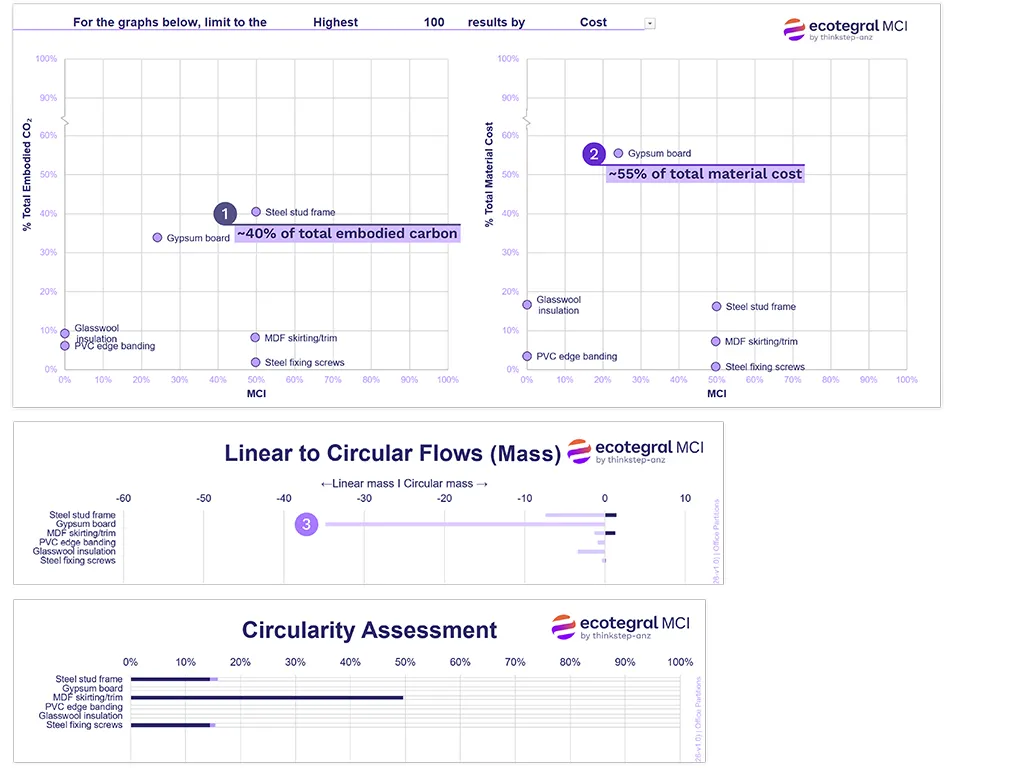
Gypsum board and the steel stud frame each represented around 40% of the embodied carbon (1) of the materials used. Gypsum board also represented around 55% of material costs (2), making it both a circularity issue and a commercial opportunity.
The mass analysis (3) told an even clearer story. Gypsum board represented the biggest portion of the linear mass flow, with steel stud framing a distant second. This meant that improving gypsum board would have a large impact on the overall circularity of the system.
Step 6: use the user influence chart to test improvement levers
The user influence chart showed that end-of-life recovery could have a major impact, potentially lifting circularity by as much as 50% (1). It also showed that extending the product life from ten years to 15 years could add another 15–25% (2).
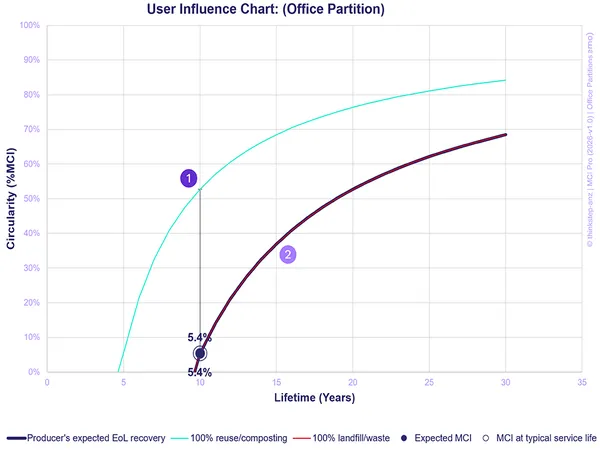
This was important because it gave the company options. It did not have to rely on one major redesign. It could combine material sourcing, recovery systems and product-life decisions to reach the target.
MCI Pro is designed for this type of decision-making.
It lets users enter bill of materials, end-of-life data and utility data, then visualise the score, hotspots and improvement levers. The Pro version also includes decision-grade results, custom materials, a larger bill of materials capacity, recycling losses data, full MCI variables, a user influence chart, MCI score graphic and declaration outputs.
Step 7: build the improvement scenario
Office Partitions Ltd used the MCI Pro results to prioritise changes that were practical, targeted and likely to make the biggest difference.
1. Tackle gypsum board first
Gypsum board was the largest material by mass, had 0% circularity and was a major cost and carbon hotspot. The company identified two changes:
- switch to gypsum board with 50% recycled content
- add a gypsum-specific skip to lift collection from 0% to 60%, once unavoidable losses were accounted for.
This was the most important intervention because gypsum board dominated the system’s linear material flow.
2. Improve recovery of steel studs
The steel studs already contained recycled content, so the team focused on end-of-life recovery. A dedicated metal skip and basic staff training could lift the collection rate to 70%.
3. Change glasswool supplier
The company found glasswool products with recycled content that offered the same performance with little or no price premium. One supplier also offered a take-back scheme, improving the end-of-life outcome for the material.
4. Leave smaller or already circular components for later
The team decided not to focus immediately on MDF and PVC. MDF was already the most circular component in the system, while PVC represented a small material volume. These materials were noted as future improvement opportunities, especially if the building manager later raised the circularity target to 60%.
5. Extend the replacement cycle
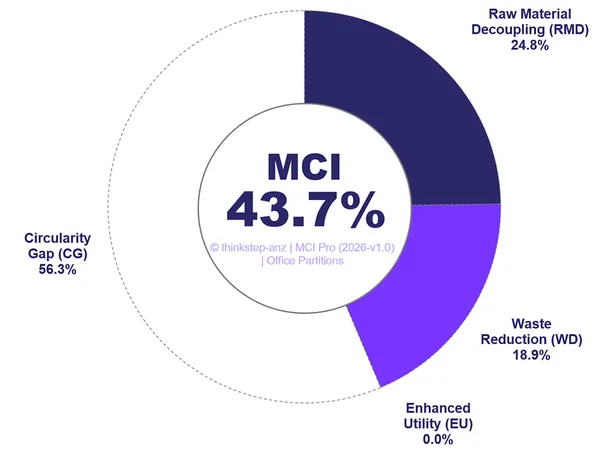
After the material and recovery changes, the system reached 43.7% circularity. This was a major improvement, but still below the 50% threshold.
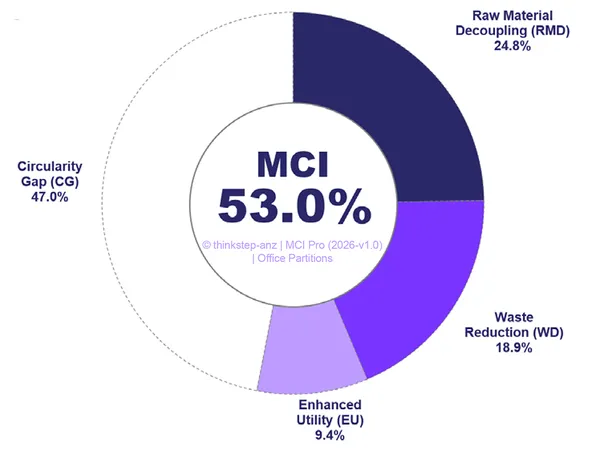
MCI Pro helped the team see that only a small change to product life was needed. By extending the replacement cycle from ten years to 12 years, Office Partitions Ltd lifted the MCI score to 53% circularity.
Step 8: review the improved result
The first improvement scenario lifted the score from 5.4% to 43.7% circularity. This was a significant improvement, but still below the building manager’s 50% threshold.
MCI Pro helped the team see that the remaining gap could be closed by extending the replacement cycle. When Office Partitions Ltd and the building manager agreed to move from a ten-year replacement cycle to a 12-year cycle, the score increased to 53% circularity.
1. Initial MCI
2. First improvements
3. Final system improvements
The result
Using MCI Pro, Office Partitions Ltd moved from a low-circularity, disposal-heavy system to a practical circular fit-out offer that met the building manager’s procurement requirement.
The final pathway combined:
- recycled-content gypsum board
- separate gypsum and metal skips
- better end-of-life recovery
- recycled-content glasswool
- supplier take-back
- a modest extension to the replacement cycle
Together, these changes lifted the system from 5.4% to 53% circularity.