
What you Need to Know about green finance
We've packaged all the information on this page into one easy PDF.
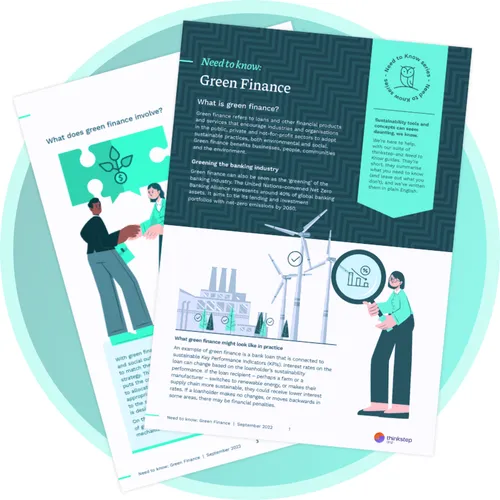
What is green finance?
Green finance refers to loans and other financial products and services that encourage industries and organisations in the public, private and not-for-profit sectors to adopt sustainable practices, both environmental and social. Green finance benefits businesses, people, communities and the environment.
Like to learn more? Get in touch with our Green Finance expert
Greening the banking industry
Green finance can also be seen as the ‘greening’ of the banking industry. The United Nations-convened Net Zero Banking Alliance represents around 40% of global banking assets. It aims to tie its lending and investment portfolios with net-zero emissions by 2050.
What green finance might look like in practice
An example of green finance is a bank loan that is connected to sustainable Key Performance Indicators (KPIs). Interest rates on the loan can change based on the loanholder’s sustainability performance. If the loan recipient – perhaps a farm or a manufacturer – switches to renewable energy, or makes their supply chain more sustainable, they could receive lower interest rates. If a loanholder makes no changes, or moves backwards in some areas, there may be financial penalties.
How do businesses benefit from using green finance?
Receive better finance terms
You could get better rates by doing good for the world, helping with your financial bottom line. Access to sustainable finance is available to organisations with a well-developed sustainability strategy. This could reward or reinforce positive work you’ve already undertaken.
Boost your triple bottom line
Green finance can help your organisation work towards the UN Sustainable Development Goals (SDGs) – a wideranging set of interconnected environmental and social goals. For example, the SDGs can help you take climate action, protect biodiversity, encourage regenerative agriculture, and promote wellbeing.
Show your sustainability credentials to customers
Showing that you care about sustainability – and are putting your money on the line – can be a powerful tool for communicating with stakeholders. Consumers are expecting sustainability improvements from producers and manufacturers. This is in turn driving banks’ investment and lending practices, creating a positive feedback loop of sustainability improvements.
Improve your reporting and strategy
Sustainability-linked loans may have longer terms (e.g. three, five or ten years) than standard loans. This encourages you to consider your finances alongside your longer-term sustainability strategies and projects. It supports impact reporting and annual performance measures that look towards future targets – rather than just the typically retrospective view of performance.
Influence industry-wide changes
Green finance and other initiatives in the finance sector have the potential for wide-spread improvements in many other sectors. A major company funded with sustainability-linked finance can encourage large positive outcomes for entire sectors, such as tourism or hospitality.

thinkstep-anz Need to Know series
This page is part of a series that simplifies sustainability topics. Explore the rest of our series.
What does green finance involve?
With green finance, the environmental and social outcomes of the finance need to match the borrower’s sustainability strategy. This ensures the borrower puts the correct governance in place to allocate and manage the funds appropriately and in a way that will lead to the sustainable outcomes the finance is designed to achieve. Here are some are examples of governance and commercial mechanisms that support green finance.
Sustainability Performance Targets (SPTs)
The borrower and lender together decide which areas of sustainable business performance the finance will focus on and develop Sustainability Performance Targets. The targets need to be ambitious and comparable to international, national or industry best practice. They also need to set a baseline from which to measure changes.
Key Performance Indicators (KPIs)
Establishing Key Performance Indicators is another important step. The metrics of the KPIs need to match those of the SPTs to accurately measure the impacts of using the finance.
Reporting and review
Reporting and reviewing the sustainable finance must be robust and transparent. This is usually done annually by an independent third party. They verify to the lender that the borrower has achieved either milestone targets or is on track to achieve the required outcomes of the entire loan facility.
Loan adjustments
After each review, the interest rate or terms of the loan may be adjusted to reflect the borrower’s performance.
What are some examples of green finance?
Commercial lending
Bank of New Zealand issued a $50 million sustainability-linked loan to a dairy producer in 2021. The producer will receive financial incentives for meeting new water quality and biodiversity targets.
Bonds
National Australia Bank has been issuing green bonds since 2014. These bonds fund projects like renewable energy. They are similar to other bonds but give investors the choice to invest in sustainability-focused projects.
Financing for businesses
New Zealand Green Investment Finance is a bank formed by the government of Aotearoa New Zealand in 2019 to fund sustainability projects. Measurable reductions in electricity use or carbon emissions are required.
Mortgages
Australia’s Commonwealth Bank offers lower mortgage rates for customers who buy, build or renovate a property to make it more sustainable and energy-efficient.
Personal lending
Banks and finance companies offer low-interest loans for household improvements like installing solar panels.
You may also be interested in...

We held a green finance webinar with Sudima Hotel / Hind Management. We discussed their sustainability-linked loan and gave a background to green finance.
Talk with a green finance expert

Martin Fryer
Head of Strategy & Disclosures
Our Head of Strategy & Impact NZ, Martin Fryer, is an experienced business strategist and expert in sustainable finance. He can help guide you through the process and advise you on best options. Get in touch with Martin to discuss how green finance can help your business.