
What you Need to Know about materiality assessment
We've packaged all the information on this page into one easy PDF.
What is materiality?
Materiality means what matters to an organisation. It covers the environmental, social and economic topics your organisation needs to focus on to become more sustainable.
What is a materiality assessment?
A materiality assessment helps your organisation identify and prioritise your sustainability topics.
In the process you engage with stakeholders such as your customers, investors, suppliers, partners, employees and local community, plus your senior team, to find and rank the subjects or areas that they consider important to your organisation. This allows you to focus your strategy on the most relevant topics and have the greatest impact.
Like to learn more? Get in touch with our materiality assessment expert
Why do a materiality assessment?
A materiality assessment helps you identify and prioritise the topics (both risks and opportunities) that add greatest value to your organisation. It also helps you engage your stakeholders, both internal and external, in your work.
| Business opportunities | Business results |
|---|---|
|
|
How do I do a materiality assessment?
Step 1: Define your strategic objectives and what you want to find out in your materiality assessment. Do you need it internally, as part of your external reporting or to inform your strategy?
Step 2: Decide which stakeholders to engage with (both internal and external). Run interviews, focus groups or surveys with them to understand what they think you should be working on. Engaging a third party to carry out this research may help you gain the most useful, candid feedback.
Step 3: Review the results. Your senior team will usually do this in a ‘business impact workshop’.
Step 4: Rank the topics on a materiality matrix (below).
Step 5: Focus on topics in the top right corner. These are the ones your internal and external stakeholders rate most highly.

thinkstep-anz Need to Know series
This page is part of a series that simplifies sustainability topics. Explore the rest of our series.
What is a materiality matrix?
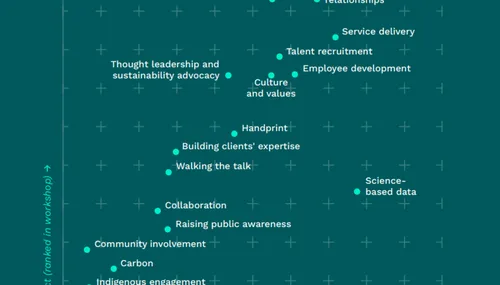
A materiality matrix is a graph that shows the results of a materiality assessment. ‘Business impact’ is measured on one axis and ‘stakeholder importance’ on the other.
All topics on your matrix are important to your organisation. Presenting them in a matrix helps the people responsible for managing the topics to visualise them and understand how they link together.
The position on a matrix does not reflect how well your organisation handles that topic. For example, you may already excel at community engagement and want to continue to make this your focus in coming years.
The example matrix below shows that ‘client relationships’ and ‘service delivery’ are important topics to our stakeholders and our business. While ‘waste and circular economy’ is important to us too, it ranks less highly.
What else do I need to know?
Reassess over time
What’s materially important to your business or your stakeholders will change over time. It’s a good idea to reassess your topics now and then – as you would any other strategic work. We recommend you review your assessment at least every three years or if something major changes (e.g. you invest in a new product).
It could reveal some surprises!
Though you might think you know what your stakeholders and leadership consider important, this is a great process to flag unexpected topics or changes in thinking.
Find the sweet spots
Don’t look at your topics in isolation. Instead, look for areas of overlap and opportunities to work on several topics at the same time. For example, if ‘customer service’ and ‘innovation’ are both material to you, tackle these topics together. It’s more efficient, improves results and encourages collaboration.
Understand your sustainability topics in a wider context
Review your materiality assessment against the UN Sustainable Development Goals (SDGs). These 17 goals form an interlinking framework to achieve peace, prosperity and a sustainable future. Mapping your materiality topics to the SDGs will give you a global context to set and report on your sustainability strategy.
Comply with reporting and listing requirements
Some reporting frameworks such as GRI and Integrated Reporting <IR> require a materiality assessment and have their own definitions. These frameworks particularly focus on how organisations create value. Companies listed on the ASX and NZX exchanges also need to report on non-financial material topics such as environmental, social and governance (ESG) factors.
What is double materiality?
No organisation exists in isolation. It is part of an industry, community and eco-system. Double materiality encourages your organisation look ‘in both directions’:
- How your operations affect people and the environment
- How the changing environment and changing social opinions affect your organisation.
It pushes you to report on topics that may not be financially material but are relevant in other ways.
Talk with our materiality expert

Nicole Sullivan can help your business with a materiality assessment, sustainability strategy, green building and much more. Get in touch with her to discuss how you can take the next steps.