
What you need to know about modern slavery
We've packaged all the information on this page into one easy PDF.
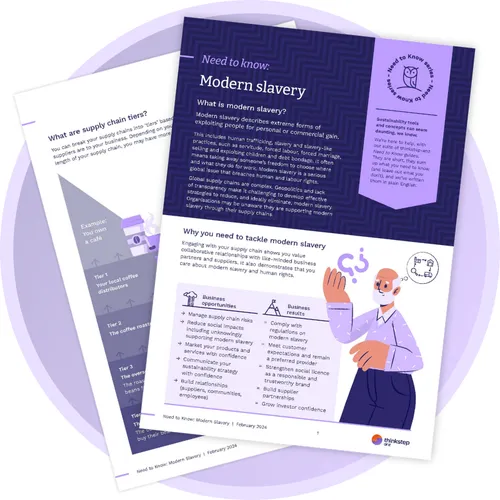
What is modern slavery?
Modern slavery describes extreme forms of exploiting people for personal or commercial gain.
This includes human trafficking, slavery and slavery-like practices, such as servitude, forced labour, forced marriage, selling and exploiting children and debt bondage. It often means taking away someone’s freedom to choose where and what they do for work. Modern slavery is a serious global issue that breaches human and labour rights.
Global supply chains are complex. Geopolitics, climate pressures, labour shortages and lack of transparency make it challenging to identify, manage and reduce modern slavery risks. Organisations may be unaware they are supporting modern slavery through their supply chains.
Like to learn more? Get in touch with our modern slavery expert
Why you need to tackle modern slavery
Engaging with your supply chain shows you value collaborative relationships with like-minded business partners and suppliers. It also demonstrates that you care about modern slavery and human rights.
| Business opportunities | Business results |
|---|---|
|
= Comply with regulations on modern slavery = Meet customer expectations and remain a preferred provider = Strengthen social licence as a responsible and trustworthy brand = Build supplier partnerships = Grow investor confidence |
What is modern slavery?
Modern slavery takes many forms. The most relevant forms for businesses are:
Human trafficking
Using violence, threats or coercion to transport, recruit or harbour people and then exploit them through forced labour, criminal activities, sexual exploitation, forced marriage or removing organs.
Forced labour
Making people work against their will, usually through threats, coercion, deception or abuse of power.
Debt bondage/ bonded labour
Forcing people who have borrowed money to work to pay off the debt with no control over their work conditions or the debt.
Child labour/slavery
Exploiting a child for someone else’s gain. This can include child trafficking and domestic slavery.
How big is the problem?
While most of us like to believe that slavery has long been outlawed, according to the latest Global Estimates of Modern Slavery (2023) from Walk Free, the International Labour Organization and the International Organization for Migration, on any given day in 2021:

50 million people live in modern slavery; 28 million of those in forced labour and/or 22 million in forced marriage.

Roughly a quarter of all victims of modern slavery are children.

Migrant workers are more than three times as likely to be in forced labour as non-migrant workers.
Modern slavery occurs in every region and in countries at every income level. The 2023 Global Slavery Index estimates that modern slavery affected around 8,000 people in Aotearoa New Zealand and 41,000 people in Australia.
Source: Global Estimates of Modern Slavery, September 2022; Global Slavery Index, 2023
How is legislation tackling modern slavery?
Australia
Australia’s Modern Slavery Act 2018 requires large businesses and other entities operating in Australia to report on modern slavery risks in their operations and supply chains, and the actions they are taking to assess and address those risks.
The Act applies to entities with annual consolidated revenue of at least A$100 million. Statements are published on Australia’s public Modern Slavery Statements Register.
Australia is reviewing how to strengthen the Act, including possible penalties, due diligence requirements and stronger reporting criteria. Australia also has an independent Anti-Slavery Commissioner.

Aotearoa New Zealand
Slavery, people trafficking and forced labour are unlawful in New Zealand.
New Zealand does not yet have a modern slavery reporting Act. However, a Modern Slavery Bill is before Parliament. If passed, it would require large New Zealand entities and overseas companies carrying on business in New Zealand to publish annual modern slavery statements.
The proposed threshold is more than NZ$100 million in consolidated revenue. The Bill also proposes penalties for some reporting failures.

International markets
Modern slavery laws are moving beyond voluntary action and reporting. The EU has introduced human rights and environmental due diligence rules for some large companies. It has also adopted a forced labour regulation that will ban products made with forced labour from the EU market from December 2027.
Other markets, including Canada and the United States, also have laws targeting forced labour in supply chains and imports.
thinkstep-anz Need to Know series
This page is part of a series that simplifies sustainability topics. Explore the rest of our series.
Which products have the highest risks of modern slavery?
Electronics
Electronics are the highest-value at-risk imports. Risks can occur in mineral extraction, component manufacturing and assembly, including through forced labour, debt bondage and state-imposed forced labour.
Garments and textiles
Fast fashion and pressure for low prices can push risks down the supply chain. Workers may face excessive hours, unsafe conditions, withheld wages, recruitment fees or limits on changing jobs.
Agriculture and fishing
Palm oil, cotton, cocoa, coffee, sugarcane, cattle and fish are often linked to human rights risks. Forced labour is also a serious issue in parts of the fishing sector, where work can be isolated and hard to monitor.
Mining
Mining can involve forced labour, child labour and unsafe work. Risks are higher for gold, coal, diamonds, conflict minerals and critical raw materials used in electronics, batteries and renewable energy.
Renewable energy
All products and services that use renewable energy can be high-risk too. Read more below.
Where does modern slavery hide in the supply chain?
Modern slavery can happen in Australia and Aotearoa New Zealand, especially where workers are isolated, dependent on employers or labour-hire providers, or afraid to speak up. However, many risks sit further down global supply chains.
Producing goods – from sourcing raw materials to manufacturing, packaging and transporting products – creates complex supply chains. Risks are often hidden in lower tiers, where visibility is low and workers have less power.
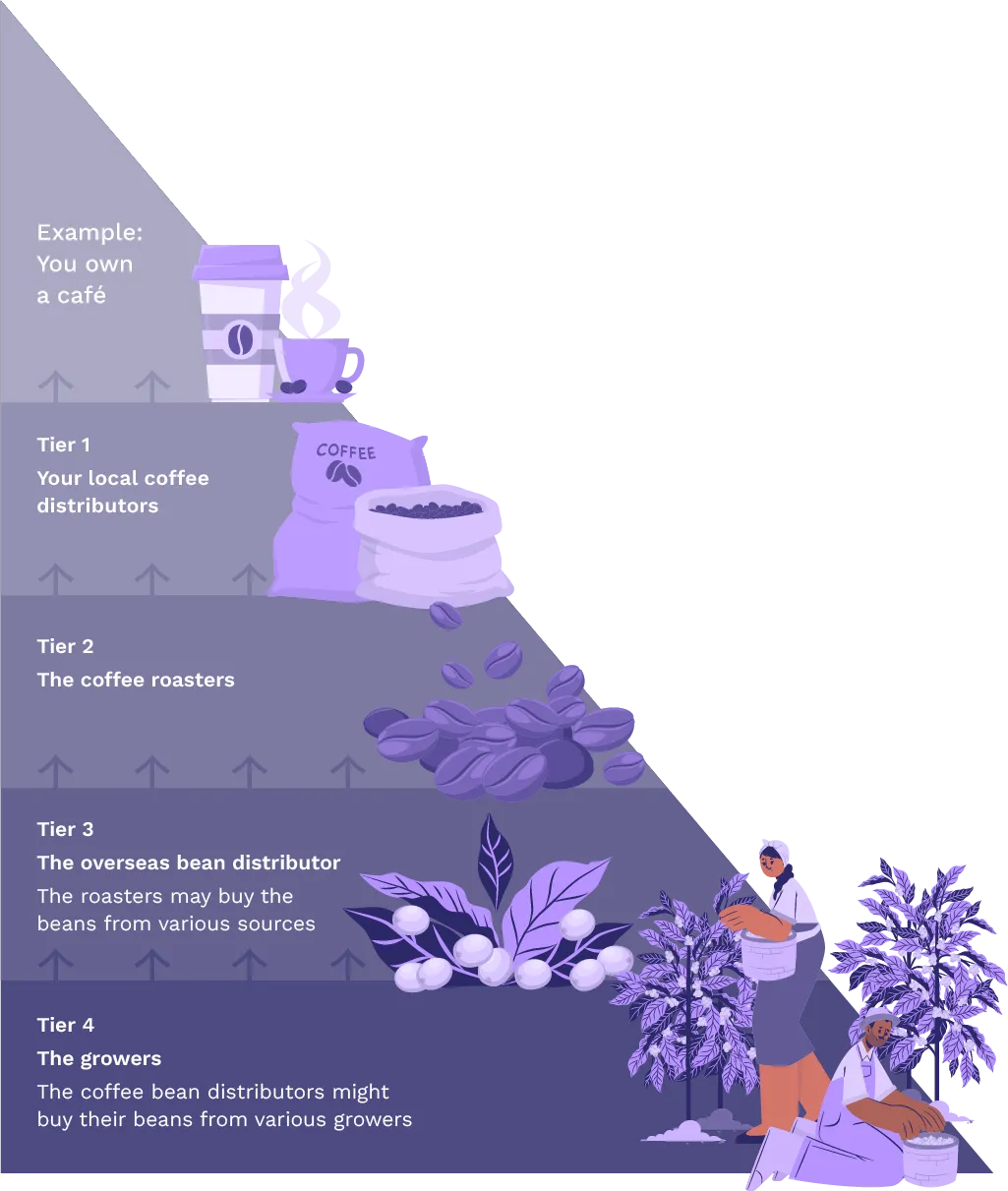
What are supply chain tiers?
You can break your supply chains into ‘tiers’ based on how close suppliers are to your business. Depending on your industry and the length of your supply chain, you may have more or fewer tiers.
Tier 1
Businesses you deal with directly and buy goods and services from. Look at your spending to identify your tier 1 suppliers.
Tier 2
Businesses that supply your tier 1 suppliers with goods and services. While they are important, you may not have a direct relationship with them.
Tier 3
Businesses that supply your tier 2 suppliers with goods and services.
Tier 4
Businesses that supply your raw material suppliers.
What do I need to do to reduce the risks of modern slavery?
Make sure you understand your business’s supply chain and operations. Do your due diligence to identify, assess and address potential human rights concerns.
1. Identify your suppliers
- Look at all the tiers of your supply chain.
- Map direct suppliers first, then prioritise high-risk products, services, countries and workforce types.
2. Assess your modern slavery risks
- Identify risks and prioritise the most severe.
- Consider country, sector, product, service and workforce risks.
- Look beyond tier 1 suppliers where visibility is often lower.
3. Manage your risks
- Set clear expectations through policies, supplier codes and contracts.
- Train your team and support suppliers to improve.
- Check evidence, track progress and avoid relying only on questionnaires.
- Have a plan to respond and provide remedy if harm is found.
4. Collaborate
- Work with external stakeholders like industry associations or public interest groups to identify high-risk suppliers and promote ethical practices. Pooling your financial and human resources and sharing information openly makes your impact go further.
Information to help you
Frameworks and certifications
Some organisations sign up to frameworks such as the UN Global Compact or B Corp, or make products that are Cradle to Cradle Certified®. These frameworks and certifications can include principles or requirements on human rights and labour.
They are useful signals, but they are not proof that modern slavery risks have been managed. Ask suppliers how they identify risks, act on findings and support remedy if harm occurs.
Policies, contracts and worker voice
Policies can show how seriously an organisation manages people, workers’ rights and supplier expectations. Ask for relevant policies, supplier codes of conduct and contract terms.
Follow up with questions about recruitment fees, minimum age, wages, hours of work, labour hire, grievance channels and who is responsible for these issues.
Worker voice matters too. Make sure workers have safe ways to raise concerns and that suppliers know how to respond if harm is found.
Renewable energy technologies as a high-risk sector
The clean energy industry - including solar and wind energy, battery storage, transmission, biofuels and electric vehicles - can have high modern slavery risks.
These technologies rely on minerals, components and global manufacturing. Risks can occur when critical minerals are extracted, refined and processed, and when components such as solar modules and batteries are made.
Demand for renewable electricity and storage is growing fast. This makes supply chain due diligence more important, not less. Companies should understand where key materials and components come from, ask suppliers for evidence and work with others to improve visibility and remedy harm.
The urgent need to cut emissions does not remove the need to protect human rights.

What are critical raw materials?
Critical minerals include metals and minerals such as cobalt, lithium, nickel, graphite, copper, high-purity silicon, rare earth elements, magnesium and high-purity alumina. They are essential for clean energy, electronics, transport, defence, health and steel.
A material is usually described as critical when it is important to the economy and has a supply chain at risk of disruption. Better recovery, reuse and recycling can help reduce pressure on primary extraction.
What are conflict minerals?
Conflict minerals are minerals from conflict-affected or high-risk areas where mining or trading may finance armed groups, fuel forced labour or other human rights abuses, or support corruption and money laundering.
They often include tin, tantalum, tungsten and gold, known as 3TG. These materials are used in electronics, energy, transport and defence.
Talk with a modern slavery expert

Martin Fryer
Head of Strategy & Disclosures
Our Head of Strategy & Impact NZ, Martin Fryer, is an experienced business strategist and expert in helping businesses reduce the risks of modern slavery and can help guide you through the process. Get in touch with Martin to discuss how your business can help tackle modern slavery.