
What you Need to Know about sustainable business strategy
We've packaged all the information on this page into one easy PDF.
Why does my organisation need to be sustainable?
Sustainable businesses are excellent businesses. They have set themselves up to succeed economically, environmentally and socially.
To be a sustainable business, you need to make sustainability front-and-centre of your organisation's business strategy. It needs to be part of your normal business and investment planning too.
Where does sustainability strategy come in?
Strategy brings focus. It helps you tackle the right things at the right time to make your organisation more sustainable. While it’s tempting to focus on ‘easy’ activities, ‘shiny’ activities, or every activity at once, you won’t make the progress you need to make.
For example, if you manufacture a product, overhauling your packaging may seem a great place to start. But if your packaging accounts for just 5% of your organisation’s carbon footprint, there are more important areas to focus on. A strategy will help you identify them.
Like to learn more? Get in touch with our sustainable business strategy expert.
What does an effective sustainability strategy look like?
- It’s part of your business strategy – not an ‘add-on’
- It focuses on environmental, social and governance activities
- It reflects what matters most to your organisation and your stakeholders
- It’s practical, with a roadmap for short-, medium- and long-term action
How will strategy help my organisation succeed sustainably?
Sustainability strategy adds value to your organisation. For example, research from Deutsche Bank/Columbia University and Morningstar shows that companies that invest in sustainability outperform the market in the medium and long terms.
| Business opportunities | Business results |
|---|---|
|
|
How do I make sustainability central to my business strategy?
Understand your ‘why’
Be clear about your purpose. Why are you in business? This should be about more than just making money. Businesses can do so much more!
Your purpose and sustainability programme need to be part of everything you do, including how you produce your products and services, train your team and manage your suppliers.

thinkstep-anz Need to Know series
This page is part of a series that simplifies sustainability topics. Explore the rest of our series.
Confirm your priorities
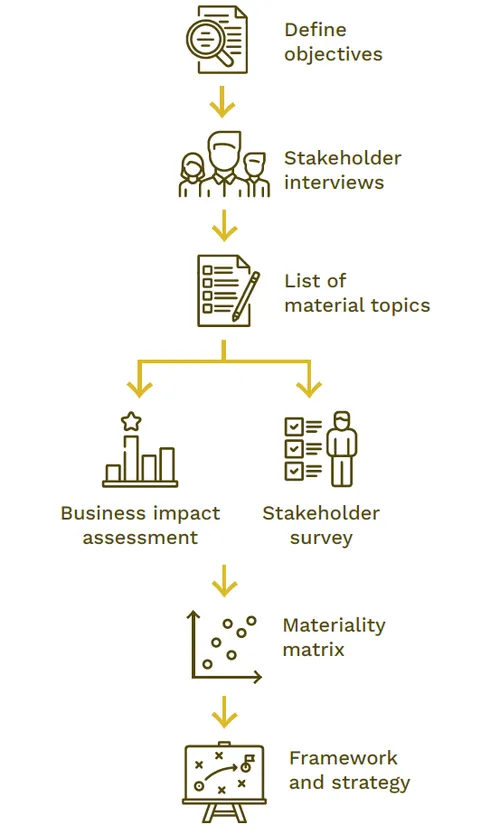
The process for a materiality assessment
Every organisation is unique. Take time to understand where to focus your efforts.
A materiality assessment is one way to do this. Start by seeking the views of your stakeholders. Within your organisation, talk with your team. Outside your organisation, ask people like your suppliers, customers, local community and regulator (if you have one) for their views.
What social, economic, environmental and governance topics do you want us to focus on to future-proof our organisation and relationship with you? Health and safety? Customer service? Our carbon footprint?
Then put a business lens over the results. What do these topics mean for our business? For how profitable we are? For retaining our top customers? For complying with regulations?
Finally, bring this information together to identify the ‘sweet spot’. While all the topics are important, these are the ones that matter most to everyone. Build your strategy around them.
Take stock of where you are now
Think of this as a ‘stocktake’ of your sustainability programme. What progress are you making to become more sustainable?
- Level 1: you’re just getting started (and that’s OK!)
- Level 2: you have a structured programme in place
- Level 3: your programme is achieving everything it can
- Level 4: acting sustainably is part of your culture (‘how we do things round here’)
Maturity may differ across your programme. For example, you may be blazing a trail to reduce your carbon emissions, but you’re just starting to tackle modern slavery in your supply chain.
Understand where you’re starting from (your baselines)
What gets measured gets managed. Set your baselines. For example:
| If your strategy involves: | You’ll need this baseline: |
|---|---|
| Reducing your carbon emissions | Your current carbon footprint |
| Improving your pay equity | Your current pay data |
| Building relationships with your local community | Community sentiment e.g. number of complaints/positive exchanges in the past year |
Confirm where you’re heading with targets and metrics
Decide what you want to achieve and how you’ll measure it. For example:
| If your strategy involves: | Target (on base year) | Metric (annual) |
|---|---|---|
| Reducing your carbon emissions | Reduce our carbon footprint | -10% |
| Improving your pay equity | Improve our pay equity | Close the gap by 5% |
| Building relationships with your local community | Reduce complaints | -10% |
Review your progress and strategy regularly ad report
Set up a regular cycle to review the progress you’re making. If you're using materiality assessment, do a new one every three years and sooner if something major changes (e.g. you enter a new market). Revisit your strategy annually and keep your eyes on your maturity too. It will help you chart where to head.
Enlist support from the people who will help you act on your strategy. Keep them up to date on what you’re achieving, with clear, concise reports and updates. Ask for help where you need it.
Link to the global context
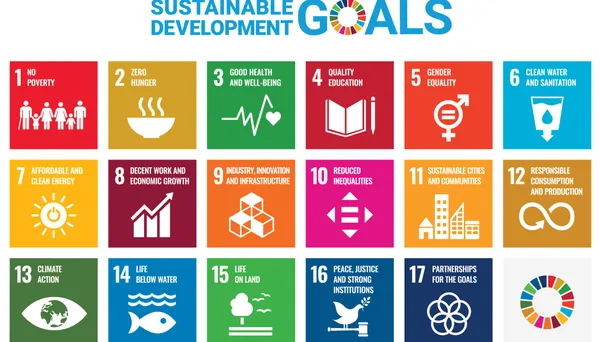
Consider using the global Sustainable Development Goals (SDGs) as a base for your sustainable business strategy. Focus on five or six goals that ‘fit’ your organisation and where you can contribute most. Some goals, like SDG13 – Climate action, are important for every organisation. Others are more important to some industries and organisations than others. For example, if you manufacture building products, SDG 9 – Industry, Innovation and Infrastructure, may be relevant.
Get in touch with our strategy expert
Martin Fryer
Head of Strategy & Disclosures
Martin Fryer is our Head of Strategy and Disclosures, and is an experienced business strategist. He helps your organisation understand and develop your sustainable business strategy. Get in touch with Martin to learn more.