InfraBuild's steps towards positive change - impact case study
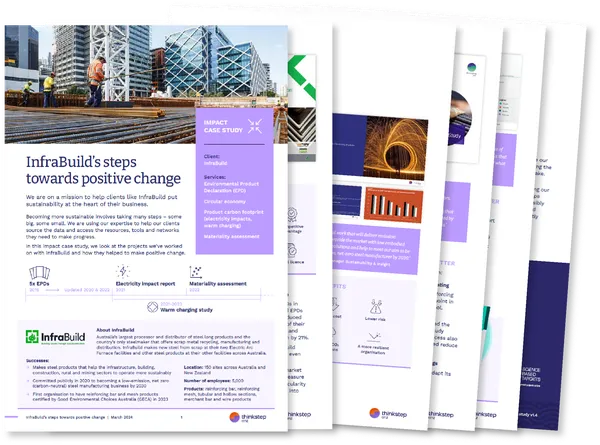
We've packaged all the information on this page into one easy PDF.
Click the image below.
We are on a mission to help clients like InfraBuild put sustainability at the heart of their business.
Becoming more sustainable involves taking many steps – some big, some small. We are using our expertise to help our clients source the data and access the resources, tools and networks they need to make progress. In this impact case study, we look at the projects we’ve worked on with InfraBuild and how they helped to make positive change.
Infrabuild are Australia’s largest processor and distributor of steel long products and the country’s only steelmaker that offers scrap metal recycling, manufacturing and distribution. InfraBuild makes new steel from scrap at their two Electric Arc Furnace facilities and other steel products at their other facilities across Australia.
Successes:
- Makes steel products that help the infrastructure, building, construction, rural and mining sectors to operate more sustainably
- Committed publicly in 2020 to becoming a low-emission, net zero (carbon-neutral) steel manufacturing business by 2030
- First organisation to have reinforcing bar and mesh products certified by Good Environmental Choices Australia (GECA) in 2023
| Location: 150 sites across Australia and New Zealand Number of employees: 5,000 |
Products: reinforcing bar, reinforcing mesh, tubular and hollow sections, merchant bar and wire products |
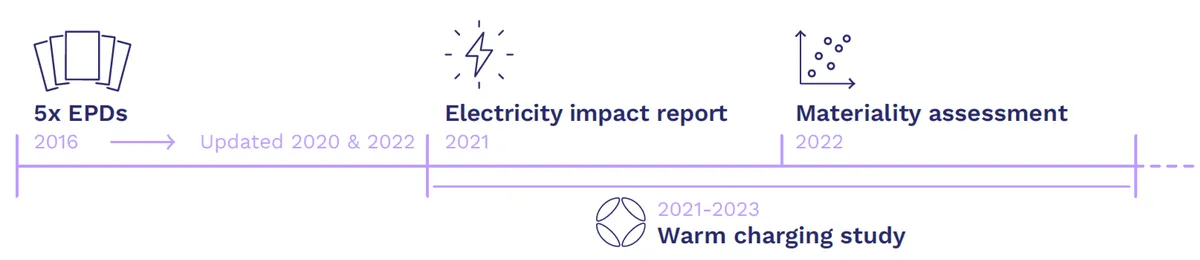
EPDs
Environmental Product Declarations (EPDs)
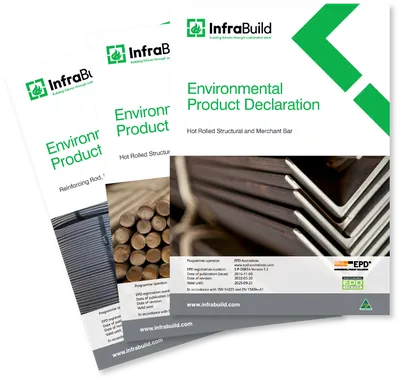
2016, 2020 (update) 2022 (update)
The challenge
InfraBuild sees publishing the sustainability credentials of its products as vitally important. This recognises the customer’s demand to provide standardised and transparent information about their environmental performance.
That’s why they asked us to help them create EPDs. We started this work in 2016 when EPDs in Australia were seen as still quite new.
What we did together
We developed five EPDs in 2016 and updated these in 2020. InfraBuild engaged us again mid-2022 to provide updated EPD data (to the new ISO 15804+A2 Standard) that InfraBuild’s customers will use to develop their own EPDs. We also helped InfraBuild understand the changes involved in moving from the +A1 to +A2 Standard.
We included Material Circularity Indicator (MCI) metrics for each product in the EPDs. The MCI gives insights on where to focus to make their processes more circular.
As InfraBuild is a highly circular manufacturer of steel (using scrap steel to make new steel with no loss of quality), including MCI metrics was the next step.
What changed for the better
Information for industry
InfraBuilds EPDs are used:
- by designers, sustainability professionals, construction experts, procurement teams and others to make informed decisions. Using InfraBuild's products can make their projects more sustainable.
- to direct customers to develop their own EPDs for their steel products such as reinforcing steel, concrete pipes and mining products.
Knowledge for change
Knowing that the bulk of their emissions come from the electricity they use, InfraBuild plans to cut its emissions by:
- moving from fossil fuel-generated electricity to 100% renewable electricity
- investigating low- or zero-emission alternatives to natural gas and coke.
Progress made visible
Between the first EPDs in 2016 and the updated EPDs in 2020, InfraBuild reduced the carbon footprint of their reinforcing bar by 9% and their reinforcing mesh by 21%.
The MCI helps InfraBuild make their processes even more circular. It also provides the market with a quantitative measure to understand the circularity of the products going into their projects.
Certified Renewable Electricity Impacts
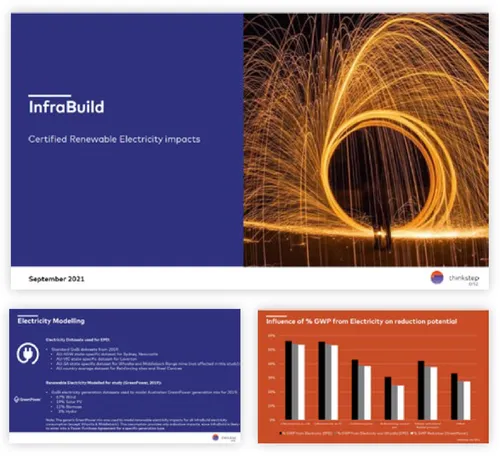
2021
The Challenge
InfraBuild makes around 1.2 million tonnes of steel from scrap annually in their electric arc furnace steelmaking facilities in Melbourne and Sydney. In FY21 scope 2 emissions were around 76% of InfraBuild’s combined scope 1 and scope 2 emissions, as a result of the electricity used from the grid.
InfraBuild wanted to know if they could reduce their carbon footprint by using renewable electricity and how this would change the carbon footprint of their products.
What we did together
We reviewed the impact of changing to certified renewable electricity. The results showed that the biggest way to reduce emissions and the embodied carbon of InfraBuild’s products is to move from fossil fuel-generated grid electricity to 100% renewable electricity.
What changed for the better
The study:
- showed scope 2 emissions would reduce to almost zero through the use of Power Purchase Agreements (PPAs)
- supported InfraBuild's business case to investigate and enter into PPAs so the business would use renewably generated electricity by 2025.
Warm charging study
The challenge
InfraBuild converts scrap steel into new steel products, including reinforcing bars and mesh, via their EAF Mills in Melbourne and Sydney. During rolling, steel billets (long, square semi-finished steel products) are sent into a reheat furnace to raise them back up to the required temperature. Warm charging is the practice of minimising the time between when the billet is cast and rolled.
InfraBuild wanted to know the actual and potential energy savings through warm charging and whether the method delivered enough gas savings to qualify as an energy-reducing process in the Green Building Council of Australia (GBCA) Green Star tool.
What we did together
We showed that the amount of gas savings means warm charging qualifies as an ‘energy-reducing
process in steel reinforcement production’ under the GBCA Green Star system.
We repeat this verification annually to confirm that the energy savings are ongoing and continue to comply with Green Star requirements.
What changed for the better
The study provided InfraBuild with:
Points under GBCA’s Green Star rating
Projects that use InfraBuild’s reinforcing steels can claim one Green Star point in the GBCA’s Design and As-Built tool. InfraBuild was already using a manufacturing process that offered the same Green Star point, but the study found that the warm charging process also used less natural gas, which helped reduce InfraBuild’s scope 1 emissions.
Better understanding of gas savings
This knowledge helps InfraBuild adapt its steelmaking progress.
Materiality assessment
The challenge
InfraBuild asked us to help them with a materiality assessment to support their sustainability report. They needed the assessment so the report could comply with the Global Reporting Initiative (GRI) framework. They also wanted to support their stakeholder engagement and sustainability programs.
What we did together
The materiality assessment involved suppliers, customers and internal stakeholders. This is a rare opportunity to engage with such rigour, depth and breadth.
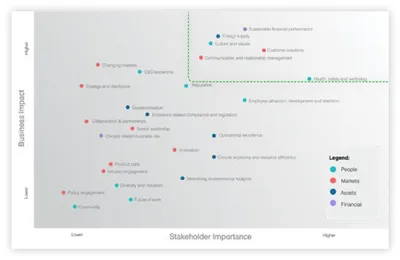
The assessment allowed InfraBuild to understand which environmental, social, and governance areas are the most important to their stakeholders and their business.
The process provided anonymous responses, allowing InfraBuild to hear the raw and unfiltered voice of the customer, which they felt was ‘powerful and important’.
They now have a deeper understanding of what matters most for their business.
What changed for the better
The process enabled InfraBuild to:
- deliver a better sustainability report
- improve communication with customers and other stakeholders
- proioritise the topics that are most important to their customers and other stakeholders
- confirm their sustainability and decarbonisation strategies.
What are the advantages of having a long-term relationship with a sustainability firm?
‘Our long-standing relationship with thinkstep-anz means we’re engaging with experts in their fields, knowledgeable professionals
who know the intricacies of sustainability and how the building' and infrastructure markets and value chains work.'
‘thinkstep-anz gets us. They know our business, they understand how we do what we do. That’s why we continue to work with thinkstep-anz to inform and guide us so we can best position ourselves now, and into the future, to meet our customers’ needs. This includes how we meet the main sustainability rating tools as well as the broader market expectations on all things sustainability.'
‘The thinkstep-anz team understands our market, the journey we are on, and why we have chosen to significantly decarbonise our
manufacturing processes, greatly reducing the embodied carbon of the products we make.'
‘Finally, thinkstep-anz provides support across the broader ESG themes, including our materiality assessment project. This helps us understand market needs for responsibly sourced and manufactured products and services that are verified to independently recognised environmental standards.’
David Bell
Manager Sustainability & Insight, InfraBuild
You might also be interested in
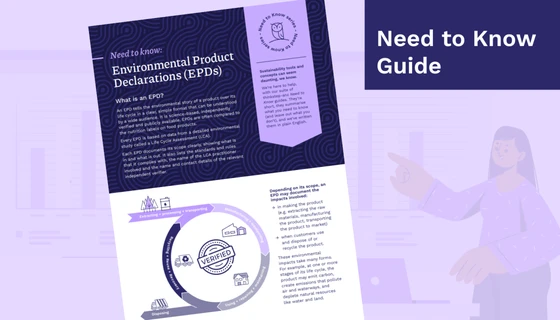
EPDs Need to Know guide
Our Need to Know guide explains Environmental Product Declarations (EPDs). EPDs tell the environmental story of a product over its life cycle in a clear, simple format. They are often compared to the nutrition labels on food products.
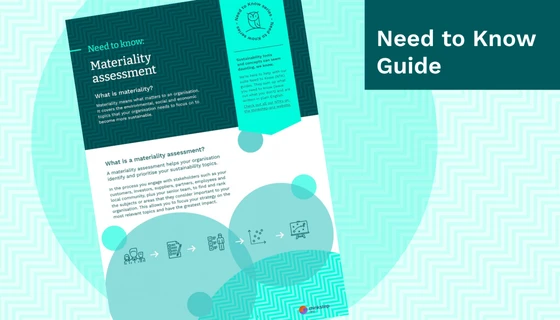
Materiality assessment Need to Know guide
This guide contains everthing you need to know about Materiality assessment. Materiality means what matters to an organisation. A materiality assessment helps your organisation identify and prioritise sustainability topics.
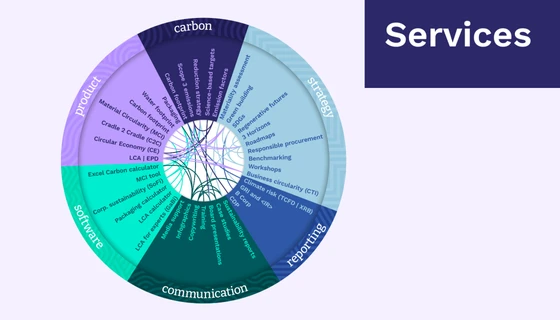
Our services
As a full-service sustainability firm, we can support you to improve sustainability across every part of your business. Our six groups of services build on one another to help you succeed sustainably.