
What you Need to Know about green buildings
We've packaged all the information on this page into one easy PDF.
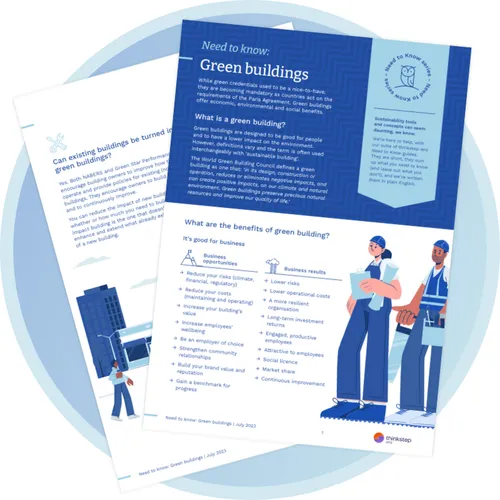
While green credentials used to be a nice-to-have, they are becoming mandatory as countries act on the requirements of the Paris Agreement. Green buildings offer economic, environmental and social benefits.
What is a green building?
Green buildings are designed to be good for people and to have a lower impact on the environment. However, definitions vary and the term is often used interchangeably with ‘sustainable building’. The World Green Building Council defines a green building as one that: ‘in its design, construction or operation, reduces or eliminates negative impacts, and can create positive impacts, on our climate and natural environment. Green buildings preserve precious natural resources and improve our quality of life.’
Like to learn more? Get in touch with our green building expert
What are the benefits of green building?
It’s good for business
| Business opportunities | Business results |
|---|---|
|
|
It’s good for the planet
- Cut down on embodied and operational carbon footprints
- Minimise pollution and resources used
- Protect biodiversity and ecosystems
- Reduce water use and pollution of waterways
It’s good for people
- Improve occupants’ wellbeing with healthy, comfortable buildings
- Provide a safe, fair environment for everyone involved in constructing buildings, including people who source raw materials and manufacture building products
- Strengthen communities and encourage active living (e.g. facilities like showers to encourage walking)
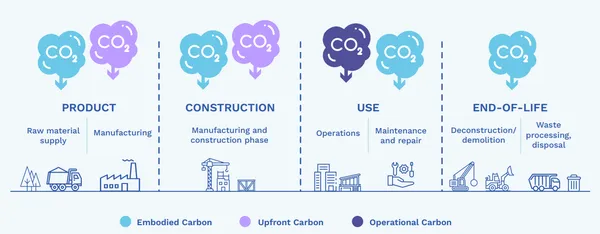
The three types of carbon involved in buildings
Embodied carbon: Carbon emissions from the materials and products the building is made of, the construction process itself, disposing of construction waste, maintenance and refurbishment throughout the building’s life, and final disposal of the building at the end of its life.
Upfront carbon: Embodied carbon up to the point of practical completion, but excluding maintenance, refurbishment and building end-of-life.
Operational carbon: Carbon emissions from using a building. They stem mainly from the energy needed to heat and cool the building, to heat water, and to power devices.
Characteristics of green buildings
- Reduce negative impacts on the environment by using less energy, water, and resources.
- Have positive impacts on the environment by increasing biodiversity (e.g. by planting native plants) or generating energy (e.g. from solar panels)
- Consider all stages of a building’s life cycle
- Use renewable energy
- Minimise waste and reuse materials as much as possible
- Are social hubs and connectors for people
- Provide good indoor air quality and lighting
- Use materials that are non-toxic, ethical and sustainable
- Use resilient design that helps people adapt to a changing environment
- Connect with nature (e.g. green indoor spaces and yards)

thinkstep-anz Need to Know series
This page is part of a series that simplifies sustainability topics. Explore the rest of our series.
Why is verification important for buildings?
A third-party certificate is an important tool to combat greenwashing – making a project appear more environmentally sustainable than it is. The only way to confirm your project complies with a sustainability standard or scheme is to have it certified. In Australia and Aotearoa New Zealand, rate your project’s claims openly, robustly, and independently. You can then have these ratings audited so that developers, clients and government departments can trust the certification. Rating systems can also ensure that construction teams follow the sustainable plans put together at the design stage.
What are Green Star and NABERS?
Green Star in Australia
The Green Building Council Australia (GBCA)’s Green Star rating system sets the standard for healthy and resilient buildings and places. Green Star tools use points to rate the environmental and social attributes of buildings and communities. Each tool consists of mandatory minimum requirements and optional credits.
Green Star can be applied to new or existing buildings, interior fit-outs, or communities:
- Green Star Buildings: covers all building types except detached residential homes and has been developed to meet current and future demands. It sets aspirational benchmarks to address important issues including climate action, loss of biodiversity, resource efficiency, and health and wellbeing
- Green Star Homes: a standard assessing how healthy, resilient and energy-efficient homes are
- Green Star Interiors: assesses the interior fit-outs in everything from offices and hotels to schools and shops
- Green Star Performance: measures improvements in how existing buildings operate
- Green Star Communities: helps improve the sustainability of projects at the neighbourhood, commercial precinct or community level.
Green Star New Zealand
Licensed from the GBCA, Green Star New Zealand adapts Green Star for Aotearoa. Green Star can be applied to new or existing buildings, fit-outs, or communities.:
- Green Star Design & As Built: guides the design and construction of any new commercial build or major refurbishment, including schools, offices, industrial facilities, shopping centres, hospitals and public buildings
- Homestar: assesses the health, efficiency, and sustainability of homes
- Homefit: checks if existing homes are warm, safe and dry
Green Star New Zealand also has rating tools for Interiors, Communities and Performance (see Green Star Australia).
National Australian Built Environment Rating System (NABERS, Australia)
NABERS measures the environmental performance of non-residential buildings and tenancies. It provides a national standard and instruments to improve the quality of the built environment.
NABERS rates the operational efficiency of buildings with a focus on:
- Energy
- Water
- Waste
- Indoor environment
This helps building owners understand their building’s performance and gives them a benchmark for progress.
In 2023 NABERS will release an embodied carbon standard (supported by technical expertise from our thinkstep-anz team). The standard will measure, verify and benchmark embodied carbon emissions in buildings. It will support the building sector to continue to decarbonise using an LCA-based methodology.
NABERSNZ (Aotearoa New Zealand)
NABERSNZ, adapted for New Zealand from NABERS, measures the operational energy of office buildings.
What role do EPDs play in green building?
An Environmental Product Declaration (EPD) tells the environmental story of a product over its life cycle in a clear, simple format that can be understood by a wide audience. EPDs provide data about the impacts of a product, such as timber or plasterboard, and help building designers choose lower-impact products.
EPDs are expected to feature in NABERS’ new embodied emissions tool, as the source of the most reliable and accurate data for building products. They also feature in New Zealand’s Building for Climate Change programme as the preferred source of data.
What else do I need to know?
Is green building more expensive?
Not necessarily. On average, green buildings come at a small premium (less than 5 percent) – but decreased energy and operational costs often offset these upfront costs quickly.
| Property performance | Cost and demand |
|---|---|
| 4.5 % premium in value* | 20% savings on total construction costs over a building’s lifetime from energy efficiency alone.** |
| 56% lower vacancy rates* | 13.4% in net income * |
| 25.4% in weighted average lease expiry (WALE)* | 34% of green building activity is driven by client demand*** |
* MSCI/Property Council of Australia Green Property Index, 2019
** World Green Building Council, 2013, The business case for green building
*** US Green Building Council, World green building trends in 2018 GBCA Green Star in Focus
Can existing buildings be turned into green buildings?
Yes. Both NABERS and Green Star – Performance ratings encourage building owners to improve how their buildings operate and provide policies for existing (non-residential) buildings. They encourage owners to build on previous ratings and to continuously improve.
You can reduce the impact of new buildings by considering whether or how much you need to build at all. The lowest impact building is the one that doesn’t need to be built. Use, enhance and extend what already exists to reduce the impact of a new building.
Talk with our expert

Nicole Sullivan, our Impact Director, is a green building expert. She previously worked as a Senior Manager of Green Star Solutions at the Green Building Council of Australia. Get in touch with Nicole to discuss your project.