
What you Need to Know about responsible procurement
We've packaged all the information on this page into one easy PDF.
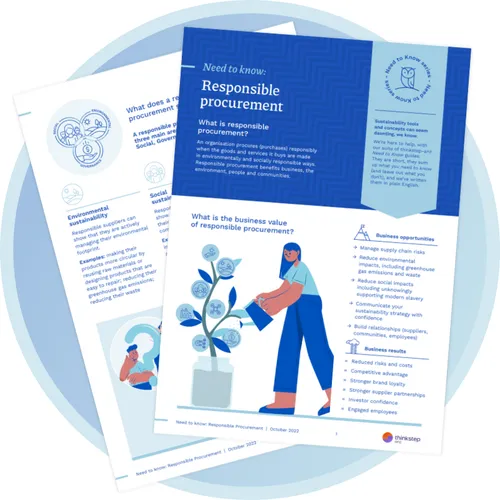
What is responsible procurement?
An organisation procures (purchases) responsibly when the goods and services it buys are made in environmentally and socially responsible ways. Responsible procurement benefits business, the environment, people and communities.
Like to learn more? Get in touch with our responsible procurement expert
What is the business value of responsible procurement?
| Business opportunities | Business results |
|---|---|
| Manage supply chain risks | Reduced risks and costs |
| Reduce environmental impacts, including greenhouse gas emissions and waste | Competitive advantage |
| Communicate your sustainability strategy with confidence | Stronger brand loyalty |
| Build relationships (suppliers, communities, employees) | Stronger supplier partnerships |
| Investor confidence | |
| Engaged employees |
What does a responsible procurement strategy involve?
A responsible procurement strategy covers the three main areas of the ESG (Environmental, Social, Governance) framework.
| Environmental sustainability | Social sustainability | Governance (running an ethical business) |
|---|---|---|
| Responsible suppliers can show that they are actively managing their environmental footprint | Responsible suppliers can show that they are caring for their employees and local communities | Responsible suppliers can show that they are complying with relevant laws and regulations in every country they operate in. Their company policies go beyond compliance and they report openly on any issues or breaches |
| Examples: making their products more circular by reusing raw materials or designing products that are easy to repair; reducing their greenhouse gas emissions; reducing their waste | Examples: creating an inclusive workplace; paying a fair wage; buying local; helping employees stay safe and well | Examples: paying a fair amount of tax; complying with Modern Slavery legislation; disclosing climate-related risks |
What is modern slavery?
Modern slavery involves exploiting other people for personal or commercial gain. It is a serious global issue and breaches human and labour rights.
Many organisations support modern slavery without realising it – through their supply chains. Modern slavery is hidden in many goods and services, including the food we eat, the clothes we wear and the cleaning services we buy.
Australia’s Modern Slavery Act 2018 requires larger companies and other entities to report on how they are preventing modern slavery risks in their operations and supply chains.
Aotearoa New Zealand’s government committed to a Plan of Action against Forced Labour, People Trafficking and Slavery in 2021. This plan sets out the actions that Government agencies will take over the five years to 2025 to combat these practices.
What does buying responsibly look like in practice?
It’s contagious, in a good way
Money talks (and procurement contracts do too). This means that every organisation that buys goods and services can influence many other organisations across its value chain. Every supplier has suppliers who have suppliers and so on. When one organisation procures responsibly, it encourages others to do the same.
Here’s an example
When your local café buys tomatoes to create the salads on its menu, it can influence its produce supplier to:
- pay its employees a fair wage (a social benefit)
- reduce the chemicals it applies to the soil (an environmental benefit)
- introduce systems to trace its organic tomato seeds back to source (a governance benefit)
The café can also encourage its supplier to delve into its own supply chain and source responsibly too. For example, the produce supplier can influence its transport provider to switch to a fleet of electric trucks. And so on and so on.
SDG 12: Responsible consumption and production
The United Nations’ Sustainable Development Goals (SDGs) recognise that responsible procurement can help protect the planet, end poverty and promote prosperity. SDG12 is about responsible consumption and production. (The two activities are linked.)
Progress on SDG12 advances other SDGs too, including SDG13: Climate action, SDG10: Reduced inequalities and SDG9: Industry, innovation and infrastructure.
thinkstep-anz Need to Know series
This page is part of a series that simplifies sustainability topics. Explore the rest of our series.
What tools does a responsible procurement framework cover?
Tool 1 – Guiding principles for responsible procurement
Most frameworks start with a short summary of the organisation’s sustainability values, strategies and procurement principles and practices. This summary sets the context and shows that the organisation is leading by example.
Tool 2 – A supplier code of conduct
This sets out the organisation’s high-level ambitions for a more sustainable supply chain. What does it expect of its suppliers to help it meet its social, environmental and governance standards?
- What does it want suppliers to be aware of and do (e.g., use materials that are relatively low-carbon sourced from countries with strong labour laws)?
- What should its suppliers expect of their own suppliers?
- What evidence do they need to provide to show they are reaching the organisation’s standards?
Tool 3 – A supplier questionnaire
An annual questionnaire captures these changes. Ask suppliers to explain how they run their business and what they are asking their own suppliers to do. Request evidence to avoid 'greenwash'.
Tool 4 – An evaluation process
Understand your suppliers based on the information from the questionnaire. Don’t immediately discount suppliers who fail to meet your standards. Work with them to help them get there. That’s a win for everyone.
Tools one and two are relevant as part of an annual review of supplier relationships or when an organisation tenders for a good or service. Expectations may change and suppliers’ ability to meet those expectations may too. An annual questionnaire captures these changes and allows you to increase your expectations over time.
What else do I need to know about responsible procurement?
Good things take time! Don’t expect to implement everything in year one. Well thought-out responsible procurement systems take several years to build. Bringing your suppliers along with you is crucial.
Adapt your existing procurement system – don’t replace it. Introducing responsible procurement does not mean throwing out your existing systems and practices. It’s about making it clear to suppliers that you care about much more than just price, delivery time and quality. That’s why you’re building environmental and social criteria into your purchasing decisions too.
What evidence should I look for?
Suppliers should include this evidence when they answer the questionnaire (Tool 3). A claim without evidence risks 'greenwash'. Reputable, third-party evidence is particularly helpful. These are some examples.
Certifications for products
- Environmental Product Declarations (EPDs) – Science-based, independently verified, publicly available
- Cradle to Cradle® Certification (C2C) – Products that are circular, safe and responsibly made
Certifications for organisations
- B Corp – Social and environmental performance
- A science-based target – Greenhouse gases
- Climate Active certification – Greenhouse gases (Australia)
- Ekos certification – Greenhouse gases (Aotearoa New Zealand)
- Toitū certification – Greenhouse gases (Aotearoa New Zealand)
- ISO14001 – Environmental management
- ISO45001 – Health and safety
- Signatory to the UN Global Compact – Ten sustainability principles
- Signatory to the International Labor Organisation – Labour standards
Relevant policies, processes and reports may also be helpful.
Talk with a responsible procurement expert

Our Head of Strategy and Impact Australia, Nicole Sullivan, works with businesses to improve their procurement throughout the supply chain. She also helps companies develop their sustainability strategy and is skilled in Green Building. Get in touch with Nicole to take the next step in your sustainability journey.