
What you Need to Know about product carbon footprints
Measuring and reducing your product’s carbon footprint
We've packaged all the information on this page into one easy PDF.
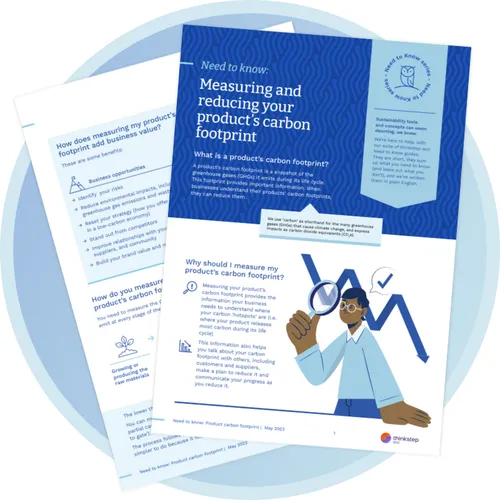
What is a product's carbon footprint?
A product’s carbon footprint is a snapshot of the greenhouse gases (GHGs) it emits during its life cycle. This footprint provides important information. When businesses understand their products’ carbon footprints, they can reduce them.
We use ‘carbon’ as shorthand for the many greenhouse gases (GHGs) that cause climate change, and express impacts as carbon dioxide equivalents (CO2e).
Like to learn more? Get in touch with our carbon footprint expert
Why should I measure my product's carbon footprint?
Measuring your product’s carbon footprint provides the information your business needs to understand where your carbon ‘hotspots’ are (i.e. where your product releases the most carbon during its life cycle).
This information also helps you talk about your carbon footprint with others, including customers and suppliers, make a plan to reduce it and communicate your progress as you reduce it.
How does measuring my product’s carbon footprint add business value?
These are some benefits:
| Business opportunities | Business results |
|---|---|
| Identify your risks | Lower risks and costs |
| Reduce environmental impacts, including greenhouse gas emissions and waste | A more resilient organisation |
| Reset your strategy (how you offer value in a low-carbon economy) | Stronger relationships |
| Stand out from competitors | Investor confidence |
| Improve relationships with your team, suppliers, and community | Engaged employees |
| Build your brand value and reputation | Market share |
| Social licence |
How do you measure a product’s carbon footprint?
You need to measure the GHGs your product and its packaging emit at every stage of their life cycles. This life cycle includes:
- Growing or producing the raw materials
- Manufacturing the product and packaging
- Transporting these raw materials
- Transporting to market
- Using the product and disposing / recycling
The lower the ‘impact’, the smaller the product’s carbon footprint.
You can measure a product’s carbon footprint over part of its life cycle too. This is known as a partial carbon footprint. Most partial carbon footprints cover the production stages only (‘cradle to gate’). These are the first three steps listed above.
The process follows similar steps to a Life Cycle Assessment (LCA). However, it is quicker and simpler to do because it focuses on one indicator only – carbon.
Who will be interested in my product’s carbon footprint?
Many people. They include your wholesale and retail customers, investors, regulators, suppliers, community, and employees.

thinkstep-anz Need to Know series
This page is part of a series that simplifies sustainability topics. Explore the rest of our series.
Communicate the footprint with an EPD
A product carbon footprint can be the first step in a full Environmental Product Declaration (EPD). EPDs are science-based public documents, like the nutrition labels on food products. They include other environmental indicators too, not just carbon. As EPDs are verified by third-party experts, they provide trusted information.
How do I measure my product’s carbon footprint?
This is where environmental specialists come in. They are typically environmental scientists, engineers, or economists. The assessment follows globally agreed standards (the International Organization for Standardization’s ISO 14067). It is often carried out using specialist software such as Sphera’s Life Cycle Assessment software (formerly GaBi) and existing ‘datasets’ too (verified data from other studies).
What sort of products can a footprint calculation cover?
Many! Food products, building products, clothes, furniture…
Here’s the rule:
If you can identify a system with a beginning and an end (say raw materials to finished product), you can review the carbon that system emits from start to finish.
Talk with our carbon footprint expert

Our carbon expert and CEO Barbara Nebel has helped clients in many industries measure and reduce the their carbon emissions. She has tackled carbon in products, services, organisations and even entire countries. Get in touch with her to understand more about the carbon footprint of your products.