
What you Need to Know about carbon in the built environment
We've packaged all the information on this page into one easy PDF.
The building and construction industry is a major source of global greenhouse gas emissions (carbon emissions). A building or infrastructure project generates carbon throughout its life cycle, from producing materials and constructing the asset to operating and maintaining it, as well as what happens to the asset at the end of its life. The total amount of carbon emitted by an asset throughout its life is often called whole-of-life carbon.
Like to learn more? Get in touch with our built environment carbon expert
Why does it matter?
A 2024 study by Infrastructure Australia found that buildings and infrastructure are directly responsible for about 30% of Australia’s total carbon emissions, while thinkstep-anz’s 2019 study suggests that New Zealand’s built environment contributes about 20% of the country’s carbon footprint. The difference comes mainly from Australia’s higher reliance on fossil fuels for electricity, a larger and more carbon-intensive construction sector and more extensive infrastructure.
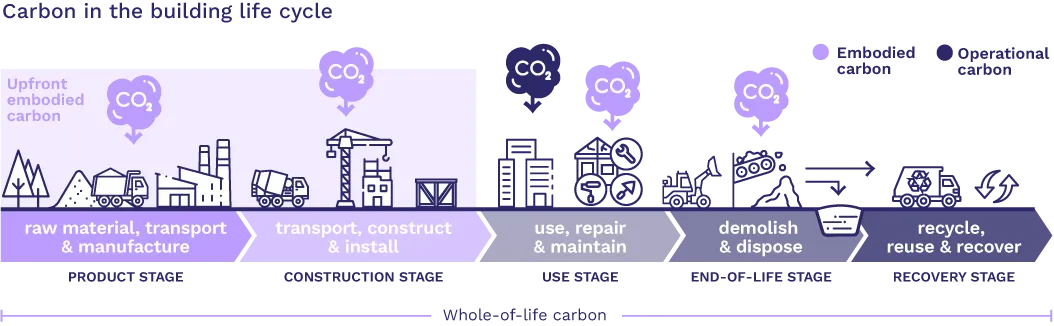
Carbon emissions from buildings and infrastructure come from two main sources:
Embodied emissions are associated with constructing and maintaining an asset, as well as treating waste at the end of the asset’s life. Upfront emissions are those embodied emissions that happen before the asset is in use.
Operational emissions are associated with using an asset. They come mainly from using electricity and fossil fuels such as diesel and natural gas.
Measuring carbon in the built environment
Predicting the carbon emissions of an asset’s entire life cycle can be challenging, as they depend on how it is used, maintained and potentially changed over time. For example, estimating the total carbon footprint of a building includes guessing how much energy it will use over its lifetime, how often materials will need replacing, and how it will eventually be demolished and the materials disposed or reused.
This uncertainty doesn’t apply to upfront carbon as these emissions are released before the asset is used and can be measured using actual data.

thinkstep-anz Need to Know series
This page is part of a series that simplifies sustainability topics. Explore the rest of our series.
Environmental product declarations (EPDs) play an important role
EPDs play a crucial role in reducing emissions in the construction industry by:
Supporting more sustainable decision-making
EPDs provide reliable data that helps building professionals select the most sustainable options for their projects.
Scoring points under green building rating tools
EPDs can help buildings earn points under green building rating tools like Green Star, NABERS Embodied Carbon and the ISC IS Rating Scheme. EPDs for building products must comply with EN 15804 or ISO 21930 to provide comparable data.
Transparent communication
EPDs help manufacturers present verified, science-based data about the environmental impact of their products in a clear, structured way that follows international standards.
EPDs are:
- Based on Life Cycle Assessment (LCA)
- Science-based
- Follow international standards
- Independently verified
- Publicly available
See examples of EPDs produced and designed by thinkstep-anz. EPDs published through EPD Australasia can be found online here.
Building a low-carbon future
Embodied carbon from materials and construction isn’t just about the emissions released before a building is finished – it also includes emissions throughout its entire life cycle, which can add up significantly.
For example, replacing flooring, repairing concrete or demolishing a building at the end of its life all generate carbon emissions. To minimise a building’s total carbon footprint, every stage – from design and construction to maintenance and demolition – needs to be planned with carbon reduction in mind.
Beware of trade-offs
When choosing materials to minimise upfront carbon, it’s important to be aware of potential trade-offs.
- Durability and lifespan:
Materials with short lifespans or low durability may need replacing sooner. - Functionality and compliance:
Materials must meet required standards and provide the necessary functionality.
Choosing the lowest carbon materials upfront might lead to higher emissions over time if they need to be replaced sooner. This means that these impacts need to be carefully considered from the start to avoid unintended consequences.
Circular economy
The future of construction must embrace the principles of the circular economy, where materials are reused and recycled rather than discarded. By designing assets that are adaptable, durable and easy to dismantle, industry can significantly reduce waste and minimise environmental impacts.
- Find out more in our circular economy Need to Know guide.
Boost carbon reductions from the beginning
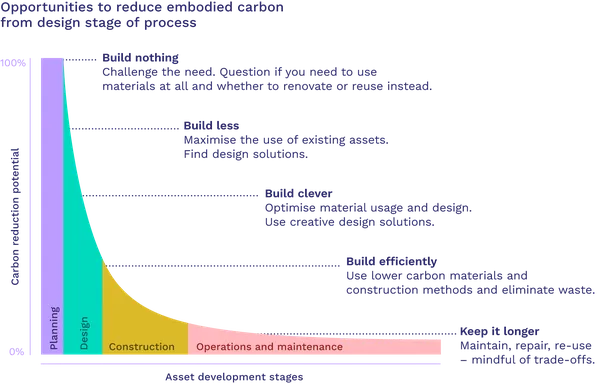
While opportunities to cut embodied carbon vary by project and location, the biggest reductions are typically achieved in the early planning and design stages.
To decarbonise the built environment, we need to minimise all emissions.
This means:
- new assets must be highly energy efficient and operate without fossil fuels
- building products and (de)construction practices must rapidly decarbonise
- existing assets must transition towards operating on 100% renewable energy.
We also need to look at how assets perform over time.
We need to ask:
- Are they energy efficient?
- Are their materials durable?
- Can they be repurposed rather than demolished?
- Can their materials be reused or recycled at the end of their life?
These questions are essential to make sure that assets not only reduce their initial emissions but also stay more sustainable over time.
Talk with our expert

As Impact Director at thinkstep-anz, Nicole supports organisations to improve their sustainability and create value at the same time. Her background as a Chemical Process Engineer with 23 years’ experience in the building products industry, including Life Cycle Assessment (LCA) and Environmental Product Declarations (EPDs) for building and construction products, can help you navigate the built environment and ensure you succeed sustainably.