
What you need to know about your organisation's carbon footprint
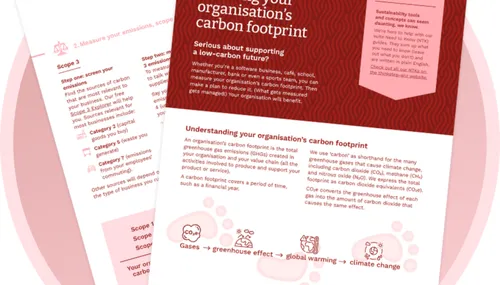
We've packaged all the information on this page into one easy PDF.
Serious about supporting a low-carbon future?
Whether you’re a software business, café, school, manufacturer, bank or even a sports team, you can measure your organisation’s carbon footprint. Then make a plan to reduce it. (What gets measured gets managed!) Your organisation will benefit.
Like to learn more? Get in touch with our carbon expert
Understanding your organisation’s carbon footprint
An organisation’s carbon footprint is the total greenhouse gas emissions (GHGs) created in your organisation and your value chain (all the activities involved to produce and support your product or service). A carbon footprint covers a period of time, such as a financial year.
We use ‘carbon’ as shorthand for the many greenhouse gases that cause climate change, including carbon dioxide (CO2), methane (CH4) and nitrous oxide (N2O). We express the total footprint as carbon dioxide equivalents (CO2e). CO2e converts the greenhouse effect of each gas into the amount of carbon dioxide that causes the same effect.
Gases --> greenhouse effect --> global warming --> climate change
What does my carbon footprint include?
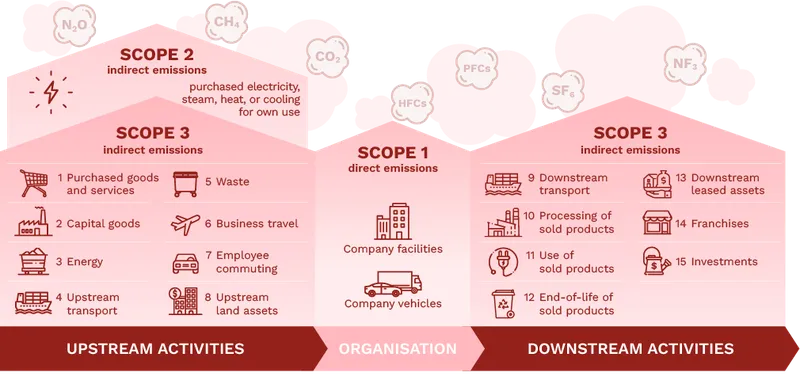
There are two standards for measuring and reporting carbon emissions. They are the international Greenhouse Gas Protocol and ISO 14064-1:2018. The Protocol splits carbon into three groups (scopes).
Scope 1 emissions are direct emissions. They come from day-to-day activities like fuelling your vehicle fleet with diesel.
Scope 2 emissions are indirect emissions. They come from the electricity you buy to run your office or factory and the heat, steam and cooling you buy.
Scope 3 emissions are also indirect emissions. They may be your biggest group of emissions but they’re ‘hidden’ in your value chain or supply chain. There are 15 categories of Scope 3 emissions. Learn more in our Scope 3 emissions Need to Know.
Like to learn more?

thinkstep-anz Need to Know series
This page is part of a series that simplifies sustainability topics. Explore the rest of our series.
How do I measure my organisation’s carbon footprint?
1. Confirm your ‘project boundaries’
Common boundaries include: operational control – you account for emissions from everything you (or your subsidy) have full control over equity share – you account for emissions from your share of ownership (e.g. if you own 10% of a factory, your footprint includes 10% of the factory’s emissions).
2. Measure your emissions, scope by scope
Scopes 1 and 2
Measuring your Scope 1 and 2 emissions is relatively simple. You’ll need two pieces of data: the volume of emissions your activities create (‘your activities’) and the impact those emissions have on the environment (‘emission factors’).
Step one: confirm your activities
For example, how many kilometres did your employees drive in your company vehicles last year? How many kilowatt hours of electricity powered your plant? Much of this information is available in monthly fuel and power bills.
Step two: find your emission factors
An emission factor represents the amount of GHG an activity releases.
For example, in New Zealand, the emission factor for one litre of diesel combusted for transport is 2.69kg of CO₂e. This means it emits this amount of GHGs.
In Australia, the Department of Climate Change, Energy, the Environment and Water (DCCEEW) provides National Greenhouse Accounts (NGA) Factors.
In New Zealand, the Ministry for the Environment (MfE) provides generic emission factors, along with workbooks and guides.
Step three: do the maths
Units of activity x emission factor per unit
= CO₂e released.
Scope 3
Step one: screen your emissions
Find the sources of carbon that are most relevant to your business. Our free Scope 3 Explorer will help you.
Sources relevant for most businesses include:
- Category 2 (capital goods you buy)
- Category 5 (waste you generate)
- Category 7 (emissions from your employees’ commuting).
Other sources will depend on the type of business you run.
Step two: measure your Scope 3 emissions
To measure these you’ll need to talk with your employees, suppliers and customers.
Say you’re estimating the emissions in Scope 3 Category 4 (upstream transport). Ask your suppliers:
- How much fuel do you use each year to transport your products to my factory?
If they can’t tell you, estimate it.
Units of activity (distance travelled between supplier factory and your site)
x emission factor per unit
= CO₂e released.
Here’s an example for Scope 3 Category 11 (using sold products). Say you make dishwashers. Ask yourself these questions:
- How many dishwashers have we sold this year?
- What’s our dishwasher’s typical lifespan?
- How much energy does one cycle use?
- How often would a customer use their dishwasher?
- Why does this matter? Yes, it’s your customers using the electricity. But you can design washing machines that use that electricity efficiently.
Units of activity (kilowatt hours of electricity)
x emission factor per unit
= CO₂e released over your products’ lifetimes.
Scope 1 + Scope 2 + Scope 3 = your organisation’s carbon footprint
Consider your chosen boundary, then add up the emissions from all three Scopes. This is your organisation’s carbon footprint.
Reducing your carbon footprint
Once you’ve measured your carbon footprint, set a target and take action. This helps focus your projects. Reducing emissions takes time. Confirm your baseline, set realistic annual targets and review your progress regularly.
How do I reduce my organisation’s carbon footprint?
Reducing emissions is about thinking differently. What can you change? Here are some examples to consider:
The energy you use. Can you move your fleet from fossil fuels and go electric? Or increase the renewable energy that powers your office or plant?
Your product’s design and packaging. Can you redesign your product to use less electricity? Can you reduce your packaging by packing your product differently?
Your value chain partners. Can you work with your suppliers of high-emission products to suggest ways for them to lower their carbon?
Your processes. Can you hold online meetings rather than travelling to a physical location?
Play your part in moving to a low-carbon world. Our planet, its people and your organisation will thank you.
Talk with a carbon expert

Our Principal Sustainability Specialist, Nicky Andrews, has a strong background in sustainability reporting. She is well equipped to help clients with their sustainability reporting and to measure their impact. Get in touch with Nicky to see how carbon footprinting can help your organisation today.