
What you Need to Know about nature-related financial disclosures
We've packaged all the information on this page into one easy PDF.
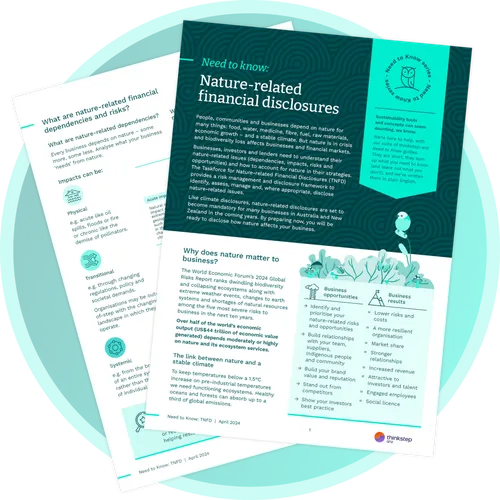
What are nature-related financial disclosures?
People, communities and businesses depend on nature for many things: food, water, medicine, fibre, fuel, raw materials, economic growth – and a stable climate. But nature is in crisis and biodiversity loss affects businesses and financial markets.
Businesses, investors and lenders need to understand their nature-related issues (dependencies, impacts, risks and opportunities) and how to account for nature in their strategies. The Taskforce for Nature-related Financial Disclosures (TNFD) provides a risk management and disclosure framework to identify, assess, manage and, where appropriate, disclose nature-related issues.
Like climate disclosures, nature-related disclosures are set to become mandatory for many businesses in Australia and New Zealand in the coming years. By preparing now, you will be ready to disclose how nature affects your business.
Why does nature matter to business?
The World Economic Forum’s 2024 Global Risks Report ranks dwindling biodiversity and collapsing ecosystems along with extreme weather events, changes to earth systems and shortages of natural resources among the five most severe risks to business in the next ten years.
Over half of the world’s economic output (US$44 trillion of economic value generated) depends moderately or highly on nature and its ecosystem services.
The link between nature and a stable climate
To keep temperatures below a 1.5°C increase on pre-industrial temperatures we need functioning ecosystems. Healthy oceans and forests can absorb up to a third of global emissions.
| Business opportunities | Business results |
|---|---|
|
|
Like to learn more? Get in touch with our disclosures expert.
‘Climate change is a primary driver of biodiversity loss. And climate change depends on biodiversity as part of the solution. So clearly the two are linked and cannot be separated.’
-- Elizabeth Mrema, Executive Secretary, United Nations Convention on Biological Diversity
What do we mean by nature?
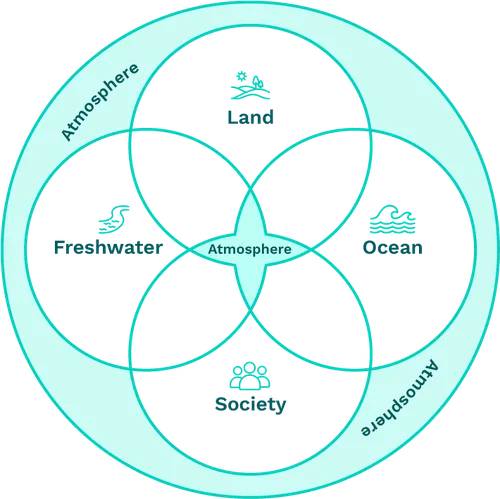
Nature refers to the natural world, made up of four areas: land, ocean, freshwater, and atmosphere. TNFD looks at how organisations and people depend on and impact natural capital, which the framework defines as ‘natural resources that combine to yield a flow of benefits to people’.
Where nature fits into the global reporting landscape
A growing global movement recognises the intrinsic and economic value of nature and is pushing for a path of recovery.
The TNFD’s recommendations are consistent with the global sustainability standards, policy goals and targets of the former Task Force for Climate-related Financial Disclosures (TCFD), International Sustainability Standards Board (ISSB) and Global Reporting Initiative (GRI).
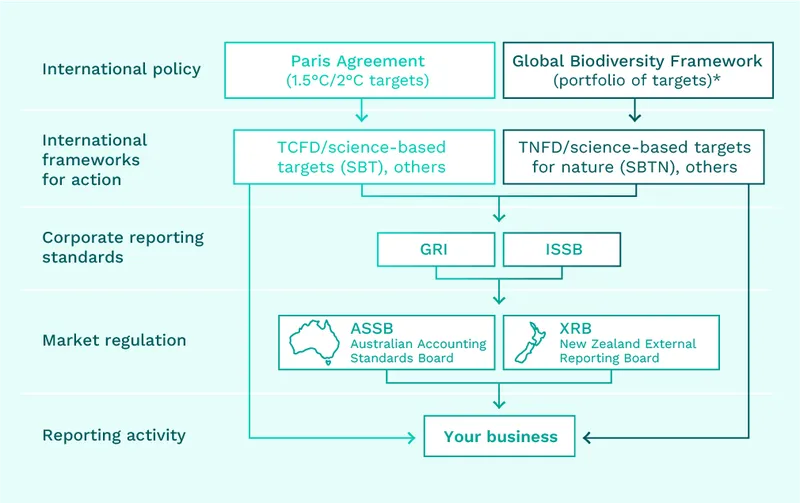
*The Kunming-Montreal Global Biodiversity Framework (GBF)
Adopted by 196 countries (including Australia and Aotearoa New Zealand) in 2022, the framework sets out a roadmap for halting biodiversity loss. It is often called the ‘Paris Agreement’ for nature. It contains four long-term goals for 2050 and 23 targets that set the agenda for global biodiversity action through to 2030.
What the TNFD recommends
The TNFD recommends that you show how your business affects nature and how nature affects your business. (This is known as double materiality.)
The resulting business and financial impacts
| Potential business impacts | Potential financial impacts |
|---|---|
|
|

thinkstep-anz Need to Know series
This page is part of a series that simplifies sustainability topics. Explore the rest of our series.
What information do you need to disclose?
The TNFD framework has the same four parts as climate-related disclosures: governance, strategy, risk management, metrics and targets. Each involves recommended disclosures.
| Part of TNFD framework | What this includes | Examples of disclosures |
|---|---|---|
Governance |
The organisation’s governance of nature-related risks and opportunities (e.g. policies and processes) | We have a nature/ biodiversity/ environment policy. Our executive team and Board review our risks and opportunities monthly. |
Strategy |
The actual and potential dependencies and impacts of nature-related risks and opportunities on the organisation’s businesses, strategy and financial planning | If we don’t have access to enough water in the future, we need to invest in new technologies to continue to operate our plant. |
Risk management |
The processes the organisation uses to identify, assess, and manage nature-related risks and opportunities – plus the risks and opportunities | We have explored several scenarios and how they would affect our business. We understand that climate and nature are inextricable parts of our business. In response, we have built these issues into our processes for managing our risks and opportunities. |
Metrics and targets |
The metrics and targets the organisation uses to assess and manage relevant nature-related risks and opportunities | We have developed an inventory and designed regionally specific metrics to measure progress against targets. These targets cover freshwater, biodiversity, oceans and land. |
Where do you start with the TNFD?
1. What do you already know?
Analyse where you are in taking climate and nature into account in your decisions. Build on existing disclosure processes and frameworks. For example, most organisations’ sustainability strategies already consider natural resources in some way.
2. What’s important?
How is nature relevant to your activities, value chain and business? What concepts does the TNFD introduce that you haven’t previously considered?
3. What can you measure?
Metrics for TNFD will look different depending on your sector and location. Start thinking about what type of metrics you want to set that are feasible and practical. A good metric is one you can collect data for, track, and relate to an achievable target. Metrics should be SMART: specific, measurable, achievable, relevant and time-bound. Environmental targets should be science-based.
Related reports, tools and concepts to help you make progress
Your climate-related disclosure (previously known as TCFD) will help you understand how climate change will affect your business and prepare for what’s ahead. It will also help you report on these impacts. The TNFD extends your view beyond carbon.
A Life Cycle Assessment measures many of the environmental impacts (e.g. water use, land use) you need to track to reduce your impact on nature.
A circular economy keeps resources in use for as long as possible. It benefits businesses, nature and people. Tools like the Material Circularity Indicator (MCI), and the Circular Transition Indicators (CTI) help you track the natural resources you use and the waste you create.
Why location matters for nature-related reporting
While CO₂ emissions have the same impact no matter where in the world they occur, nature impacts are specific to a region. For example, a period of water scarcity in New Zealand or Tasmania means quite a different thing to a period of water scarcity in Western Australia.
Indigenous peoples are stewards of 80% of the world’s remaining biodiversity and a source of traditional knowledge about the planet’s ecosystems. These ideas and views are critical to halting and reversing nature loss. Talk to Indigenous people in the areas you operate to bring together traditional knowledge and Western science.
Talk to an expert

Martin Fryer
Head of Strategy & Disclosures
Martin Fryer is our Head of Strategy and Disclosures. He is experienced with climate risk in the corporate sector with a focus on science-based targets, sustainability strategy and climate- and nature-related disclosure projects. Get in touch to discuss your reporting requirements, including support to produce engaging, plain English, well-designed disclosures.